In a groundbreaking study poised to reshape our understanding of marine pollution dynamics, scientists have unveiled a self-sustaining loop involving microplastics and planktonic organisms in ocean ecosystems. This research, focusing on the rotifer species Brachionus plicatilis, highlights a particularly alarming biological interaction: these tiny aquatic creatures are not only ingesting microplastic particles but are also selectively grazing on them, excreting, and subsequently reingesting these particles in a continuous cycle. Such discoveries deepen concerns about the pervasive nature of microplastics and their complex ecological consequences.
The research elucidates a phenomenon that the authors term the “Plankton-Plastic Predation Loop,” which denotes an intricate feedback mechanism between plankton and microplastics. Traditionally, microplastics have been regarded primarily as passive pollutants, but this study foregrounds their active role in the feeding behaviors of fundamental marine consumers. Brachionus plicatilis, a widely distributed rotifer, was observed exhibiting preferences regarding which microplastic particles to consume, suggesting an unexpected level of selectivity in ingesting non-natural particles suspended in their habitat.
Investigators meticulously analyzed the feeding patterns of Brachionus plicatilis in controlled laboratory environments that simulated natural marine conditions. They introduced microplastic particles varying in size, shape, and composition and monitored rotifer responses using advanced microscopy and chemical tracing techniques. The results showed a clear predilection for certain types of microplastics, indicating that these organisms are not indiscriminate feeders but rather exercise a degree of selective grazing when encountering synthetic particles. This selectivity could have significant ramifications for the fate of various microplastic pollutants in marine environments.
One of the more disturbing facets of this research lies in the excretion and reingestion aspect of the loop. After consuming microplastics, rotifers were found to excrete these materials in fecal pellets, which then remained suspended or slowly settled in aquatic microhabitats. These same rotifers—or conspecifics—were observed to reconsume these excreted plastic fragments, creating a recycling system that effectively traps microplastics within the planktonic community. This recycling loop increases the residence time of microplastics within the biological food webs and complicates attempts to model or predict microplastic transport and accumulation in oceans.
The ecological implications of such a cycle are profound. Plankton occupy a crucial niche as primary consumers and the base of the marine food web. If microplastics are cyclically ingested and reingested by rotifers, these pollutants could be efficiently passed up the trophic chain, potentially impairing higher-order consumers. Microplastics have been linked to physical blockages, altered feeding efficiency, and toxicological stresses; thus, the Plankton-Plastic Predation Loop could exacerbate these effects by increasing exposure frequency and concentrations within marine biota.
Furthermore, this recycling mechanism may alter microplastic biogeochemistry and distribution patterns in unpredictable ways. Traditional dispersal models treat microplastics as inert particles passively moving with currents. However, the biological processing by plankton could modify particle aggregation, degradation rates, and local accumulation. Biological excretion can create fecal pellets that sink faster than free-floating particles, potentially accelerating the deposition of microplastics to benthic habitats where they pose harm to bottom-dwelling species.
The study also ventures into the physiological impacts on Brachionus plicatilis itself. While rotifers are small and seemingly resilient, repeated ingestion of microplastics could lead to internal damage and energy deficits. The researchers conducted assays revealing altered reproduction rates and lifespans when rotifers were exposed to environmentally relevant concentrations of microplastics. These findings suggest that microplastic ingestion imposes sub-lethal but ecologically significant stress, which could have cascading effects on plankton population dynamics and, by extension, marine ecosystem stability.
Interestingly, the selective grazing behavior on microplastics raises questions about the sensory and decision-making mechanisms of these microscopic organisms. Do these rotifers detect surface textures, chemical signatures, or particle sizes differently when encountering synthetic particles compared to organic matter? Understanding the sensory cues involved could open new avenues for comprehending how pollutants integrate into natural food webs, potentially informing the design of biodegradable alternatives less likely to disrupt feeding behaviors.
This research contributes a critical piece to the puzzle of how microplastics interact within marine ecosystems beyond simple physical contamination. It underscores the need for integrating biological processes into microplastic pollution models and encourages a multidisciplinary approach combining marine biology, chemistry, and environmental sciences. By illuminating the nuances of microplastic uptake and recycling by plankton, the study calls for reassessments of existing marine pollution mitigation strategies.
The discovery of the Plankton-Plastic Predation Loop not only advances scientific knowledge but also carries urgent policy implications. Efforts to regulate plastic waste, reduce microplastic emissions, and monitor marine health must now consider these microscopic interactions that amplify pollution impacts. This feedback loop exemplifies the complex, often unforeseen ways human-made pollutants interface with natural systems, emphasizing an imperative for proactive environmental stewardship.
Moreover, the standout nature of Brachionus plicatilis as a key node in this process highlights the vulnerability of particular plankton species to anthropogenic changes. Since rotifers are widespread and contribute significantly to nutrient cycling and energy transfer in marine realms, their entanglement with microplastic pollution could induce far-reaching shifts in oceanic biogeochemical cycles. Further research aimed at other plankton taxa will be vital to ascertain the broader applicability of the predation loop phenomenon.
Technological advances underpinning this research, including high-resolution imaging and microplastic tracking, demonstrate the utility of combining innovative tools to unravel the microscopic dimensions of pollution ecology. These methodologies allow for the precise quantification of particle ingestion and provide unprecedented insight into fine-scale interactions, hidden from traditional observation methods. The resulting data sets form a critical foundation for predictive modeling efforts within oceanographic research.
As the study’s findings disseminate through the scientific community and public discourse, they may spur greater public awareness of microplastic pollution’s insidious nature. Highlighting the biological feedback mechanisms that entrap microplastics in marine food webs adds a new dimension to the narrative of plastic pollution, moving beyond mere presence to intricate ecological entanglement. Such awareness can fuel support for systemic changes in plastic production, consumption, and waste management.
In conclusion, the revelation of a marine Plankton-Plastic Predation Loop reflects a sophisticated and troubling integration of synthetic pollutants into natural feeding cycles. Rotifers like Brachionus plicatilis, considered minor players in vast oceanic systems, emerge as pivotal actors in governing microplastic fate and impact. This research signals a call to deepen our understanding of microplastic ecology and to urgently refine strategies aimed at curbing their proliferation in marine environments. The battle against plastic pollution, it seems, must reckon not only with the materials themselves but also with the biological networks they disrupt and perpetuate.
Subject of Research: The self-sustaining cycle of microplastic ingestion, excretion, and reingestion by rotifer species Brachionus plicatilis in marine environments.
Article Title: A marine Plankton-Plastic Predation Loop: selective grazing, excretion and reingestion of microplastics by the rotifer Brachionus plicatilis.
Article References:
Bermúdez, J.R., Jolo, R., Swarzenski, P.W. et al. A marine Plankton-Plastic Predation Loop: selective grazing, excretion and reingestion of microplastics by the rotifer Brachionus plicatilis. Micropl.&Nanopl. 5, 40 (2025). https://doi.org/10.1186/s43591-025-00148-3
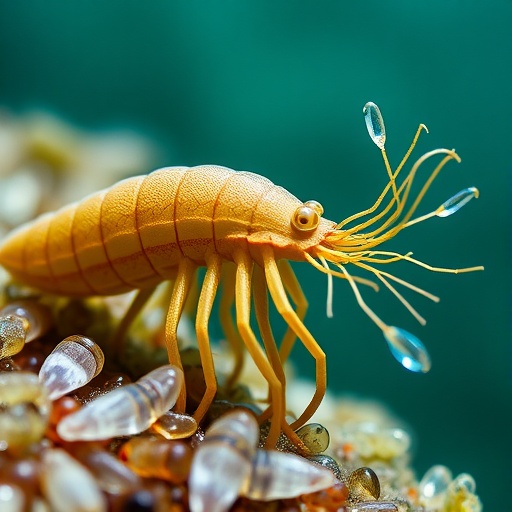
Image Credits: AI Generated
DOI: https://doi.org/10.1186/s43591-025-00148-3
Tags: aquatic food web interactionsBrachionus plicatilisecological consequences of microplasticsfeeding behaviors of rotiferslaboratory analysis of microplasticsmarine pollution dynamicsmarine rotifersmicroplastics recyclingocean ecosystemsPlankton-Plastic Predation Loopplanktonic organismsselective grazing on microplastics