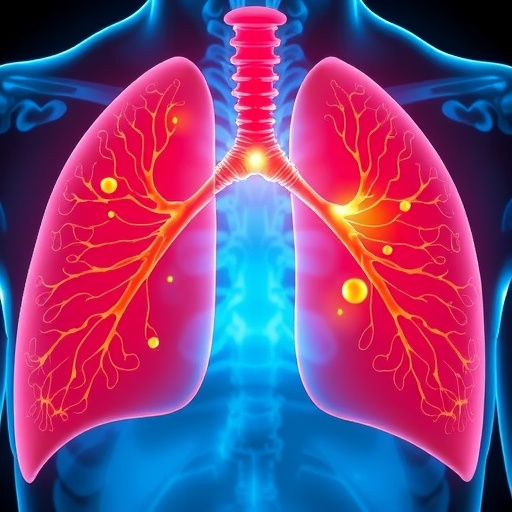
In a groundbreaking study published in Cancer Cell, researchers at The University of Texas MD Anderson Cancer Center have unveiled pivotal insights into the earliest stages of lung cancer development, emphasizing the critical role of inflammation as a driving force that precedes tumorigenesis. By employing cutting-edge spatial transcriptomics technology, this team has constructed detailed, high-resolution cellular and molecular maps of lung tissue spanning from precancerous lesions to fully developed malignancies. This innovative approach allows scientists to pinpoint precise locations and gene expression patterns within tissue architecture, thereby uncovering the intricate interplay of cells and their microenvironment during the initial phases of lung cancer formation.
Spatial transcriptomics represents a transformative method in cancer biology, transcending traditional bulk sequencing by preserving spatial context and cellular heterogeneity. This advancement enables researchers to not only catalog which genes are active but to localize their expression within specific cell clusters and tissue regions, offering an unprecedented window into tumor microenvironments. The MD Anderson team capitalized on this technology to analyze 56 human lung tissue samples encompassing precursor lesions and advanced tumors from 25 patients. Validation with an independent cohort of 36 lesions from 19 patients ensured robustness, collectively comprising analysis of over 486,000 spatial transcriptomic spots and more than 5 million individual cells.
The study reveals that the earliest cancerous transformations occur in highly inflamed regions within lung tissue. These inflammatory hotspots are richly populated by proinflammatory cells, which surround alveolar cell populations that are predisposed to malignant progression. This proinflammatory milieu appears to act as a critical promoter of tumor initiation, setting the stage for subsequent genetic and epigenetic alterations. Such findings challenge the conventional focus solely on genetic mutations and highlight inflammation as a foundational biological process that may be harnessed for early intervention.
At the molecular level, the team’s analyses identified interleukin-1 beta (IL-1B) as a key inflammatory cytokine instrumental in this tumorigenic niche. Neutralization of IL-1B in experimental models significantly diminished the population of lung precursor cells, suggesting that IL-1B signaling underpins the early cellular changes that cascade into full-blown lung cancer. This discovery holds profound therapeutic implications, as targeted anti-inflammatory agents could intercept the disease at its inception, potentially reducing incidence and improving patient prognoses dramatically.
Notably, these spatial transcriptomic maps delineate a dynamic landscape where proinflammatory activity is not only spatially localized but temporally regulated, being most pronounced in early lung cancer phases and persisting in relevant murine models. The conservation of these inflammatory patterns across species bolsters the translational potential of the findings, providing a robust platform for developing inflammation-focused therapeutic strategies, either as monotherapies or in concert with existing treatments such as immunotherapy.
Immunotherapy, which has revolutionized the treatment of advanced lung cancer by mobilizing the immune system to attack tumor cells, may benefit from combination with inflammation-targeting agents. By reducing the proinflammatory environment that nurtures early tumor cells, such combination approaches could profoundly impede tumor initiation and progression, thereby expanding the arsenal of lung cancer interception tools.
This research underscores the importance of dissecting the tumor microenvironment with spatially resolved approaches that capture cellular interactions and functional states with exceptional granularity. Understanding the molecular drivers within these localized niches unveils hidden vulnerabilities and novel biomarkers for early detection and therapeutic targeting. The intricate mapping performed by the MD Anderson team paves the way for a new paradigm in oncology, where interception strategies are informed by spatial and temporal biology rather than static genomic snapshots.
Beyond therapeutic implications, the data generated by this study contribute to the broader field of functional genomics and tumor biology, enriching the scientific community’s understanding of neoplastic processes in the lung. The comprehensive dataset, encompassing millions of cells and hundreds of thousands of transcriptomic spots, offers a resource for future investigations into lung cancer initiation, progression, and resistance mechanisms.
The multidisciplinary collaboration that drove this work integrates expertise from translational molecular pathology, genomic medicine, and data science, exemplifying the power of convergent science. With support from prominent institutions and funding bodies—including the National Cancer Institute, CPRIT, and the James P. Allison Institute—the study stands as a testament to the transformative impact of investment in innovative cancer research technologies.
In summary, by illuminating the nexus between inflammation and the earliest lung cancer events through spatial transcriptomics, this study opens avenues for proactive cancer interception. Targeting inflammatory pathways, particularly IL-1B, represents a promising strategy to abrogate tumor initiation and enhance patient outcomes. As lung cancer remains a leading cause of cancer-related mortality worldwide, these insights hold significant promise for altering disease trajectories and herald a new era in precision oncology.
Subject of Research: Lung Cancer Initiation and Progression via Inflammation and Spatial Transcriptomics Mapping
Article Title: (Not explicitly provided; presumed from study: “Spatial Transcriptomic Profiling Reveals Inflammation-Driven Early Lung Cancer Initiation”)
News Publication Date: (Not specified in the source content)
Web References: https://faculty.mdanderson.org/profiles/humam_kadara.html, https://www.cell.com/cancer-cell/fulltext/S1535-6108(25)00445-3
References: Published in Cancer Cell; includes contributions from MD Anderson Cancer Center scientists, funded by several cancer research organizations
Image Credits: The University of Texas MD Anderson Cancer Center (Image of Humam Kadara, Ph.D.)
Keywords: Lung cancer, Inflammation, Immunotherapy, Tumorigenesis, Tumor development, Genomics, Functional genomics, Transcriptomics, Transcriptomes
Tags: cancer biology advancementscancer detection innovationsearly stages of lung tumorigenesisgene expression patterns in cancerhigh-resolution cellular mappinginflammation and cancer developmentlung cancer researchMD Anderson Cancer Center studymolecular maps of lung tissueprecancerous lung lesionsspatial transcriptomics technologytumor microenvironment analysis