• HOME
  • NEWS
  • EXPLORE
    • CAREER
      • Companies
      • Jobs
    • EVENTS
    • iGEM
      • News
      • Team
    • PHOTOS
    • VIDEO
    • WIKI
  • BLOG
  • COMMUNITY
    • FACEBOOK
    • INSTAGRAM
    • TWITTER
Saturday, February 7, 2026
BIOENGINEER.ORG
No Result
View All Result
  • Login
  • HOME
  • NEWS
  • EXPLORE
    • CAREER
      • Companies
      • Jobs
        • Lecturer
        • PhD Studentship
        • Postdoc
        • Research Assistant
    • EVENTS
    • iGEM
      • News
      • Team
    • PHOTOS
    • VIDEO
    • WIKI
  • BLOG
  • COMMUNITY
    • FACEBOOK
    • INSTAGRAM
    • TWITTER
  • HOME
  • NEWS
  • EXPLORE
    • CAREER
      • Companies
      • Jobs
        • Lecturer
        • PhD Studentship
        • Postdoc
        • Research Assistant
    • EVENTS
    • iGEM
      • News
      • Team
    • PHOTOS
    • VIDEO
    • WIKI
  • BLOG
  • COMMUNITY
    • FACEBOOK
    • INSTAGRAM
    • TWITTER
No Result
View All Result
Bioengineer.org
No Result
View All Result
Home NEWS Science News Cancer

DNA-Built Nanostructures Safely Target, Image Cancer Tumors

Bioengineer by Bioengineer
January 28, 2014
in Cancer
Reading Time: 2 mins read
1
Share on FacebookShare on TwitterShare on LinkedinShare on RedditShare on Telegram

A team of researchers at the University of Toronto has discovered a method of assembling “building blocks” of gold nanoparticles as the vehicle to deliver cancer medications or cancer-identifying markers directly into cancerous tumors. The study, led by Warren Chan, Professor at the Institute of Biomaterials & Biomedical Engineering (IBBME) and the Donnelly Centre for Cellular & Biomolecular Research (CCBR), appears in an article in Nature Nanotechnology this week.
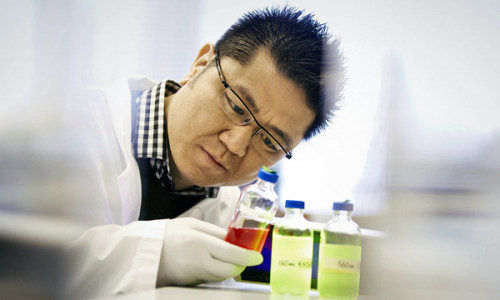
DNA-Built Nanostructures Safely Target, Image Cancer Tumors

“To get materials into a tumor they need to be a certain size,” explains Chan. “Tumors are characterized by leaky vessels with holes roughly 50 — 500 nanometers in size, depending on the tumor type and stage. The goal is to deliver particles small enough to get through the holes and ‘hang out’ in the tumor’s space for the particles to treat or image the cancer. If particle is too large, it can’t get in, but if the particle is too small, it leaves the tumor very quickly.”

Chan and his researchers solved this problem by creating modular structures ‘glued’ together with DNA. “We’re using a ‘molecular assembly’ model — taking pieces of materials that we can now fabricate accurately and organizing them into precise architectures, like putting LEGO blocks together,” cites Leo Chou, a 5th year PhD student at IBBME and first author of the paper. Chou was awarded a 2012-13 Canadian Breast Cancer Foundation Ontario Region Fellowship for his work with nanotechnology.

“The major advantage of this design strategy is that it is highly modular, which allows you to ‘swap’ components in and out. This makes it very easy to create systems with multiple functions, or screen a large library of nanostructures for desirable biological behaviors,” he states.

The long-term risk of toxicity from particles that remain in the body, however, has been a serious challenge to nanomedical research.

“Imagine you’re a cancer patient in your 30s,” describes Chan. “And you’ve had multiple injections of these metal particles. By the time you’re in your mid-40s these are likely to be retained in your system and could potentially cause other problems.”

DNA, though, is flexible, and over time, the body’s natural enzymes cause the DNA to degrade, and the assemblage breaks apart. The body then eliminates the smaller particles safely and easily.
But while the researchers are excited about this breakthrough, Chan cautions that a great deal more needs to be known.

“We need to understand how DNA design influences the stability of things, and how a lack of stability might be helpful or not,” he argues.

“The use of assembly to build complex and smart nanotechnology for cancer applications is still in the very primitive stage of development. Still, it is very exciting to be able to see and test the different nano-configurations for cancer applications,” Chan adds.

Story Source:

The above story is based on materials provided by University of Toronto, Erin Vollick.
Share12Tweet8Share2ShareShareShare2

Related Posts

Deep Learning Uncovers Tetrahydrocarbazoles as Potent Broad-Spectrum Antitumor Agents with Click-Activated Targeted Cancer Therapy Approach

February 7, 2026

Newly Discovered Limonoid DHL-11 from Munronia henryi Targets IMPDH2 to Combat Triple-Negative Breast Cancer

February 7, 2026

New Discovery Reveals Why Ovarian Cancer Spreads Rapidly in the Abdomen

February 6, 2026

New Study Finds Americans Favor In-Clinic Screening Over At-Home Tests for Cervical Cancer

February 6, 2026
Please login to join discussion

POPULAR NEWS

  • Robotic Ureteral Reconstruction: A Novel Approach

    Robotic Ureteral Reconstruction: A Novel Approach

    82 shares
    Share 33 Tweet 21
  • Digital Privacy: Health Data Control in Incarceration

    63 shares
    Share 25 Tweet 16
  • Study Reveals Lipid Accumulation in ME/CFS Cells

    57 shares
    Share 23 Tweet 14
  • Breakthrough in RNA Research Accelerates Medical Innovations Timeline

    53 shares
    Share 21 Tweet 13

About

We bring you the latest biotechnology news from best research centers and universities around the world. Check our website.

Follow us

Recent News

Decoding Prostate Cancer Origins via snFLARE-seq, mxFRIZNGRND

Digital Health Perspectives from Baltic Sea Experts

Florida Cane Toad: Complex Spread and Selective Evolution

Subscribe to Blog via Email

Enter your email address to subscribe to this blog and receive notifications of new posts by email.

Join 73 other subscribers
  • Contact Us

Bioengineer.org © Copyright 2023 All Rights Reserved.

Welcome Back!

Login to your account below

Forgotten Password?

Retrieve your password

Please enter your username or email address to reset your password.

Log In
No Result
View All Result
  • Homepages
    • Home Page 1
    • Home Page 2
  • News
  • National
  • Business
  • Health
  • Lifestyle
  • Science

Bioengineer.org © Copyright 2023 All Rights Reserved.