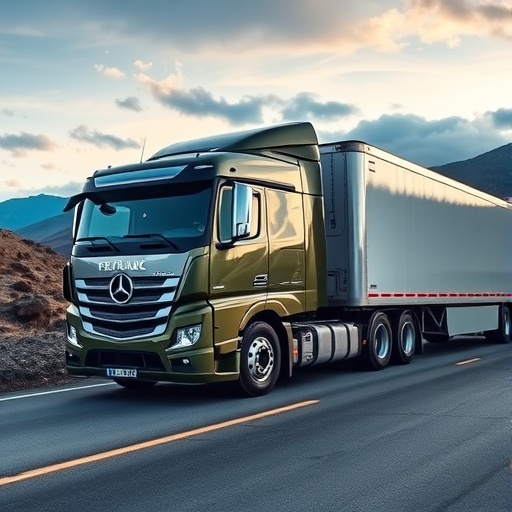
In an era where climate change has become an existential threat, the transportation sector remains one of the most significant contributors to global carbon emissions. Within this sector, long-haul heavy-duty trucking is particularly notorious for its disproportionate environmental impact due to its reliance on fossil fuels and extensive operational demands. However, recent groundbreaking research led by Su, Lin, and Chen, published in Nature Communications, offers a potential pathway to revolutionize this industry by optimizing the carbon footprint of long-haul heavy-duty electric trucks (E-Trucks). This innovative study not only paves the way toward sustainable freight transportation but also challenges prevailing assumptions about the true environmental costs associated with electrifying heavy-duty vehicle fleets.
Heavy-duty trucks, often responsible for transporting vast quantities of goods across continents, traditionally depend on diesel engines, which emit substantial volumes of CO₂ and other pollutants. Electrification has been heralded as the Holy Grail for decarbonization in this sector, yet the transition is complicated by the substantial energy required for long-distance hauling and the associated battery limitations. The research conducted by Su and colleagues addresses these core challenges by developing an optimization framework designed to minimize the overall carbon footprint while maintaining operational feasibility for these massive transportation tasks.
The study leverages a multidisciplinary approach, combining engineering principles, environmental science, and advanced systems optimization algorithms. By integrating data on electric powertrain performance, battery energy density, charging infrastructure availability, and real-world route characteristics, the researchers constructed a comprehensive model reflecting the complex interplay between technical constraints and environmental impacts. This model enables the simulation of various operational scenarios to identify optimal configurations under different logistical and geographic conditions.
One of the most striking aspects of the study is its nuanced consideration of the electricity generation mix that powers E-Trucks. It acknowledges that the carbon intensity of electricity can vary dramatically depending on location and time, influenced by factors such as renewable energy penetration, grid demand, and fossil fuel dependency. By incorporating these temporal and spatial dynamics, the model ensures that the optimizations tailored for vehicle operation also align with minimizing indirect emissions from electricity generation.
Critical to the analysis was the incorporation of charging station placement and scheduling. The researchers recognize that unplanned or inefficient charging can lead not only to increased downtime but also to elevated emissions if trucks charge during periods of peak grid carbon intensity. Therefore, the study proposes intelligent charging strategies that coordinate vehicle operation schedules with grid conditions, maximizing energy use from cleaner sources and reducing the need for oversized batteries that add weight and increase energy consumption.
Battery technology remains a pivotal focus. Heavy-duty E-Trucks require substantial battery capacity to cover long distances, but increased battery weight can paradoxically elevate energy consumption and thus emissions. The research delves into optimizing battery size, balancing capacity with weight and efficiency. This balance is crucial for ensuring that trucks can meet delivery timelines without excessive carbon costs in terms of battery manufacture and operational energy use.
The study introduces an optimization algorithm that simultaneously considers vehicle design parameters, route selection, charging schedules, and grid carbon intensity to yield the minimal total carbon footprint. This holistic approach departs from traditional siloed analyses and provides actionable insights to manufacturers, logistics companies, and policymakers aiming for sustainable freight networks.
Beyond the technical contributions, the implications of this research extend into policy and infrastructure planning realms. It suggests that well-coordinated deployment of charging infrastructure, aligned with renewable energy expansion, can magnify the carbon reduction benefits of heavy-duty E-Trucks. Governments and industry stakeholders can use these findings to inform investment priorities, ensuring that electrification efforts are not undermined by inadequate grid capabilities or poorly designed operational strategies.
Moreover, the study highlights that achieving substantial carbon footprint reductions is not solely a matter of switching fuel sources but requires integrated system-level thinking. The combination of vehicle technology, energy supply chains, and operational logistics must be optimized concurrently to realize the full climate benefits of electrifying freight transportation.
The authors provide compelling evidence that strategic scheduling of charging times to coincide with periods of low grid carbon intensity can decrease overall emissions by a significant margin. This insight underscores the importance of grid agility and demands better communication between transportation operators and grid managers, fostering the emergence of smart grid ecosystems that can accommodate the growing electrification of heavy transport.
While the research centers on long-haul operations, its frameworks and conclusions have broader applicability across different vehicle classes and operational contexts. The principles of integrating vehicle design, energy supply, and logistics optimization can inspire similar efforts in urban delivery fleets, intermodal transport chains, and other areas where balancing environmental and operational efficiency remains a challenge.
However, challenges remain. The prevailing grid infrastructure and renewable energy penetration levels vary globally, and not all regions may immediately benefit equally from the proposed optimizations. Furthermore, scaling up the manufacturing of heavy-duty E-Trucks and supporting battery technologies to meet rising demand will require substantial resource inputs, potentially leading to supply chain complexities.
Nonetheless, the work by Su and colleagues signifies a watershed moment in the sustainable transformation of freight transportation. Through comprehensive modeling, the research reshapes the narrative around electric heavy-duty trucks, presenting a more sophisticated and achievable roadmap toward reducing carbon footprints. It galvanizes further innovation in vehicle technology, charging infrastructure, and energy management, emphasizing that true sustainability arises from systemic optimization rather than piecemeal solutions.
As companies and governments accelerate commitments to net-zero emissions, insights from this study are poised to influence strategic decisions regarding electric freight transport deployment. The optimized operational frameworks proposed will ensure that the transition to E-Trucks delivers maximum environmental benefit while maintaining economic and logistical viability.
In a global context where freight volumes continue to grow alongside e-commerce and globalization, adopting cleaner heavy-duty transportation solutions is imperative. Su, Lin, and Chen’s pioneering research thus offers not only technical advancements but a compelling vision for a greener future where long-haul logistics align harmoniously with climate goals.
This transformative approach encourages stakeholders across sectors to embrace a data-driven, systems-focused mindset, redefining how sustainable transport infrastructure is planned and deployed. By closing the loop between energy supply, vehicle operation, and route management, the study exemplifies how multidisciplinary research can unlock efficiencies crucial for combating climate change challenges head-on.
Ultimately, the journey toward sustainable E-Truck transportation will require continued collaboration between engineers, environmental scientists, policymakers, and industry players. The comprehensive optimization framework developed in this study provides a vital foundation upon which future innovations can build, steering heavy-duty trucking toward an environmentally responsible epoch characterized by reduced carbon footprints and enhanced operational excellence.
Article References:
Su, J., Lin, Q. & Chen, M. Optimizing carbon footprint in long-haul heavy-duty E-Truck transportation. Nat Commun 16, 9562 (2025). https://doi.org/10.1038/s41467-025-64792-2
Image Credits: AI Generated
Tags: battery limitations in electric vehiclescarbon footprint optimizationClimate change and transportationdecarbonization in truckingenvironmental impact of heavy-duty trucksfossil fuel alternatives for truckingheavy-duty vehicle electrificationlong-haul electric trucksNature Communications researchoperational demands of E-Trucksreducing CO₂ emissions in logisticssustainable freight transportation