Credit: Mathias Lecuyer
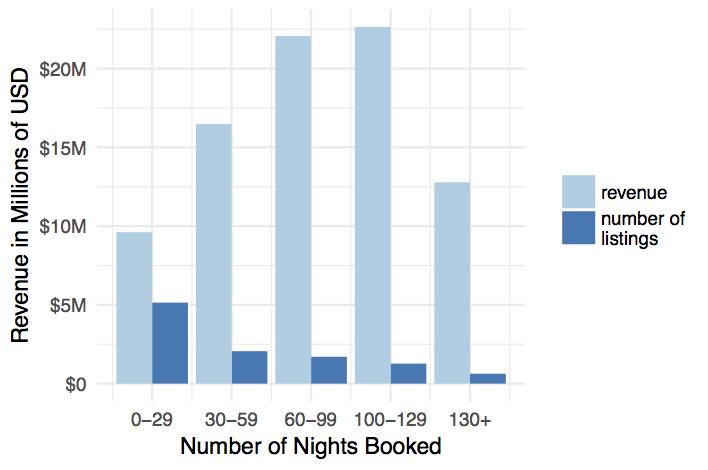
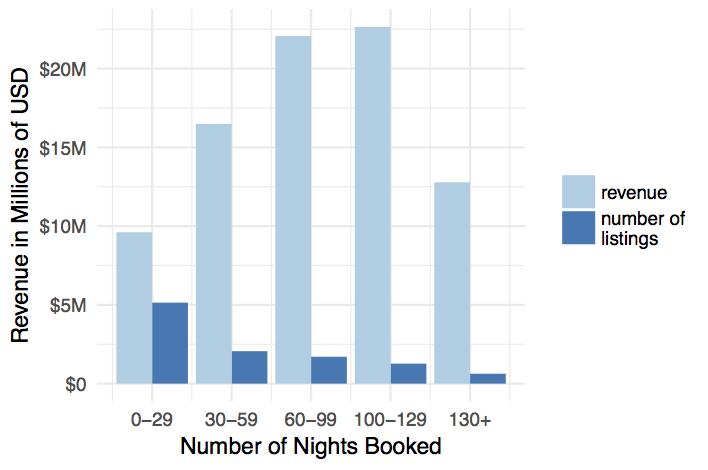
Most Airbnb hosts in Manhattan make less than $10,000 a year, but hosts who rent out their homes for more than 90 days each year make $20,000 or more, generating 80 percent of the revenue, says a new study by Columbia University researchers.
Researchers point to a common statistical bias — the long-tail frequency distribution — to explain how two seemingly contradictory facts can be true: Airbnb's claim that most hosts are ordinary people wringing extra money from an underused asset, and claims by home-sharing critics that most of Airbnb's revenue comes from operators running quasi hotels.
"A majority of Airbnb listings are rarely used, but a small share of listings generates most of the revenue," said the study's senior author Augustin Chaintreau, a computer science professor at Columbia Engineering. "Something similar happens on Amazon and Netflix–most books and movies are rarely sold, but the popular titles account for most of the sales."
The researchers' findings will be presented Wednesday, April 5, at the Association for Computing Machinery's 2017 World Wide Web conference in Perth, Australia.
Researchers scraped Manhattan listings from Airbnb's Website to infer how often each home was booked, and how much revenue it generated over nine months, within an 11-month period ending in February 2016. Consistent with Airbnb's own results, they found that nearly two-thirds of an estimated 12,000 listings in Manhattan were booked less than 30 days a year, and that half of all hosts earned $10,000 or less, suggesting that most hosts are not commercial operators.
But they also found that 35 percent of listings were rented for 90 days or more, capturing 80 percent of all revenue, a finding consistent with a recent report by researchers at Penn State, funded by a hotel-industry trade group.
Previous studies of abuse in New York City's home-sharing economy have focused on hosts renting out multiple units. A 2014 investigation by New York State Attorney General Eric Schneiderman found that 6 percent of NYC hosts listed three or more units on Airbnb, generating 37 percent of the revenue. The Penn State researchers found that hosts with two or more listings made 32 percent of the revenue.
Responding to pressure from regulators, Airbnb last fall launched a "one host, one home" policy in New York City that has led to the removal of 4,100 listings, said Nick Papas, an Airbnb spokesman. Papas called the study's conclusions irrelevant because they are based on data collected before the transition.
When researchers ran their analysis again on data from December 2016 through February 2017, they found that top earners had taken a moderate pay cut, with 35 percent of homes generating 69 percent of the revenue. It's unclear if a new city law barring hosts from advertising their homes on Airbnb for less than 30 days may also be having an effect.
An occasional Airbnb guest himself, Mathias Lecuyer, the study's lead author and a graduate student at Columbia, said he became interested in the question of who benefits from the sharing economy after reading conflicting news stories and reflecting on his own ambivalence.
"Airbnb is much easier when you're traveling, especially if you have kids," he said. "You have a kitchen and a living room and can save money by cooking. But when I'm at home, I'd hate to deal with the noise and other potential problems if my neighbors were constantly renting out their place."
The researchers take no sides in the Airbnb debate–it's up to regulators to look at the data and decide where to draw the line, they say. They estimate that limiting Manhattan rentals to 90-days might reduce revenue from $50,000 to $25,000 for the top 10 percent of earners, but keep income largely the same for the majority of hosts making $10,000 a year or less.
Still, they caution that policy changes might create other consequences that would need to be considered, such as rising rental prices that attract more occasional hosts, or Airbnb losing its appeal if too many listings are rarely available.
###
Max Tucker, a graduate student at Columbia, is the study's third author.
Study: Improving the Transparency of the Sharing Economy
Media Contact
Kim Martineau
[email protected]
646-717-0134
@CUSEAS
http://www.engineering.columbia.edu/
############
Story Source: Materials provided by Scienmag