• HOME
  • NEWS
  • EXPLORE
    • CAREER
      • Companies
      • Jobs
    • EVENTS
    • iGEM
      • News
      • Team
    • PHOTOS
    • VIDEO
    • WIKI
  • BLOG
  • COMMUNITY
    • FACEBOOK
    • INSTAGRAM
    • TWITTER
Saturday, December 20, 2025
BIOENGINEER.ORG
No Result
View All Result
  • Login
  • HOME
  • NEWS
  • EXPLORE
    • CAREER
      • Companies
      • Jobs
        • Lecturer
        • PhD Studentship
        • Postdoc
        • Research Assistant
    • EVENTS
    • iGEM
      • News
      • Team
    • PHOTOS
    • VIDEO
    • WIKI
  • BLOG
  • COMMUNITY
    • FACEBOOK
    • INSTAGRAM
    • TWITTER
  • HOME
  • NEWS
  • EXPLORE
    • CAREER
      • Companies
      • Jobs
        • Lecturer
        • PhD Studentship
        • Postdoc
        • Research Assistant
    • EVENTS
    • iGEM
      • News
      • Team
    • PHOTOS
    • VIDEO
    • WIKI
  • BLOG
  • COMMUNITY
    • FACEBOOK
    • INSTAGRAM
    • TWITTER
No Result
View All Result
Bioengineer.org
No Result
View All Result
Home NEWS Science News

Researchers create artificial materials atom-by-atom

Bioengineer by Bioengineer
March 27, 2017
in Science News
Reading Time: 2 mins read
0
Share on FacebookShare on TwitterShare on LinkedinShare on RedditShare on Telegram
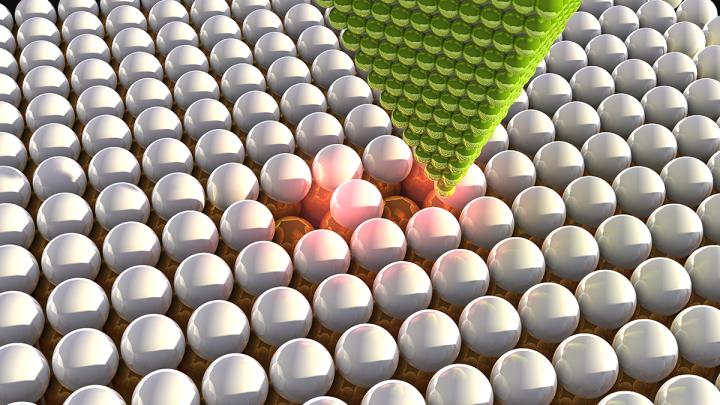
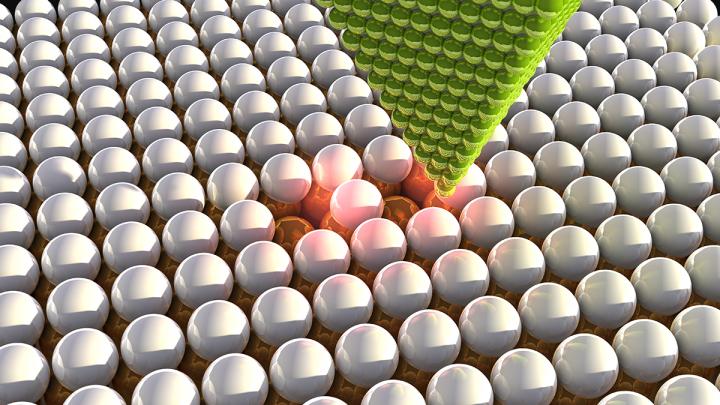
IMAGE

Credit: Ella Maru Studio & Aalto University

Researchers at Aalto University have manufactured artificial materials with engineered electronic properties. By moving individual atoms under their microscope, the scientists were able to create atomic lattices with a predetermined electrical response. The possibility to precisely arrange the atoms on a sample bring 'designer quantum materials' one step closer to reality. By arranging atoms in a lattice, it becomes possible to engineer the electronic properties of the material through the atomic structure.

Working at a temperature of four degrees Kelvin, the researchers used a scanning tunnelling microscope (STM) to arrange vacancies in a single layer of chlorine atoms supported on a copper crystal.

"The correspondence between atomic structure and electronic properties is of course what happens in real materials as well, but here we have complete control over the structure. In principle, we could target any electronic property and implement it experimentally", says Dr. Robert Drost who carried out the experiments at Aalto University.

Using their atomic assembly method, the research team demonstrated complete control by creating two real-life structures inspired by fundamental model systems with exotic electronic properties.

The approach is not limited to the chlorine system chosen by the research team either. The same method can be applied in many well-understood systems in surface and nanoscience and could even be adapted to mesoscopic systems, such as quantum dots, which are controlled through lithographic processes.

"There are many fascinating theoretical proposals that don't exist in real materials. This is our chance to test these ideas experimentally", explains Academy Research Fellow Teemu Ojanen at Aalto University.

###

The study was performed at Aalto University's Department of Applied Physics and the groups are parts of the Academy of Finland's Centres of Excellence in Low Temperature Quantum Phenomena and Devices (LTQ) and Computational Nanosciences (COMP). The Aalto Centre for Quantum Engineering (CQE), Academy of Finland and the European Research Council (ERC) funded the research. A consortia funding application to further pursue designer matter is currently under review.

Media Contact

Peter Liljeroth
[email protected]
358-503-636-115
@aaltouniversity

http://www.aalto.fi/en/

############

Story Source: Materials provided by Scienmag

Share12Tweet8Share2ShareShareShare2

Related Posts

Trial Tests Sensorimotor Stimulation for High-Risk Newborns

Trial Tests Sensorimotor Stimulation for High-Risk Newborns

December 20, 2025
Why Multiregional Accounting Matters for Corporate Emissions

Why Multiregional Accounting Matters for Corporate Emissions

December 20, 2025

Predicting Hospitalization Disability in Older Heart Failure Patients

December 20, 2025

Patient Tech Readiness and Nursing Robot Adoption

December 20, 2025
Please login to join discussion

POPULAR NEWS

  • Nurses’ Views on Online Learning: Effects on Performance

    Nurses’ Views on Online Learning: Effects on Performance

    70 shares
    Share 28 Tweet 18
  • NSF funds machine-learning research at UNO and UNL to study energy requirements of walking in older adults

    71 shares
    Share 28 Tweet 18
  • Unraveling Levofloxacin’s Impact on Brain Function

    53 shares
    Share 21 Tweet 13
  • Exploring Audiology Accessibility in Johannesburg, South Africa

    51 shares
    Share 20 Tweet 13

About

We bring you the latest biotechnology news from best research centers and universities around the world. Check our website.

Follow us

Recent News

Trial Tests Sensorimotor Stimulation for High-Risk Newborns

Why Multiregional Accounting Matters for Corporate Emissions

Predicting Hospitalization Disability in Older Heart Failure Patients

Subscribe to Blog via Email

Enter your email address to subscribe to this blog and receive notifications of new posts by email.

Join 70 other subscribers
  • Contact Us

Bioengineer.org © Copyright 2023 All Rights Reserved.

Welcome Back!

Login to your account below

Forgotten Password?

Retrieve your password

Please enter your username or email address to reset your password.

Log In
No Result
View All Result
  • Homepages
    • Home Page 1
    • Home Page 2
  • News
  • National
  • Business
  • Health
  • Lifestyle
  • Science

Bioengineer.org © Copyright 2023 All Rights Reserved.