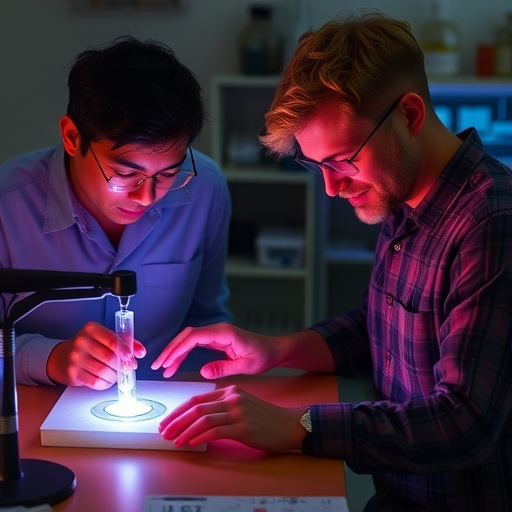
In a remarkable breakthrough detailed in the prestigious journal Science, an international team of researchers has unveiled a novel photochemical method that enables heterolytic dissociation of molecular hydrogen (H₂) at ambient temperature—an achievement long sought after in the realm of hydrogen activation chemistry. Led by Prof. WANG Feng from the Dalian Institute of Chemical Physics (DICP), Chinese Academy of Sciences, in collaboration with Prof. Paolo Fornasiero from the University of Trieste, Italy, this study introduces a light-driven strategy that not only challenges traditional thermal methods but also opens pathways for sustainable chemical manufacturing of valuable hydrocarbons under mild conditions.
Hydrogenation reactions are quintessential in the chemical industry, constituting approximately a quarter of all chemical processes worldwide. Central to these reactions is the cleavage of the H–H bond, a step traditionally achieved either through homolytic or heterolytic pathways. Homolytic dissociation generates neutral hydrogen radicals, whereas heterolytic dissociation produces charged, polar hydrogen species. The latter is highly prized for its selectivity in reducing polar functional groups, making it indispensable for the synthesis of fine chemicals. However, prevailing heterolytic cleavage methods necessitate elevated temperatures and pressures, which translate to considerable energy usage and safety concerns, thus posing significant challenges for industrial scalability.
The research team’s innovative approach harnesses the power of photochemistry to circumvent these limitations. Employing gold-loaded titanium dioxide (Au/TiO₂) as a model photocatalyst, they demonstrated that ultraviolet (UV) light irradiation induces electron transfer within the catalyst. Specifically, photons excite electrons in TiO₂, which subsequently migrate to the gold nanoparticles. Simultaneously, positive holes are localized at defective interfacial sites characterized by Au–O–Ti linkages. This spatial separation engenders electron-hole pairs that catalytically drive the cleavage of the hydrogen molecule through a heterolytic mechanism, efficiently generating polar hydrogen intermediates at room temperature.
One of the groundbreaking findings of this investigation is the near-linear dependence of heterolytic H₂ dissociation rate on light intensity. This key observation affirms the photocatalytic nature of the reaction, clearly distinguishing it from conventional thermally activated processes. The ability to control such reactivity simply by modulating light provides unprecedented tunability and underscores the potential for solar-driven or energy-efficient catalytic solutions in hydrogen activation.
Beyond mechanistic insights, the researchers showcased the practical applications of their photochemical strategy by coupling it with the conversion of inert carbon dioxide (CO₂) into ethane—a hydrocarbon of immense industrial significance. Utilizing the heterolytically dissociated hydrogen species, they achieved almost complete reduction of CO₂ to ethane at ambient temperature, a feat that could revolutionize CO₂ valorization processes. The study further cascaded this reaction with photocatalytic dehydrogenation of ethane to ethylene, garnering over 99% ethylene yield after continuous UV irradiation spanning 1,500 hours, highlighting both the efficiency and remarkable stability of the system.
Importantly, this light-induced method is not confined to the Au/TiO₂ system alone. The team illustrated its universality across various visible-light-responsive photocatalysts, including Au loaded on nitrogen-doped TiO₂ (Au/N-TiO₂), cerium oxide (Au/CeO₂), and bismuth vanadate (Au/BiVO₄). Implementing solar irradiation, these catalysts were demonstrated to convert CO₂ with ethane selectivity approaching an impressive 90%, paving the way for scalable and sustainable solar fuel production technologies.
The implications of this work are multifold, encompassing environmental, economic, and technological dimensions. By enabling the room-temperature heterolytic dissociation of hydrogen and subsequent selective CO₂ reduction in photochemical reactors, the study presents a paradigm shift in green chemical synthesis. This could drastically reduce the carbon footprint of fuel and chemical industries that currently rely on energy-intensive processes, thus contributing significantly to global efforts aimed at carbon emission mitigation and climate change alleviation.
Prof. WANG Feng emphasized the transformative potential of their findings, envisioning the light-induced heterolytic H₂ dissociation strategy evolving into commercially viable sunlight-driven or photothermal-coupled technologies. Such advancements would be particularly impactful for modern coal-based chemical industries, enabling the upgrading of existing infrastructure toward cleaner and more efficient operations.
Technically, the study delves into intricate photoelectrochemical phenomena involving electron dynamics at the nanoscale interface of Au and TiO₂. The formation of Au–O–Ti interfacial defects serves not only to trap holes but also to spatially decouple charge carriers, preventing recombination losses—a critical factor for achieving high photocatalytic efficiency. This strategic design of catalyst architecture underpins the robust catalytic performance observed and sets a new benchmark for the rational engineering of photocatalysts tailored for hydrogen activation.
Furthermore, by aligning experimental data with in-situ spectroscopic analyses and theoretical modeling, the team elucidated the underlying reaction pathways and charge transfer kinetics governing H₂ molecule cleavage and CO₂ reduction steps. These insights contribute valuable knowledge to the broader field of photocatalysis, informing future developments in artificial photosynthesis and renewable fuel synthesis.
This achievement also intersects with the global movement toward circular carbon economy frameworks, whereby CO₂ is not merely a waste product but a feedstock for synthesizing valuable chemicals and fuels. The demonstrated ethane-to-ethylene transformation additionally addresses the growing demand for lightweight olefins used extensively in polymer and chemical sectors, showcased here through a robust, long-term stable catalytic system operating under mild conditions.
In summary, this pioneering work articulates a highly efficient, light-induced heterolytic hydrogen dissociation mechanism, enabling groundbreaking advances in CO₂ reduction and hydrocarbon synthesis at ambient conditions. The combination of fundamental photochemical insights with practical applications heralds a new era in sustainable catalysis, propelling the scientific community closer to achieving energy-efficient, low-carbon chemical processes vital for the future of global industry.
Subject of Research: Not applicable
Article Title: Photochemical H2 dissociation for nearly quantitative CO2 reduction to ethylene
News Publication Date: 4-Aug-2025
Web References: http://dx.doi.org/10.1126/science.adq3445
Image Credits: DICP
Keywords
Hydrogen, Photocatalysis, Carbon dioxide
Tags: ambient-temperature hydrogen dissociationDalian Institute of Chemical Physics researchenergy-efficient hydrogen cleavagefine chemicals synthesisheterolytic dissociation methodshydrogenation reactions in industryinnovative chemical pathwayslight-driven chemical processesmolecular hydrogen activationphotochemical hydrogen activationsustainable chemical manufacturingtraditional thermal methods in chemistry