• HOME
  • NEWS
  • EXPLORE
    • CAREER
      • Companies
      • Jobs
    • EVENTS
    • iGEM
      • News
      • Team
    • PHOTOS
    • VIDEO
    • WIKI
  • BLOG
  • COMMUNITY
    • FACEBOOK
    • INSTAGRAM
    • TWITTER
Saturday, February 7, 2026
BIOENGINEER.ORG
No Result
View All Result
  • Login
  • HOME
  • NEWS
  • EXPLORE
    • CAREER
      • Companies
      • Jobs
        • Lecturer
        • PhD Studentship
        • Postdoc
        • Research Assistant
    • EVENTS
    • iGEM
      • News
      • Team
    • PHOTOS
    • VIDEO
    • WIKI
  • BLOG
  • COMMUNITY
    • FACEBOOK
    • INSTAGRAM
    • TWITTER
  • HOME
  • NEWS
  • EXPLORE
    • CAREER
      • Companies
      • Jobs
        • Lecturer
        • PhD Studentship
        • Postdoc
        • Research Assistant
    • EVENTS
    • iGEM
      • News
      • Team
    • PHOTOS
    • VIDEO
    • WIKI
  • BLOG
  • COMMUNITY
    • FACEBOOK
    • INSTAGRAM
    • TWITTER
No Result
View All Result
Bioengineer.org
No Result
View All Result
Home NEWS Science News

Structural knowledge of the DNA repair complex

Bioengineer by Bioengineer
March 21, 2017
in Science News
Reading Time: 2 mins read
0
Share on FacebookShare on TwitterShare on LinkedinShare on RedditShare on Telegram
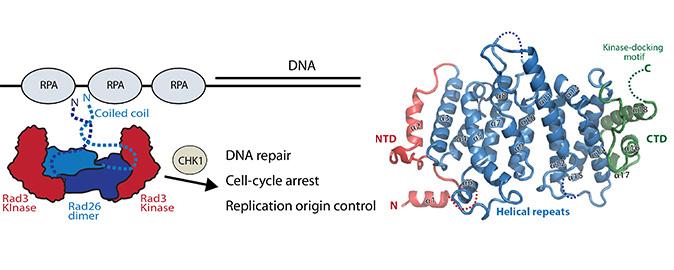
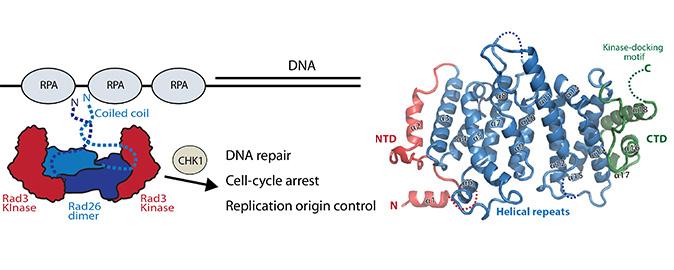
IMAGE

Credit: Kasper Røjkjær Andersen

New Danish research provides mechanistic insight into how DNA is monitored and repaired if damage occurs. The results may eventually help to improve the treatment of certain types of cancer, as the DNA repair complex provides a mechanism for cancer cells to resist chemotherapy.

Our DNA is constantly exposed to damage and to protect the genome, cells have evolved mechanisms that monitor and repair these damages. Our structural knowledge of the protein complexes that monitor DNA has so far been limited. New research now describes the structure and organisation of the DNA controls protein Rad26 and shows how the kinase Rad3 is recruited to sites of damaged DNA.

To maintain the genome integrity, DNA damages have to be monitored and repaired. The first step in this process is orchestrated by the Rad3 kinase. Rad26 is a functional subunit of Rad3-rad26 DNA repair complex and is responsible for bringing the kinase to sites of DNA damage, but the mechanism behind kinase recruitment and structural knowledge of how this complete is organized has until now been unclear.

New results from Aarhus reveal the crystal structure of Rad26 and identify the elements that are important for recruiting Rad3 kinase. Rad26 is a dimer with a conserved interface in the N-terminal part of the protein. Biochemical data demonstrated that Rad26 uses its C-terminal domain and a conserved motif to recruit Rad3. From the in vitro reconstituted Rad3-Rad26 complex, small-angle X-ray scattering and electron microscopic studies, it is possible to model the quaternary structure and thus bring us closer to a mechanistic understanding Rad3-Rad26 DNA repair apparatus.

Rad3 signalling ensures that cells do not divide before DNA damages are repaired and thus provides cancer cells with a mechanism to resist chemotherapy by repairing these DNA damages. Our new structural knowledge will help the development of Rad3 inhibitors that make cancer cells more susceptible to chemotherapy and this new treatment is now being tested in clinical trials.

###

The results were published in The Journal of Biological Chemistry: doi: 10.1074/jbc.M117.780189.

Media Contact

Kasper Røjkjær Andersen
[email protected]
45-87-15-49-28
@aarhusuni

http://www.au.dk

############

Story Source: Materials provided by Scienmag

Share12Tweet8Share2ShareShareShare2

Related Posts

Boosting Remote Healthcare: Stepped-Wedge Trial Insights

February 7, 2026

Barriers and Boosters of Seniors’ Physical Activity in Karachi

February 7, 2026

Evaluating Pediatric Emergency Care Quality in Ethiopia

February 7, 2026

TPMT Expression Predictions Linked to Azathioprine Side Effects

February 7, 2026
Please login to join discussion

POPULAR NEWS

  • Robotic Ureteral Reconstruction: A Novel Approach

    Robotic Ureteral Reconstruction: A Novel Approach

    82 shares
    Share 33 Tweet 21
  • Digital Privacy: Health Data Control in Incarceration

    63 shares
    Share 25 Tweet 16
  • Study Reveals Lipid Accumulation in ME/CFS Cells

    57 shares
    Share 23 Tweet 14
  • Breakthrough in RNA Research Accelerates Medical Innovations Timeline

    53 shares
    Share 21 Tweet 13

About

We bring you the latest biotechnology news from best research centers and universities around the world. Check our website.

Follow us

Recent News

Boosting Remote Healthcare: Stepped-Wedge Trial Insights

Barriers and Boosters of Seniors’ Physical Activity in Karachi

Evaluating Pediatric Emergency Care Quality in Ethiopia

Subscribe to Blog via Email

Enter your email address to subscribe to this blog and receive notifications of new posts by email.

Join 73 other subscribers
  • Contact Us

Bioengineer.org © Copyright 2023 All Rights Reserved.

Welcome Back!

Login to your account below

Forgotten Password?

Retrieve your password

Please enter your username or email address to reset your password.

Log In
No Result
View All Result
  • Homepages
    • Home Page 1
    • Home Page 2
  • News
  • National
  • Business
  • Health
  • Lifestyle
  • Science

Bioengineer.org © Copyright 2023 All Rights Reserved.