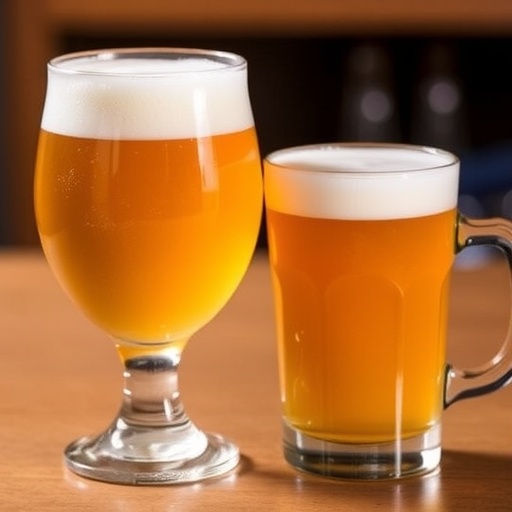
In the world of brewing, few elements hold as much significance as the frothy head crowning a glass of beer. This foam is not merely decorative; it serves as a key indicator of the beer’s quality and fermentation completeness. Despite its central role, the intricate physics behind the formation and stability of beer foam has remained somewhat elusive. However, groundbreaking research published in the journal Physics of Fluids now sheds light on the subtle and complex mechanisms that govern beer foam stability, offering new insights with far-reaching implications beyond the brewery.
At its core, beer foam consists of countless tiny air bubbles ensconced within thin films of liquid, which separate each bubble from its neighbors. The stability of these films is critical. If these films rupture, the bubbles collapse, and the foam dissipates quickly. Understanding what fortifies these liquid films against rupture is vital not only to brewers but also to industries where foam stability is essential, such as firefighting, oil recovery, and even medical treatments targeting vascular conditions.
The research team, hailing from ETH Zurich and Eindhoven University of Technology, approached this longstanding enigma by meticulously examining different types of beer at various stages of fermentation. Their toolbox combined advanced imaging techniques—specifically wave interference and interferometry—to visualize the behavior of the films at the microscopic level. Alongside these methods, rheometry allowed them to characterize the mechanical properties of the foam’s liquid films in unprecedented detail.
Their findings reveal that the nature of beer foam stability is deeply tied to the fermentation process. In beers subjected to a single fermentation, the key factor maintaining the foam’s integrity is surface viscosity—a property that describes the film’s resistance to flow at the interface between air and liquid. This viscous resistance prevents the films from thinning too swiftly, thereby extending the lifetime of the bubbles.
Conversely, double-fermented beers exhibit a markedly different mechanism. Here, proteins aggregated within the beer coalesce into quasi two-dimensional networks within the thin films. This assembly imparts an unusual elasticity to the films, allowing them to withstand deformation far more effectively than purely viscous films. Such elasticity acts as a robust scaffold, preventing the films from bursting and thereby sustaining the foam for longer periods.
What makes these results captivating is how they bridge the microscopic molecular interactions to macroscopic foam stability. The researchers were able to directly visualize protein aggregates forming at the interface of two approaching bubbles, confirming long-held hypotheses about the protective role of these biomolecules. The interplay between surface viscosity and elastic protein networks opens new pathways for designing foam systems across multiple fields.
Importantly, this study positions beer as an exemplary model system to grasp foam physics generally. The creation of stable foams remains a prized challenge in engineering, as foams inherently tend toward instability. By dissecting the natural solutions utilized by beer foams, scientists can now contemplate engineered foams that mimic these mechanisms without relying on traditional surfactants, which often pose environmental or health risks.
Applications of such engineered foams could be transformative. For example, firefighting foams must be both highly stable and environmentally benign. The insights gained from beer foam proteins forming resilient, elastic networks provide a blueprint for crafting next-generation foam formulations that are both sustainable and effective. Similarly, in medical fields, controlled foam stability can influence treatments such as sclerotherapy for varicose veins, where foam underpins the therapeutic process.
Beyond industrial applications, these findings resonate with the broader quest to understand complex fluids and soft matter physics. Foam is a quintessential example of soft matter, involving intricate interactions between gas, liquid, and interfaces. The revelation that the fermentation process can dramatically modulate interfacial properties expands our understanding of how biological and chemical processes influence material properties at the microscale.
This research journey was propelled by a multidisciplinary approach, integrating physics, chemistry, and biology. The innovative use of interferometric imaging provided real-time, high-resolution views of phenomena previously inferred only indirectly. Such direct visualization enables researchers to quantify attributes like film thickness and deformation under varying conditions, bringing clarity to the dynamics of bubble interactions and foam longevity.
The authors emphasize that this knowledge could empower brewers to tailor foam characteristics more precisely. By identifying the factors that enhance or diminish foam stability, breweries could optimize their fermentation protocols or ingredient composition to produce beers with consistent, desirable head qualities. This not only improves the sensory experience for consumers but also serves quality control and branding purposes.
Looking forward, the research team envisions expanding their work to explore additional variables such as temperature effects, hop compounds, and carbonation levels, all of which influence foam behavior. Moreover, the study paves the way for novel foam materials inspired by nature’s own strategies, prompting scientific inquiry into bio-inspired design of functional surfaces and interfaces.
In sum, what began as a deep dive into the foam atop a beer glass has unveiled subtle yet profound principles of physics and materials science. These findings illuminate the delicate balance of forces that maintain foam integrity and propose a new paradigm for designing foams that are more robust, efficient, and adaptable. The convergence of tradition and modern science, visible even in the humble beer foam, promises innovations that ripple across diverse domains.
Subject of Research: Stability mechanisms of beer foam and their physical underpinnings.
Article Title: The hidden subtlety of beer foam stability: A blueprint for advanced foam formulations
News Publication Date: 26-Aug-2025
Web References: https://doi.org/10.1063/5.0274943
References: Emmanouil Chatzigiannakis, Alexandra Alicke, Lea Le Bars, Lucas Bidoire, Jan Vermant. Physics of Fluids, 26 August 2025.
Image Credits: AIP/Chatzigiannakis et al.
Keywords
Foam physics, Physics, Fluids, Soft matter physics
Tags: air bubbles in beer foamapplications of foam in medicinebeer foam stabilitybrewing technology advancementsfermentation process in brewingfoam in firefightingimplications of foam stabilityliquid film dynamicsphysics of beer foamquality indicators in beerresearch on beer qualityscience of beer brewing