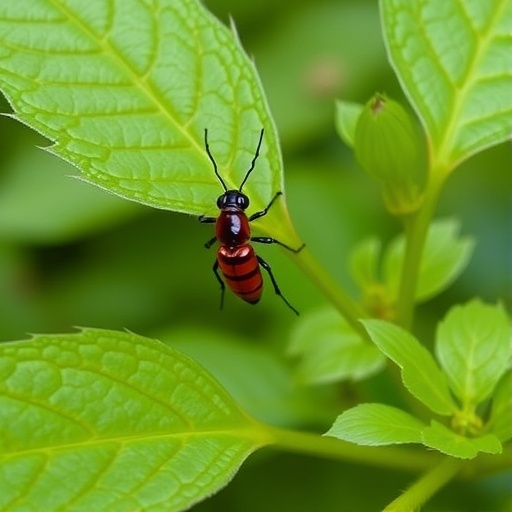
Plants may induce “leaky gut syndrome” — permeability of the gut lining — in insects as part of a multipronged strategy for protecting themselves from being eaten, according to researchers at Penn State. By improving our understanding of plant defenses, the findings could contribute to the development of new pest control methods.
“We found that a combination of physical and chemical defenses in corn plants can disrupt the protective gut barriers of fall armyworms, creating opportunities for gut microbes to invade their body cavities,” said Charles Mason, postdoctoral scholar in entomology. “This can cause septicemia, which can kill the insect, or simply trigger an immune response, which can weaken the insect.”
The researchers reared fall armyworms in the laboratory and inoculated them with one of three types of naturally occurring gut bacteria. They fed the insects on one of three types of maize — one that is known to express enzymes that produce perforations in insect gut linings; one that is characterized by numerous elongated trichomes, or fine hairs that occur on the surface of the plant and help defend against herbivores; and one that has just a few short trichomes. The team used scanning electron microscopy to evaluate the impacts of the various bacteria and maize types on the integrity of the fall armyworms’ gut linings.
The scientists found that the presence of all three types of gut bacteria decreased the ability of fall armyworm larvae to damage maize plants, especially when other defenses — such as elongated trichomes and enzymes, both of which can perforate gut linings — were present. However, the species of gut bacteria varied in the extent to which they weakened the insects. The results will appear in the July 22 issue of Proceedings of the National Academy of Sciences.
“Our results reveal a mechanism by which some plants use insects’ gut microbiota against them in collaboration with their own defenses,” said Mason.
Gary Felton, professor and head of the Department of Entomology, noted that the results should have broad significance towards understanding the ecological function of plant defenses.
“In the context of our study, disparate plant defenses, such as leaf trichomes and plant enzymes, all require certain gut microbes for their optimal defense against herbivores,” he said. “Our results predict that the variation in the effectiveness of plant defenses in nature may be, in significant part, due to the variability observed in the microbial communities of insect guts.”
The team said the results could help to inform the development of insect-resistant crops.
“It may be advantageous to ‘stack’ plant defenses that target the insect gut in order to create a ‘leaky gut’ that exposes the insect to microbial assaults on their immune system,” said Mason.
The U.S. Department of Agriculture and National Science Foundation supported this research.
Journal Reference:
Charles J. Mason, Swayamjit Ray, Ikkei Shikano, Michelle Peiffer, Asher G. Jones, Dawn S. Luthe, Kelli Hoover, Gary W. Felton. Plant defenses interact with insect enteric bacteria by initiating a leaky gut syndrome. Proceedings of the National Academy of Sciences, 2019; 201908748 DOI: 10.1073/pnas.1908748116
Tags: chemical defenses in plantscorn plant pest resistancecorn plants and insect interactionentomology research findingsfall armyworm gut permeabilitygut microbes and insect healthimproving pest management through plant biologyinsect immune response to plant defensesleaky gut syndrome in insectsmaize varieties and insect interactionsmaize varieties and insect resistancemicrobial invasion in insect gutspest control strategiespest control strategies using plant defensesphysical and chemical plant defensesphysical defenses against herbivoresPlant defense mechanismsplant defenses against insectsplant-induced septicemia in insectssepticemia in insectsunderstanding insect immune responses