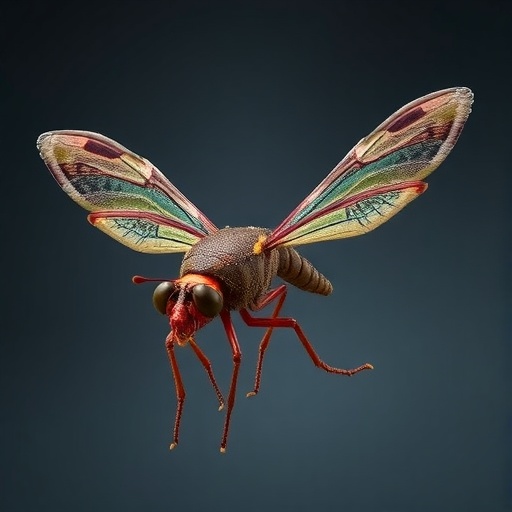

New research led by an international team of scientists has identified three new species of Bittacidae, an ancient family of insects known for their unique wing structures, which thrived during the Middle Jurassic period. These findings not only highlight the diversity of this insect group but also provide critical insights into how environmental conditions during that time may have influenced the evolution of morphological traits, particularly the formation of wing spots.
The Bittacidae family, commonly referred to as hangingflies, has garnered attention for their distinctive wing patterns and behaviors. These insects are characterized by elongated bodies and elongated legs, which allow them to perch elegantly on foliage. The latest research, published in Scientific Nature, delves into the evolutionary adaptations of these creatures, focusing on their intricate wing spot diversity. With the discovery of these three new species, scientists are gaining a clearer picture of the evolutionary pathways that led to the vast variety of wing patterns observed in today’s species.
The research team, consisting of experts in paleontology and entomology, undertook an exhaustive examination of fossilized specimens from China’s Middle Jurassic period. These fossils, remarkably preserved, provided crucial clues regarding the morphological diversity of the Bittacidae lineage. The fossil analysis indicates that the newly identified species retained some primitive features while simultaneously showcasing advancements that align with the environmental demands of their time.
.adsslot_egjO5aMDcv{width:728px !important;height:90px !important;}
@media(max-width:1199px){ .adsslot_egjO5aMDcv{width:468px !important;height:60px !important;}
}
@media(max-width:767px){ .adsslot_egjO5aMDcv{width:320px !important;height:50px !important;}
}
ADVERTISEMENT
One of the new species exhibits a remarkable array of wing spots, each distinct in shape and size. This variety may serve multiple purposes, such as camouflage from predators or attracting mates during the reproductive season. The intricate patterns that scientists observed could suggest that these insects, much like modern species, relied on visual signals to communicate and interact within their ecosystems.
Additionally, researchers have posited that these wing patterns may have played a significant role in thermoregulation. The dispersal of melanin pigments within the wings contributes not only to coloration but potentially influences how these insects managed their body temperature, particularly in the varying climates of the Middle Jurassic. Such insights suggest a complex interplay between morphological traits and environmental factors, emphasizing the adaptive strategies that have emerged over millions of years.
Furthermore, the study of these new species shines a light on the evolutionary mechanisms driving speciation within Bittacidae. As the environment changed during the Jurassic period, variations in wing structure likely provided advantages for survival and reproduction. The findings propose that certain traits became pronounced, allowing various species to exploit different ecological niches, thus expanding their range and prevalence throughout prehistoric ecosystems.
The fieldwork associated with this study involved meticulous excavations at key fossil sites known for yielding well-preserved specimens. The researchers utilized advanced imaging techniques to analyze the morphology of the fossils, comparing them with existing Bittacidae species to establish phylogenetic relationships. The robust methodology highlights the importance of collaborative efforts in paleontological research, where multidisciplinary approaches yield richer data and interpretations.
In this context, the study not only enhances our understanding of Bittacidae but also contributes to the broader narrative of insect evolution during the Jurassic. It underscores the dynamic nature of evolutionary change, illustrating how species adapt to their surroundings over time. This adaptability is crucial for understanding the resilience of life on Earth, especially in response to changing climates and ecological pressures.
The implications of this research extend beyond the Bittacidae family alone. It serves as a reminder of the importance of preserving our natural history, as fossils provide windows into past biodiversity and evolutionary processes. The loss of such specimens would mean losing invaluable insights into the evolutionary history of life on our planet.
Artists and scientists alike stand to benefit from these findings. The vivid descriptions of wing structures and their potential uses in the behavior of these ancient insects open up new avenues for exploration in both scientific and artistic domains. Just as the intricate details of these wing spots captured the attention of scientists, they may very well inspire works in art and design, bridging the gap between science and creativity.
As researchers continue to investigate the fossil records, developments such as this one reaffirm the significance of historical biodiversity as we confront contemporary environmental challenges. The lessons learned from the past can inform efforts to conserve modern species, guiding strategies aimed at protecting the planet’s remaining ecosystems.
In conclusion, the discovery of three new Bittacidae species offers a refined understanding of wing spot diversity and evolutionary adaptations during the Middle Jurassic. It emphasizes the richness of life forms that once roamed the Earth and invites ongoing investigation into the depths of our planet’s history. As scientists continue to unearth and analyze fossilized remains, we can hope to unlock more secrets of the past that shape our understanding of the natural world today.
With each new fossil discovery, we inch closer to piecing together the complex tapestry of life that has existed on Earth. The work of Yu, Wang, Zhang, and their colleagues represents a critical step toward appreciating the myriad ways in which ancient species navigated their environments, survived, and thrived, redefining what we know about insect evolution.
Subject of Research: Evolutionary adaptations and morphological diversity of Bittacidae in the Middle Jurassic.
Article Title: Correction: Three new species from the Middle Jurassic of China provide insights on wing spots diversity of Bittacidae (Insecta: Mecoptera).
Article References: Yu, J., Wang, J., Zhang, Y. et al. Correction: Three new species from the Middle Jurassic of China provide insights on wing spots diversity of Bittacidae (Insecta: Mecoptera). Sci Nat 112, 54 (2025). https://doi.org/10.1007/s00114-025-02004-z
Image Credits: AI Generated
DOI:
Keywords: Evolution, Bittacidae, Jurassic, morphology, entomology, paleoecology.
Tags: ancient insect family studiesBittacidae insect diversityenvironmental influence on insect evolutionevolutionary adaptations of insectsfossilized specimens analysisinsights into insect morphologyMiddle Jurassic period fossilsmorphological traits evolutionnew species of hangingfliespaleontology and entomology researchunique wing structures in Bittacidaewing spot patterns in insects