• HOME
  • NEWS
  • EXPLORE
    • CAREER
      • Companies
      • Jobs
    • EVENTS
    • iGEM
      • News
      • Team
    • PHOTOS
    • VIDEO
    • WIKI
  • BLOG
  • COMMUNITY
    • FACEBOOK
    • INSTAGRAM
    • TWITTER
Friday, August 7, 2026
BIOENGINEER.ORG
No Result
View All Result
  • Login
  • HOME
  • NEWS
  • EXPLORE
    • CAREER
      • Companies
      • Jobs
        • Lecturer
        • PhD Studentship
        • Postdoc
        • Research Assistant
    • EVENTS
    • iGEM
      • News
      • Team
    • PHOTOS
    • VIDEO
    • WIKI
  • BLOG
  • COMMUNITY
    • FACEBOOK
    • INSTAGRAM
    • TWITTER
  • HOME
  • NEWS
  • EXPLORE
    • CAREER
      • Companies
      • Jobs
        • Lecturer
        • PhD Studentship
        • Postdoc
        • Research Assistant
    • EVENTS
    • iGEM
      • News
      • Team
    • PHOTOS
    • VIDEO
    • WIKI
  • BLOG
  • COMMUNITY
    • FACEBOOK
    • INSTAGRAM
    • TWITTER
No Result
View All Result
Bioengineer.org
No Result
View All Result
Home NEWS Science News

Nanocages for gold particles: What is happening inside?

Bioengineer by Bioengineer
March 16, 2017
in Science News
Reading Time: 2 mins read
0
Share on FacebookShare on TwitterShare on LinkedinShare on RedditShare on Telegram
IMAGE

Credit: Tokyo Institute of Technology

In living organisms, free metal ions are stored and transported through proteins assembled into highly ordered structures such as protein cages via a reaction called biomineralization. This sophisticated biological strategy has attracted the attention of biotechnologists who speculate that natural ion-storage protein cages can be used to grow metal nanoparticles with desired properties.

Gold nanoparticles (AuNPs) are known for their excellent functions in catalysis, bioimaging, drug delivery, and therapy; therefore, the synthesis of AuPs with controlled sizes and shapes is very important for their application in nanomedicine. In protein scaffolds, AuNPs are formed by a sequential process involving Au deposition and agglomeration into small nanoclusters which act as nucleation centers for AuNP growth. However, the dynamic mechanism underlying the formation of Au nanoclusters in protein environments remains unclear.

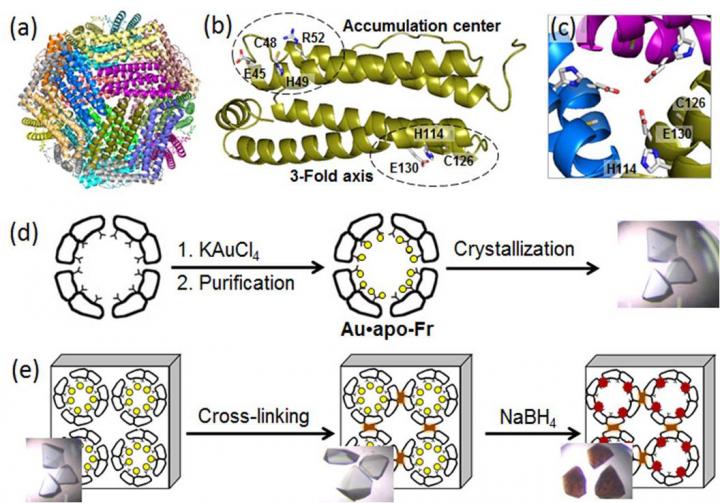
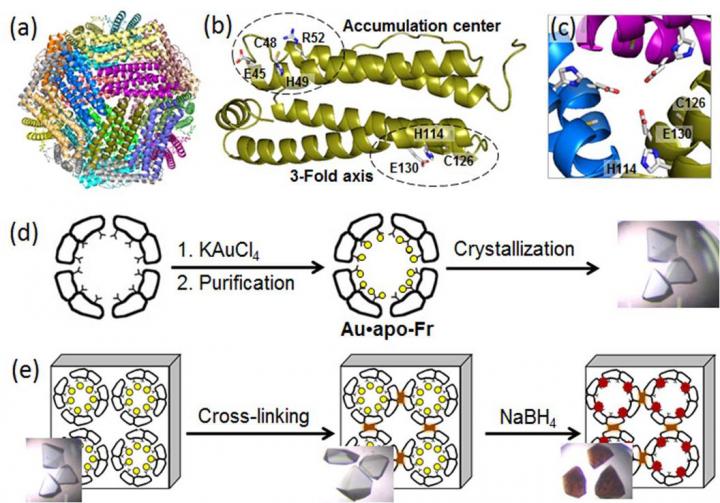
To disclose molecular processes behind AuNP growth in protein nanocages, a group of biomolecular engineers at Tokyo Institute of Technology, led by Takafumi Ueno, used high-resolution crystallography and analyzed the formation of Au nanoclusters in ferritin. A universal intracellular iron-storage protein produced by almost all living organisms, ferritin forms a self-assembled 24-subunit nanocage with two specific metal-binding sites: the 3-fold axis channel and the accumulation center (Figure). Since Au ions have high affinity for sulfur, the scientists modified the accumulation center by introducing an additional sulfur-containing cystein residue to enhance Au uptake into the protein cage. Then, they reinforced Au-containing ferritin crystals by cross-linking in glutaraldehyde (Figure) to maintain their lattice structure. These modifications enabled the reduction of Au ions in the crystals and determination of binding positions of Au ions inside the ferritin cage by high resolution crystallography.

In the next step, the immobilized Au ions were reduced into Au(0) atoms using a reducing agent (NaBH4). As a result, the scientists could observe that the reduced Au agglomerated into nanoclusters formed in the 3-fold symmetric channels and in the metal accumulation centers (Figure), which was due to the gradual Au movement and conformational changes of surrounding amino acids.

The results obtained by Professor Ueno and his colleagues uncover the mechanism behind the formation of Au nanoclusters which are expected as nucleation centers for subsequent AuNP growth in the unique protein environment, providing a platform for future investigation of biomineralization and nanoparticle synthesis in biomolecular scaffolds.

###

Media Contact

Emiko Kawaguchi
[email protected]
81-357-342-975

http://www.titech.ac.jp/english/index.html

############

Story Source: Materials provided by Scienmag

Share12Tweet8Share2ShareShareShare2

Related Posts

Coal Boilers Could Provide Practical Treatment for Organic Cleaning Wastewater

Coal Boilers Could Provide Practical Treatment for Organic Cleaning Wastewater

August 7, 2026
SDSS-V Maps the Galaxy With New All-Sky Spectra, Including Southern Hemisphere Firsts

SDSS-V Maps the Galaxy With New All-Sky Spectra, Including Southern Hemisphere Firsts

August 6, 2026

Piezo Ion Channels Identified as Therapeutic Targets in Digestive Diseases

August 6, 2026

Immune memory emerges as promising therapeutic target for diabetes and complications

August 6, 2026
Please login to join discussion

POPULAR NEWS

  • Coal Boilers Could Provide Practical Treatment for Organic Cleaning Wastewater

    29 shares
    Share 12 Tweet 7
  • SDSS-V Maps the Galaxy With New All-Sky Spectra, Including Southern Hemisphere Firsts

    29 shares
    Share 12 Tweet 7
  • Piezo Ion Channels Identified as Therapeutic Targets in Digestive Diseases

    29 shares
    Share 12 Tweet 7
  • Immune memory emerges as promising therapeutic target for diabetes and complications

    29 shares
    Share 12 Tweet 7

About

We bring you the latest biotechnology news from best research centers and universities around the world. Check our website.

Follow us

Recent News

Coal Boilers Could Provide Practical Treatment for Organic Cleaning Wastewater

SDSS-V Maps the Galaxy With New All-Sky Spectra, Including Southern Hemisphere Firsts

Piezo Ion Channels Identified as Therapeutic Targets in Digestive Diseases

Subscribe to Blog via Email

Enter your email address to subscribe to this blog and receive notifications of new posts by email.

Join 86 other subscribers
  • Contact Us

Bioengineer.org © Copyright 2023 All Rights Reserved.

Welcome Back!

Login to your account below

Forgotten Password?

Retrieve your password

Please enter your username or email address to reset your password.

Log In
No Result
View All Result
  • Homepages
    • Home Page 1
    • Home Page 2
  • News
  • National
  • Business
  • Health
  • Lifestyle
  • Science

Bioengineer.org © Copyright 2023 All Rights Reserved.