
Rice, the staple food for more than half the global population, has long demanded intensive agricultural inputs, especially water and synthetic fertilizers, to sustain its high yields. This reliance not only strains the environment but also raises pressing questions about the sustainability of rice cultivation amid growing concerns over climate change and global food security. Against this backdrop, an innovative study led by researchers at the Nara Institute of Science and Technology (NAIST) sheds new light on the natural alliances between rice roots and soil microbes. Their findings, published in Plant and Cell Physiology, offer promising avenues to reduce fertilizer dependence by harnessing the plant’s own microbial partners.
At the heart of this research lies the intricate relationship between rice roots and the microbial communities that colonize them. While it’s established that plants recruit symbiotic microbes to survive in nutrient-poor environments, the dynamics governing the assembly and function of these communities in field-grown paddy rice remain obscure. This study bridges that knowledge gap by comparatively analyzing root microbiomes from rice cultivated in fertilized versus unfertilized soils over multiple growing seasons.
The research team conducted their investigations on an experimental paddy field that has produced healthy rice crops for more than seven decades without external fertilizer or pesticide inputs. By juxtaposing microbial populations from this nutrient-poor field to those in a nearby conventionally fertilized field, they sought to decipher how rice roots assemble microbial consortia and what functional roles these bacteria might play under contrasting soil nutrient conditions.
.adsslot_MzuGTL4CyJ{width:728px !important;height:90px !important;}
@media(max-width:1199px){ .adsslot_MzuGTL4CyJ{width:468px !important;height:60px !important;}
}
@media(max-width:767px){ .adsslot_MzuGTL4CyJ{width:320px !important;height:50px !important;}
}
ADVERTISEMENT
Employing high-throughput 16S rRNA gene sequencing, the researchers systematically profiled microbial DNA extracted from rice roots belonging to three prominent Japanese cultivars—but not limited to a single genotype—collected at regular intervals over the course of multiple years. This longitudinal sampling allowed for an unprecedented resolution of microbiome dynamics as rice plants matured and progressed through developmental stages.
One of the pivotal discoveries was that microbial diversity in the rice root endosphere increased as the plants grew, demonstrating a dynamic and evolving microbial assembly rather than a static community. In unfertilized, high-yielding fields, root microbiomes were notably enriched with nitrogen-fixing bacteria, such as members of Rhizobium and related taxa, capable of converting atmospheric nitrogen into bioavailable forms. This microbial nitrogen fixation essentially compensates for the absence of synthetic fertilizer, enabling healthy plant growth in nutrient-limited soils.
Moreover, the study detailed a temporal shift in microbial community composition aligned with rice developmental stages. Anaerobic bacteria predominated during the early vegetative phase when paddy fields are submerged, creating low-oxygen conditions. As the plants transitioned to reproductive and maturation stages—accompanied by typical water drainage practices—the community shifted towards aerobic and microaerophilic bacteria. This succession likely reflects adaptation to fluctuating rhizosphere oxygen levels, underscoring the fine-tuned microbial dynamics driven by rice cultivation management.
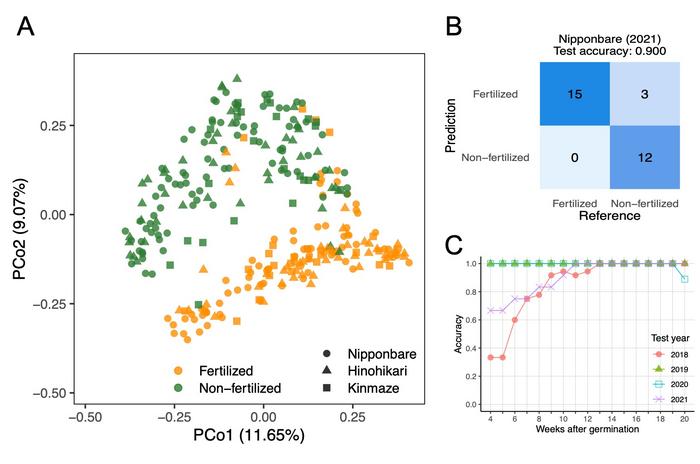
To differentiate the fertilization status of soil samples based on microbiome data, the researchers also developed a machine learning classification model utilizing the Random Forest algorithm. Intriguingly, the highest predictive accuracy was achieved using microbiome samples collected between 13 and 19 weeks post-germination. This window corresponds with a period of microbial community stability and consolidation, suggesting a critical “assembly phase” that could be targeted for microbial interventions in sustainable agriculture.
The implications of this research extend far beyond academic curiosity. By isolating and characterizing beneficial microbes, particularly nitrogen-fixers and other growth-promoting bacteria, there is potential to develop microbial inoculants tailored to rice cultivation under low-input or organic conditions. Customized microbial blends could supplement or replace chemical fertilizers, enhancing yield sustainability and mitigating environmental impacts such as greenhouse gas emissions and soil degradation.
Professor Yusuke Saijo, the study’s lead investigator, emphasizes this translational potential: “Our findings point toward a future where microbial consortia can be harnessed strategically to support rice growth, potentially revolutionizing sustainable agriculture by reducing reliance on synthetic inputs.” This vision aligns with global efforts to promote eco-friendly farming practices that safeguard ecosystem health while ensuring food security.
The robustness of the study is amplified by the collaboration of eminent researchers across multiple Japanese institutions, including the University of Tokyo, Tokyo Institute of Technology, Nagoya University, and Tohoku University. Together, they integrated expertise across plant biology, microbiology, ecology, and agricultural science to execute a comprehensive and multifaceted analysis of rice root microbiomes.
Beyond rice, these insights contribute to a broader understanding of plant-microbe interactions in agroecosystems, shedding light on ecological dynamics that can be leveraged in diverse cropping systems. Elucidating how plants recruit and modulate their microbial partners in response to environmental stresses and management regimes is pivotal for the evolution of precision agriculture and microbiome engineering.
This study, published on June 9, 2025, represents a significant step toward disentangling the complex biological networks within the rhizosphere of a globally critical crop. As the agricultural sector faces increasing pressure to feed a growing population sustainably, leveraging the inherent biological resources within crop microbiomes offers a compelling, science-driven strategy to meet these challenges.
Subject of Research:
Not applicable
Article Title:
Field Dynamics of the Root Endosphere Microbiome Assembly in Paddy Rice Cultivated under No Fertilizer Input
News Publication Date:
9-Jun-2025
References:
10.1093/pcp/pcaf045
Image Credits:
Assistant Professor John Jewish Dominguez from Nara Institute of Science and Technology, Japan
Keywords:
Applied sciences and engineering, Agriculture, Agricultural engineering, Food crops, Rice, Fertilizers, Crop production, Crops, Bacterial symbiosis, Symbiosis, Sustainable agriculture
Tags: agricultural sustainability practicesbeneficial soil microbesclimate change and agricultureenvironmental impact of agriculturefertilizer-free agriculturefood security and crop yieldsinnovative farming researchmicrobial partnerships in plantspaddy rice production methodsreducing fertilizer dependencerice root microbiomesustainable rice cultivation