The mystery of how human breast milk is synthesized within the mammary gland has long intrigued scientists, yet surprisingly, it remains vastly underexplored. Now, a groundbreaking study from ETH Zurich, led by Professor Marcy Zenobi-Wong’s team specializing in Tissue Engineering and Biofabrication, promises to reshape the way researchers understand lactation. By developing minuscule, three-dimensional replicas of lactating breast tissue, her group has opened a new window not only into the fundamental biology of milk production but also into the broader landscape of female health research.
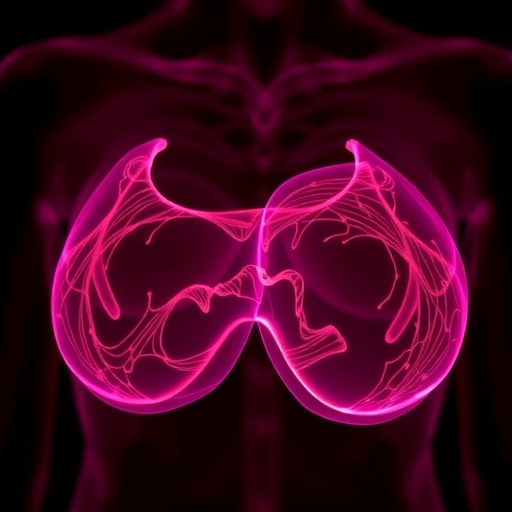
The cornerstone of this pioneering work is a revolutionary volumetric bioprinting technique that deploys a laser to sculpt delicate microarchitectures within a photosensitive liquid. Unlike traditional additive manufacturing methods that print layer by layer, this process involves directing laser beams from multiple angles into a liquid medium. Where these light doses accumulate, the liquid instantly solidifies, precisely forming tiny, physiologically relevant structures that mimic the milk ducts and alveoli—the very sites where milk is produced inside the breast. The bioink utilized in this method originates from bovine udder tissue, providing a framework enriched with biomolecules closely resembling those in human breast tissue, thus offering an authentic extracellular environment conducive to cell growth.
.adsslot_odl72eRVPg{ width:728px !important; height:90px !important; }
@media (max-width:1199px) { .adsslot_odl72eRVPg{ width:468px !important; height:60px !important; } }
@media (max-width:767px) { .adsslot_odl72eRVPg{ width:320px !important; height:50px !important; } }
ADVERTISEMENT
Despite these major breakthroughs, the researchers emphasize that their model does not yet produce complete human breast milk in its full biochemical complexity. Milk, a marvelously intricate biofluid, is composed of hundreds of constituents including a spectrum of complex sugars, numerous proteins, diverse lipids, a range of immune cells, and even living microorganisms. The current system has so far replicated only the initial components. However, this platform represents a critical tool for dissecting the multifaceted lactation process under controlled laboratory conditions for the first time. Such an in vitro model circumvents many ethical and technical barriers that previously impeded research in this domain, particularly since it relies on cells naturally present in human milk rather than invasive tissue sampling or animal models.
The implications of this innovative bioprinting platform extend far beyond milk production. Because lactation is a complex physiological process influenced by myriad factors including hormonal regulation, maternal health, and environmental exposures, the ability to culture and manipulate mammary epithelial cells in biomimetic scaffolds unlocks new vistas for scientific inquiry. For instance, the model offers a promising avenue to systematically evaluate how drugs, chemicals, or environmental toxins might affect lactation, potentially guiding safer medication use during breastfeeding. Moreover, it holds promise for studying pathological states such as mastitis or breast cancer by providing an experimental milieu that closely mimics native tissue architecture and cell function, thus enhancing relevance to human health.
Beyond its scientific and technological advances, this research profoundly addresses a critical gap in biomedical research related to female biology. Historically, many facets of women’s health, including lactation, have been marginalized or inadequately studied, partly due to ethical concerns and difficulties in accessing human tissues. This novel approach, leveraging non-invasive cell sources and sidestepping animal models, paves the way for ethically sound and accessible studies. The researchers envision that their work will not only elevate the visibility of lactation research but also catalyze broader investigations into neglected conditions such as endometriosis, fertility disorders, and other female reproductive health challenges.
Looking forward, the team aims to enhance the throughput and complexity of their tissue models, exploiting advanced 3D printing techniques to generate larger and more intricate lactation systems. Such progress could accelerate discoveries about human milk composition and lactation physiology, ultimately contributing to improved interventions for breastfeeding difficulties and maternal-infant health. Furthermore, the platform’s versatility may prove invaluable for personalized medicine approaches, enabling studies tailored to individual genetic or environmental contexts.
In essence, this landmark research ushers in a new era in lactation science, transforming how scientists can study, manipulate, and ultimately support this vital biological function. As Zenobi-Wong succinctly states, the model is a crucial step toward demystifying the origins of milk and, by extension, the myriad factors influencing women’s health. The potential ripple effects of this work extend far beyond the laboratory, promising hope to countless mothers and infants worldwide facing breastfeeding challenges.
In summary, the volumetric bioprinting of biomimetic breast tissue scaffolds seeded with human milk-derived mammary epithelial cells marks a transformative moment in both tissue engineering and female health research. By faithfully reconstructing the microenvironment necessary for milk production, this innovative platform invites a wealth of future exploration into fundamental biology, disease modeling, and therapeutic development. The study stands as a testament to the power of cutting-edge technology married with compassionate inquiry into some of the most intimate dimensions of human life.
Subject of Research: Cells
Article Title: Volumetric printed biomimetic scaffolds support in vitro lactation of human milk-derived mammary epithelial cells
News Publication Date: 4-Jun-2025
Web References: https://doi.org/10.1126/sciadv.adu5793
References: Zenobi-Wong M., Hasenauer A., et al. “Volumetric printed biomimetic scaffolds support in vitro lactation of human milk-derived mammary epithelial cells,” Science Advances, June 4, 2025.
Image Credits: ETH Zurich
Keywords: Lactation, Breast Tissue Engineering, Volumetric Bioprinting, Mammary Epithelial Cells, Biomimetic Scaffolds, Human Milk Production, In Vitro Lactation, Tissue Modeling, Female Health Research, Milk Composition, 3D Bioprinting Technology, Biofabrication
Tags: 3D bioprinted mammary glandsbovine udder tissue applicationsextracellular environment for cell growthfemale health research innovationslab-grown breast tissuelactation science breakthroughslaser-assisted bioprintingmicroarchitectures in tissue engineeringmilk production biologystudy on human breast milk synthesistissue engineering advancementsvolumetric bioprinting techniques