In the heart of an urban landscape as sprawling and complex as Chicago, an extraordinary tale of evolution unfolds quietly, locked within the museum drawers of the Field Museum. Here, scientists have discovered real-time evolutionary changes in two common city rodents, the eastern chipmunk and eastern meadow vole, through meticulous examination of skulls collected over a span exceeding a century. This groundbreaking research, recently published in the journal Integrative and Comparative Biology, reveals how urbanization is shaping wildlife in subtle but significant ways, shedding light on the intricate dynamics between animals and their rapidly changing environments.
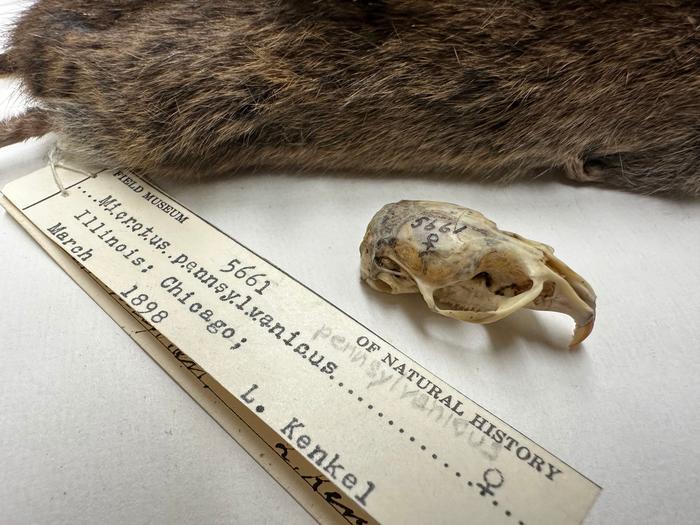
Evolution is traditionally viewed as a gradual and protracted process, marked by incremental changes across millennia. However, when organisms encounter sudden environmental upheavals, evolutionary pressures can accelerate adaptation, allowing species to survive and persist in drastically altered habitats. The Field Museum’s extensive natural history collection served as a remarkable time capsule, enabling researchers to peer across 125 years of ecological history and track morphological changes in two rodent species that thrive in the Chicago metropolitan area. This study leverages the rare opportunity to observe the tangible outcomes of urban-driven evolution.
The two species selected for this study, eastern chipmunks (Tamias striatus) and eastern meadow voles (Microtus pennsylvanicus), represent distinct ecological strategies. Chipmunks, members of the squirrel family, are primarily aboveground foragers that maintain a diverse diet, ranging from seeds and nuts to insects and small amphibians, enabling them to exploit a variety of food resources in city parks and green spaces. In contrast, voles share a closer kinship with hamsters and spend much of their lives within underground burrow systems, subsisting largely on plant matter. These ecological differences frame the context for understanding the distinct evolutionary paths encountered by each species amidst urban expansion.
.adsslot_ISGeopcdLw{ width:728px !important; height:90px !important; }
@media (max-width:1199px) { .adsslot_ISGeopcdLw{ width:468px !important; height:60px !important; } }
@media (max-width:767px) { .adsslot_ISGeopcdLw{ width:320px !important; height:50px !important; } }
ADVERTISEMENT
Central to the investigators’ approach was the morphological analysis of skulls, a method that provides critical insights into an animal’s sensory capabilities, diet, and overall biological adaptations. By measuring metrics such as skull length and dental row dimensions, the researchers could deduce changes directly linked to ecological pressures. Moreover, advanced techniques like geometric morphometrics, which digitally map three-dimensional cranial landmarks, allowed for an enhanced and precise quantification of shape changes, providing a more nuanced understanding of evolutionary shifts than traditional linear measurements alone.
The study’s comprehensive dataset included skull measurements from 132 chipmunks and 193 voles, with a subset subjected to high-resolution 3D scanning. This multifaceted analysis revealed that chipmunks’ skulls have increased in overall size over the past century, a change that may reflect adaptations to altered dietary conditions in the urban environment. Paradoxically, the length of their teeth rows decreased, a phenomenon researchers hypothesize is linked to a dietary shift away from hard, natural foods like nuts and seeds toward softer, human-associated food sources commonly found in cities.
In contrast, the voles exhibited a distinct cranial modification: the auditory bullae—bone structures enclosing the inner ear—demonstrated a marked reduction in size over the examined time period. This reduction is postulated to be a response to the cacophonous urban soundscapes of Chicago. Smaller auditory bullae might serve to buffer the rodents from chronic exposure to excessive noise, potentially protecting their hearing or enhancing their ability to differentiate biologically relevant sounds from background noise. This finding exemplifies how sensory organs can evolve rapidly in response to the unique challenges of urban habitats.
To disentangle the influences driving these cranial changes, the researchers correlated morphological data with environmental variables, including historical temperature records and urban sprawl metrics derived from satellite imagery dating back to 1940. The intensity and spread of urbanization emerged as the predominant factor associated with cranial adaptations, whereas climate variables failed to explain the morphological trends. This underscores the profound impact of anthropogenic habitat transformation on local fauna, signaling that urban pressures—rather than broader climatic factors—are steering evolutionary trajectories in these rodent populations.
The implications of these findings extend beyond academic interest, painting a vivid picture of how wildlife navigates the ecological labyrinth created by human activity. The enlargement of chipmunk body size juxtaposed with the reduction in dental size may indicate that while these rodents are thriving numerically, the quality and nature of their urban diet differ fundamentally from their wild counterparts. By foraging on anthropogenic foods, chipmunks might be gaining caloric benefits but potentially face nutritional or health trade-offs, a situation that complicates assumptions about urban ecology.
Similarly, the auditory adaptations displayed by voles highlight the less visible but equally critical sensory adjustments animals must undergo to survive in cities. Urban noise pollution does not merely interfere with human well-being; it also imposes selective pressures on animal communication, predator awareness, and environmental perception. Morphological responses such as reduced auditory bullae dimensions suggest a biological strategy to mitigate sensory overload or to fine-tune hearing capabilities under noisy conditions, a finding that opens novel avenues for urban bioacoustics research.
Moreover, the study highlights the indispensable role of natural history collections in illuminating evolutionary processes. By providing access to meticulously curated specimens collected over many decades, museums like the Field Museum act as biological archives, enabling scientists to conduct temporal comparisons that would be impossible to replicate otherwise. Such collections empower researchers to uncover evolutionary dynamics that unfold on timescales relevant to human observation, challenging the notion that evolution is only a phenomenon of deep time.
The collaboration among scientists and emerging scholars, including interns from the Field Museum Women in Science program, further exemplifies how inclusive scientific efforts can propel discovery. Their contributions to data collection and analysis demonstrate the value of integrating modern technology—such as 3D scanning—with traditional anatomical research methods, yielding comprehensive insights into how urban ecosystems serve as crucibles for evolutionary change.
Ultimately, this research serves as a compelling reminder that human activities reverberate through the biological fabric of our planet, often in ways that escape casual notice. The intricate adjustments observed in the skulls of chipmunks and voles reflect not only their survival strategies but also the broader narrative of life adapting amidst human dominance. Recognizing and understanding these patterns is vital for fostering coexistence and protecting the wild heritage that persists in even the most unexpected places—our cities.
Subject of Research: Evolutionary and morphological adaptations in urban-dwelling rodents (eastern chipmunks and eastern meadow voles) in response to urbanization
Article Title: Limited cranial shifts in city-dwelling rodents after a century of urbanization
News Publication Date: 26-Jun-2025
Image Credits: © Field Museum
Keywords: Evolutionary biology, Evolution, Evolutionary ecology, History of life, Life sciences, Ecology, Ecological adaptation, Organismal biology, Anatomy, Animal physiology, Animals, Wildlife, Vertebrates, Mammals, Rodents
Tags: adaptation to urban habitatsChicago rodent evolutioneastern chipmunk adaptationeastern meadow vole survivalecological history of Chicagoevolutionary pressures in citiesField Museum research findingsmorphological changes in rodentsreal-time evolutionary changesurban environments and wildlifeUrban wildlife adaptationurbanization impact on species