• HOME
  • NEWS
  • EXPLORE
    • CAREER
      • Companies
      • Jobs
    • EVENTS
    • iGEM
      • News
      • Team
    • PHOTOS
    • VIDEO
    • WIKI
  • BLOG
  • COMMUNITY
    • FACEBOOK
    • INSTAGRAM
    • TWITTER
Thursday, April 2, 2026
BIOENGINEER.ORG
No Result
View All Result
  • Login
  • HOME
  • NEWS
  • EXPLORE
    • CAREER
      • Companies
      • Jobs
        • Lecturer
        • PhD Studentship
        • Postdoc
        • Research Assistant
    • EVENTS
    • iGEM
      • News
      • Team
    • PHOTOS
    • VIDEO
    • WIKI
  • BLOG
  • COMMUNITY
    • FACEBOOK
    • INSTAGRAM
    • TWITTER
  • HOME
  • NEWS
  • EXPLORE
    • CAREER
      • Companies
      • Jobs
        • Lecturer
        • PhD Studentship
        • Postdoc
        • Research Assistant
    • EVENTS
    • iGEM
      • News
      • Team
    • PHOTOS
    • VIDEO
    • WIKI
  • BLOG
  • COMMUNITY
    • FACEBOOK
    • INSTAGRAM
    • TWITTER
No Result
View All Result
Bioengineer.org
No Result
View All Result
Home NEWS Science News

Diving with the sharks

Bioengineer by Bioengineer
March 13, 2017
in Science News
Reading Time: 2 mins read
0
Share on FacebookShare on TwitterShare on LinkedinShare on RedditShare on Telegram
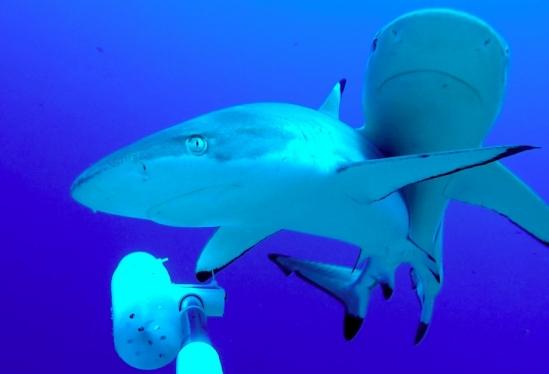
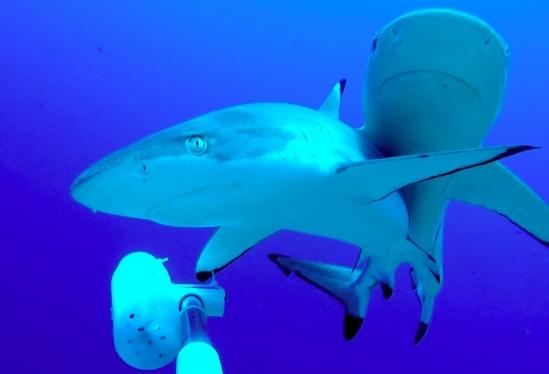
IMAGE

Credit: Darcy Bradley

Swimming with metaphorical sharks is one thing, but actually getting into the water with the razor-toothed ocean predators? Crazy, right? Not according to the masses of shark-obsessed scuba divers who travel great distances — and pay big money — to get face time with the giant fish.

A multimillion-dollar global industry is constructed around the promise of doing just that: cage diving with white sharks in South Africa and Guadeloupe Island; shark feeding in the Bahamas, Mexico or Fiji; diving with huge schools of hammerheads in Cocos Island and Galapagos.

That's great for thrill-seekers, but what about the sharks? As most scuba divers know — and previous studies have shown — sharks more commonly swim away from people than toward them. Does that avoidance behavior persist after the divers leave? Do sharks steer clear of sites that are frequented by divers?

Eager to understand how scuba diving activities over multiyear time scales influence shark behavior, scientists at UC Santa Barbara and Florida International University set out to find answers. They found human-shark interaction can take place without long-term effects on the sharks. Their research appears in the Marine Ecology Progress Series.

"Unfortunately, human impacts on shark populations are ubiquitous on our planet," said lead author Darcy Bradley, a postdoctoral researcher at UCSB's Bren School of Environmental Science & Management. "That makes it difficult to separate shark behavioral changes due to scuba diving from behavioral changes caused by other human activities like fishing."

The researchers went to Palmyra, a remote atoll in the central Pacific Ocean, where shark populations are healthy, fishing is not allowed and the majority of its near pristine underwater world is rarely dived. However, Palmyra is home to a small scientific research station, where researchers dive in a handful of locations. This made the atoll an ideal site for studying whether and how shark abundance and behavior differ between locations where diving is more common and those where it is not.

The team studied whether scuba diving activities have long-term consequences for shark populations. They used baited remote underwater video systems — cameras lowered to the ocean floor with a small amount of bait — to survey sharks and other predators from the surrounding reef.

"After reviewing 80 hours of underwater footage taken from video surveys conducted in 2015 — 14 years after Palmyra was established as a wildlife refuge and scientific diving activities began — we found that shark abundance and shark behavior were the same at sites with and without a long history of scuba diving," said co-author Jennifer Caselle, a research biologist at UCSB's Marine Science Institute.

"Our results suggest that humans can interact with reef sharks without long-term behavioral impacts," Bradley said. "That's good news. It means that well-regulated shark diving tourism doesn't necessarily undermine shark conservation goals."

###

Media Contact

Julie Cohen
[email protected]
805-893-7220
@ucsantabarbara

http://www.ucsb.edu

############

Story Source: Materials provided by Scienmag

Share12Tweet8Share2ShareShareShare2

Related Posts

Insights into CD4+ T-Cell Depletion and Pulmonary Infections in Critically Ill Immunocompromised Patients

Insights into CD4+ T-Cell Depletion and Pulmonary Infections in Critically Ill Immunocompromised Patients

April 2, 2026

Lentinus edodes-Derived β-Glucan Suppresses Human Cervical Cancer Progression via DMBT1 Pathway

April 2, 2026

Advanced Sensors Reduce Costs in Genetic Disorder Research

April 2, 2026

Stard7: An Emerging but Mysterious Factor in Colorectal Cancer

April 2, 2026
Please login to join discussion

POPULAR NEWS

  • blank

    Revolutionary AI Model Enhances Precision in Detecting Food Contamination

    96 shares
    Share 38 Tweet 24
  • Imagine a Social Media Feed That Challenges Your Views Instead of Reinforcing Them

    1007 shares
    Share 398 Tweet 249
  • Promising Outcomes from First Clinical Trials of Gene Regulation in Epilepsy

    51 shares
    Share 20 Tweet 13
  • Popular Anti-Aging Compound Linked to Damage in Corpus Callosum, Study Finds

    44 shares
    Share 18 Tweet 11

About

We bring you the latest biotechnology news from best research centers and universities around the world. Check our website.

Follow us

Recent News

Insights into CD4+ T-Cell Depletion and Pulmonary Infections in Critically Ill Immunocompromised Patients

Lentinus edodes-Derived β-Glucan Suppresses Human Cervical Cancer Progression via DMBT1 Pathway

Advanced Sensors Reduce Costs in Genetic Disorder Research

Subscribe to Blog via Email

Enter your email address to subscribe to this blog and receive notifications of new posts by email.

Join 78 other subscribers
  • Contact Us

Bioengineer.org © Copyright 2023 All Rights Reserved.

Welcome Back!

Login to your account below

Forgotten Password?

Retrieve your password

Please enter your username or email address to reset your password.

Log In
No Result
View All Result
  • Homepages
    • Home Page 1
    • Home Page 2
  • News
  • National
  • Business
  • Health
  • Lifestyle
  • Science

Bioengineer.org © Copyright 2023 All Rights Reserved.