• HOME
  • NEWS
  • EXPLORE
    • CAREER
      • Companies
      • Jobs
    • EVENTS
    • iGEM
      • News
      • Team
    • PHOTOS
    • VIDEO
    • WIKI
  • BLOG
  • COMMUNITY
    • FACEBOOK
    • INSTAGRAM
    • TWITTER
Saturday, February 7, 2026
BIOENGINEER.ORG
No Result
View All Result
  • Login
  • HOME
  • NEWS
  • EXPLORE
    • CAREER
      • Companies
      • Jobs
        • Lecturer
        • PhD Studentship
        • Postdoc
        • Research Assistant
    • EVENTS
    • iGEM
      • News
      • Team
    • PHOTOS
    • VIDEO
    • WIKI
  • BLOG
  • COMMUNITY
    • FACEBOOK
    • INSTAGRAM
    • TWITTER
  • HOME
  • NEWS
  • EXPLORE
    • CAREER
      • Companies
      • Jobs
        • Lecturer
        • PhD Studentship
        • Postdoc
        • Research Assistant
    • EVENTS
    • iGEM
      • News
      • Team
    • PHOTOS
    • VIDEO
    • WIKI
  • BLOG
  • COMMUNITY
    • FACEBOOK
    • INSTAGRAM
    • TWITTER
No Result
View All Result
Bioengineer.org
No Result
View All Result
Home NEWS Science News Neuroscience

Brain Molecule Regulating Human Emotion, Mood

Bioengineer by Bioengineer
November 27, 2013
in Neuroscience, Proteomics
Reading Time: 1 min read
1
Share on FacebookShare on TwitterShare on LinkedinShare on RedditShare on Telegram

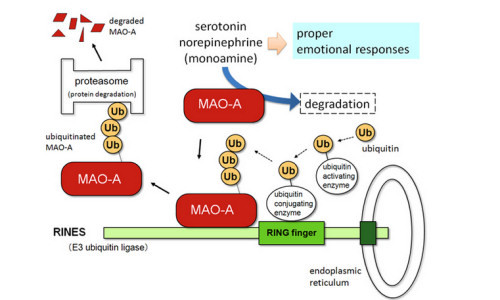
A RIKEN research team has discovered an enzyme called Rines that regulates MAO-A, a major brain protein controlling emotion and mood. The enzyme is a potentially promising drug target for treating diseases associated with emotions such as depression.
Brain Molecule Regulating Human Emotion, Mood

Monoamine oxidase A (MAO-A) is an enzyme that breaks down serotonin, norephinephrine and dopamine, neurotransmitters well-known for their influence on emotion and mood. Nicknamed the “warrior gene”, a variant of the MAOA gene has been associated with increased risk of violent and anti-social behaviour.

While evidence points to a link between MAO-A levels and various emotional patterns, however, the mechanism controlling MAO-A levels in the brain has remained unknown.

Now, a research team headed by Jun Aruga at the RIKEN Brain Science Institute has shown that a ligase named Rines (RING finger-type E3 ubiquitin ligase) regulates these levels. Their research shows that mice without the Rines gene exhibit impaired stress responses and enhanced anxiety, controlled in part through the regulation of MAO-A levels. The study has been published in Journal of Neuroscience.

As the first study to demonstrate regulation of MAO-A protein via the ubiquitin proteasomal system, this research presents a promising new avenue for analyzing the role of MAO-A in brain function. Further research promises insights into the treatment of anxiety, stress-related disorders and impaired social functions.

Story Source:

The above story is reprinted from materials provided by RIKEN Brain Science Institute.
Share13Tweet8Share2ShareShareShare2

Related Posts

Redox biomarker could predict progression of epilepsy

October 5, 2016

Neural membrane’s structural instability may trigger multiple sclerosis

October 5, 2016

Scientists find new path in brain to ease depression

October 5, 2016

Key players responsible for learning and memory formation uncovered

October 3, 2016
Please login to join discussion

POPULAR NEWS

  • Robotic Ureteral Reconstruction: A Novel Approach

    Robotic Ureteral Reconstruction: A Novel Approach

    82 shares
    Share 33 Tweet 21
  • Digital Privacy: Health Data Control in Incarceration

    63 shares
    Share 25 Tweet 16
  • Study Reveals Lipid Accumulation in ME/CFS Cells

    57 shares
    Share 23 Tweet 14
  • Breakthrough in RNA Research Accelerates Medical Innovations Timeline

    53 shares
    Share 21 Tweet 13

About

We bring you the latest biotechnology news from best research centers and universities around the world. Check our website.

Follow us

Recent News

Evaluating Pediatric Emergency Care Quality in Ethiopia

TPMT Expression Predictions Linked to Azathioprine Side Effects

Improving Dementia Care with Enhanced Activity Kits

Subscribe to Blog via Email

Success! An email was just sent to confirm your subscription. Please find the email now and click 'Confirm' to start subscribing.

Join 73 other subscribers
  • Contact Us

Bioengineer.org © Copyright 2023 All Rights Reserved.

Welcome Back!

Login to your account below

Forgotten Password?

Retrieve your password

Please enter your username or email address to reset your password.

Log In
No Result
View All Result
  • Homepages
    • Home Page 1
    • Home Page 2
  • News
  • National
  • Business
  • Health
  • Lifestyle
  • Science

Bioengineer.org © Copyright 2023 All Rights Reserved.