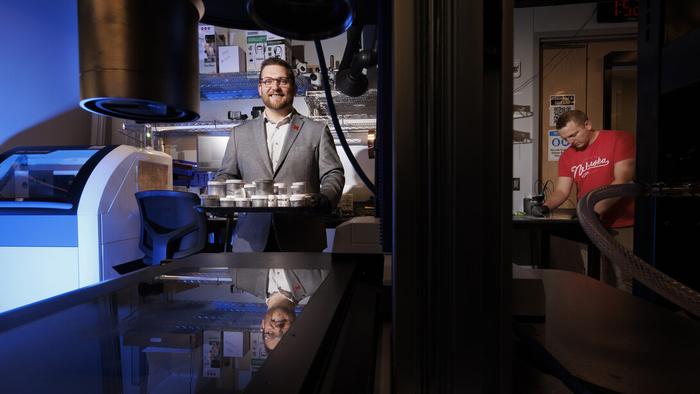
In a groundbreaking advancement that bridges biology and robotics, a team of engineers from the University of Nebraska–Lincoln has unveiled a novel intelligent artificial muscle capable of autonomously detecting damage and initiating its own repair. This innovation brings soft robotics a significant step closer to mimicking the remarkable self-healing abilities found in natural organisms, promising a transformation in wearable technologies and robotics applications.
The research, led by Eric Markvicka, Robert F. and Myrna L. Krohn Assistant Professor of Biomedical Engineering, alongside graduate students Ethan Krings and Patrick McManigal, was recently presented at the prestigious IEEE International Conference on Robotics and Automation held in Atlanta, Georgia. Their paper distinguished itself as one of 39 finalists from 1,606 submissions for the ICRA 2025 Best Paper Award. It was simultaneously recognized as a finalist in the Best Student Paper category and for excellence in mechanisms and design, underscoring the innovation’s impact within the robotics community.
Soft robotics, an emerging field striving to replicate biological systems’ compliance and adaptability, has made significant strides in fabricating stretchable electronic components and actuators that conform to complex environments. However, replicating biology’s innate ability to detect and recover from damage remains a formidable challenge. Traditional soft robotics components lack the autonomous self-repair capability intrinsic to living tissues, often requiring external intervention once damaged. The Nebraska team addresses this longstanding limitation by proposing a multi-layered muscle architecture that seamlessly combines damage sensing, localization, and autonomous self-healing into a single integrated system.
.adsslot_0nx2Yt973w{ width:728px !important; height:90px !important; }
@media (max-width:1199px) { .adsslot_0nx2Yt973w{ width:468px !important; height:60px !important; } }
@media (max-width:767px) { .adsslot_0nx2Yt973w{ width:320px !important; height:50px !important; } }
ADVERTISEMENT
At the heart of this technology lies a sophisticated design consisting of three distinct layers. The bottommost layer serves as the damage detection system, embodying a soft electronic skin embedded with liquid metal microdroplets dispersed within a silicone elastomer matrix. This configuration enables continuous electrical monitoring of structural integrity. When the artificial muscle experiences puncture or extreme pressure that disrupts this bottom layer, new electrical pathways form due to the interaction between fractured traces, effectively serving as an electrical signature of the damage site.
Upon detecting this unique electrical footprint, an onboard microcontroller activates the next phase of the healing process by increasing the electric current through the compromised area. This elevated current transforms the damaged zone into a localized Joule heater, generating sufficient heat to affect the middle layer of the muscle — a stiff thermoplastic elastomer responsible for the self-healing action. The thermal energy melts and reprocesses this thermoplastic, effectively sealing the puncture or tear in the muscle’s structure, restoring its integrity without external assistance.
The final stage focuses on resetting the damage detection network to its pristine state, enabling the system to endure multiple cycles of damage detection and repair autonomously. This is achieved through an innovative application of electromigration — a phenomenon traditionally perceived as detrimental in microelectronics due to its propensity to cause circuit degradation. Instead of viewing electromigration as a failure mode, Markvicka’s team ingeniously harnesses it to erase the electrically conductive damage-induced networks formed in the bottom skin layer. By deliberately increasing the current beyond typical operational levels, electromigration expels metal ions from damaged electrical traces, effectively “resetting” the system and preparing it for subsequent damage detection events.
This utilization of electromigration as a constructive mechanism represents a paradigm shift in the design philosophy of self-healing materials and electronics, transforming a known hindrance into a functional feature. It enables a fully autonomous self-healing cycle that does not require external repair inputs and can be repeated indefinitely, marking a milestone in bioinspired robotics technologies.
The potential applications are vast, especially in agricultural environments where robots encounter sharp, unpredictable objects like thorns, plastic fragments, or twigs that can cause frequent and varied damage. Autonomous self-healing actuators would drastically improve machine durability and reliability in these settings. Furthermore, the technology promises substantial advancements in wearable health monitoring devices, which must withstand the rigors of daily wear and tear while maintaining functional integrity over long periods.
Beyond practical utility, this self-healing capability carries profound environmental implications. The average consumer electronics product today has a lifespan of merely one to two years, after which it contributes to a mounting global electronic waste problem, laden with toxic substances such as lead and mercury. By enabling devices and components that autonomously repair themselves and thus extend operational lifespans, this invention offers a promising pathway to mitigating electronic waste, easing the burden on ecosystems and human communities alike.
Markvicka articulates this vision vividly: “If we can begin to create materials that are able to passably and autonomously detect when damage has happened, and then initiate these self-repair mechanisms, it would really be transformative.” His team’s work endeavors not only to refine electronic and robotic systems but to fundamentally evolve how machines interact with the environment — moving closer to the dynamic resilience of living organisms.
This research was made possible through funding from the National Science Foundation, NASA Nebraska Established Program to Stimulate Competitive Research, and the Nebraska Tobacco Settlement Biomedical Research Development Fund. These supporters underscore the vital role of sustained investment in high-risk, high-reward technological advancement.
The design philosophy of this intelligent artificial muscle encapsulates core engineering principles—integrating sensing, actuation, and repair within a composite system—while leveraging unconventional physical processes like electromigration in beneficial ways. The embodiment of such bioinspired multi-functionality within soft robotics is expected to catalyze further discoveries and applications that today exist only in conceptual blueprints.
As soft robotics continues to evolve, devices that heal themselves promise to revolutionize fields from medical prosthetics to environmental sensing and autonomous machinery. This work signifies a remarkable leap forward in achieving synthetic systems with lifelike autonomy and resilience, inspiring future research that may one day fully replicate the adaptive, regenerative prowess of living muscle tissue.
Subject of Research: Not applicable
Article Title: Intelligent Self-Healing Artificial Muscle: Mechanisms for Damage Detection and Autonomous Repair of Puncture Damage in Soft Robotics
Image Credits: University Communication and Marketing | University of Nebraska-Lincoln
Tags: autonomous damage detectionbiological systems mimicryEric Markvicka researchICRA 2025 Best Paper AwardIEEE International Conference on RoboticsNebraska engineering innovationself-healing artificial musclesself-repairing roboticssoft robotics advancementssoft robotics challengesstretchable electronic componentswearable technology transformation