
In the relentless quest to understand the subtle and complex nature of aircraft emissions, a pioneering investigation has unveiled an unprecedented diversity in the microscopic particles expelled by turbofan jet engines. Newly identified particle types with unique internal microstructures may hold profound implications for atmospheric science, climate modeling, and public health. This breakthrough in the characterization of ultrafine particles emitted from commercial aviation engines opens a new frontier, challenging conventional understanding and underscoring the nuanced complexity of aviation pollution.
For decades, soot—carbonaceous, non-volatile particles—has dominated scientific discussions surrounding aircraft exhaust. These soot particles, often exhibiting a turbostratic structure characterized by disordered graphene-like layers, have been well documented. However, the latest research conducted at a Zurich Airport test facility challenges this narrow view by revealing a spectrum of particle types far more diverse than previously recognized. High-resolution transmission electron microscopy (HRTEM) has enabled scientists to delve beneath the surface, uncovering four distinct categories of nanoparticles varying not only in size but more crucially in their internal architecture.
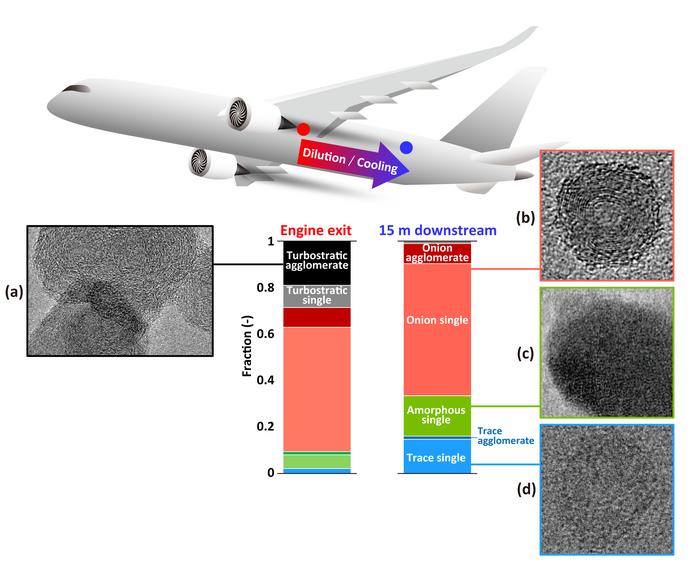
Among the four particle types identified, the turbostratic soot particles conform to conventional expectations, exhibiting diameters around 67 nanometers. They show layered and disordered graphene-like carbon sheets, typical indicators of soot formed by incomplete combustion. However, what sets the research apart is the discovery of three other particulate morphologies not previously attributed to aircraft exhaust. One of these is the “onion-like” particle, measuring approximately 17 nanometers, boasting well-ordered, spherical multilayered graphene structures reminiscent of concentric carbon shells. This structure is commonly synthesized in nanomaterials science but had not before been observed in the aviation emission context.
Complementing these are amorphous particles, measuring roughly 26 nanometers, lacking a crystalline framework and thus described as non-crystalline or disordered. These particles exhibit a more irregular internal composition, suggesting formation processes distinct from soot. Even smaller, trace amorphous particles measuring about 17 nanometers were also documented. Crucially, these latter three types tend to be single, non-agglomerated spheres rather than clusters, contrasting strikingly with the large, grape-like agglomerates typical of turbostratic soot.
A revealing aspect of the study lies in the spatial distribution of these particles relative to the engine exit. While turbostratic soot dominated in sheer number at the immediate engine exit, their relative abundance declines precipitously within a mere 15 meters downstream. At this juncture, the particle landscape is largely dominated by the onion-like and amorphous types. This shift strongly indicates dynamic chemical and physical transformations occurring almost instantaneously in the wake of the exhaust plume.
The research team proposes that the onion-like and amorphous particles belong predominantly to the volatile fraction of emissions, formed through nucleation and condensation processes rather than direct combustion. These volatile particles likely originate from the thermal and chemical breakdown of jet engine lubricating oils, subsequently aggregating into nanoscale spheres. Their diminutive size and volatile nature suggest they may behave quite differently in the atmosphere compared to traditional soot, affecting both atmospheric chemistry and human respiratory exposure in novel ways.
Exploring their physicochemical properties, the unique internal microstructures are hypothesized to influence particle volatility, surface reactivity, and solubility. The onion-like multilayered graphene shells, for example, may confer surprising chemical stability or distinct interaction potentials with biological tissues and atmospheric constituents. Conversely, the amorphous particles—without ordered carbon frameworks—may readily dissolve or react in pulmonary environments or cloud droplets, altering their environmental fates.
This discovery also propels fundamental questions about particle formation mechanisms in high-temperature combustion environments. Known synthetic methods for producing onion-like carbon nanoparticles, such as applying high-energy conditions to soot or carbon precursors, echo the possible energetic environments within jet engines. Yet the spontaneous formation of such highly ordered spheres in aircraft exhaust is unprecedented and demands comprehensive mechanistic studies. These investigations could unlock insights not only into atmospheric aerosol science but also into advanced nanomaterials synthesis inspired directly by combustion phenomena.
Beyond scientific intrigue, the findings bear significant ramifications for climate science and public health. Ultrafine particles from aircraft can influence atmospheric radiative forcing both directly and indirectly through contrail formation and cloud interactions. An expanded understanding of particle diversity and volatility is essential for improving predictive models of climate impact. Additionally, differential toxicity or deposition patterns within the human respiratory system between soot agglomerates and these newly identified nanoparticle morphologies remain unexplored terrain crucial for risk assessment among populations residing near airports or frequently exposed to aviation pollution.
Despite such advances, this research also lays bare many uncertainties. Questions linger regarding the exact chemical composition of onion-like and amorphous particles, their atmospheric longevity, and the extent to which these particles undergo further transformation or removal by environmental processes. The atmospheric dynamics of these nanostructures, their interactions with other pollutants, and biological membranes are fertile ground for multidisciplinary inquiry.
In conclusion, this meticulous study heralds a paradigm shift in the comprehension of aircraft particulate emissions. By employing sophisticated microscopy techniques and strategically positioned sampling downstream of engine exhausts, researchers have mapped a complex particle population previously unknown. The implications resonate across climate science, nanotechnology, toxicology, and atmospheric chemistry, compelling collaborative efforts to elucidate the life cycle, impacts, and mitigation strategies for these newly characterized ultrafine particles. Such understanding is vital as the world confronts intensifying aviation demands alongside stringent environmental and health standards.
Subject of Research: Not applicable
Article Title: Unique Microphysical Structures of Ultrafine Particles Emitted from Turbofan Jet Engines
News Publication Date: 8-Apr-2025
References:
Fushimi, A.; Saitoh, K.; Fujitani, Y.; Takegawa, N. Identification of jet lubrication oil as a major component of aircraft exhaust nanoparticles. Atmos. Chem. Phys. 2019, 19, 6389−6399.
Image Credits: NIES/ZHAW/TMU
Keywords
Aircraft exhaust particles, ultrafine nanoparticles, turbofan jet engines, turbostratic soot, onion-like carbon particles, amorphous particles, volatile particles, internal microstructure, nanoparticle formation, atmospheric aerosol, jet engine lubrication oil, high-resolution transmission electron microscopy (HRTEM).
Tags: aircraft emissionsatmospheric science and aviationclimate modeling implicationshigh-resolution transmission electron microscopyinternal microstructures of nanoparticlesnanoparticle diversity in aircraft exhaustpublic health risks from aviation pollutionsoot particles in aviationturbofan jet engine pollutionultrafine particles from aviationunconventional aircraft exhaust findingsZurich Airport particle research