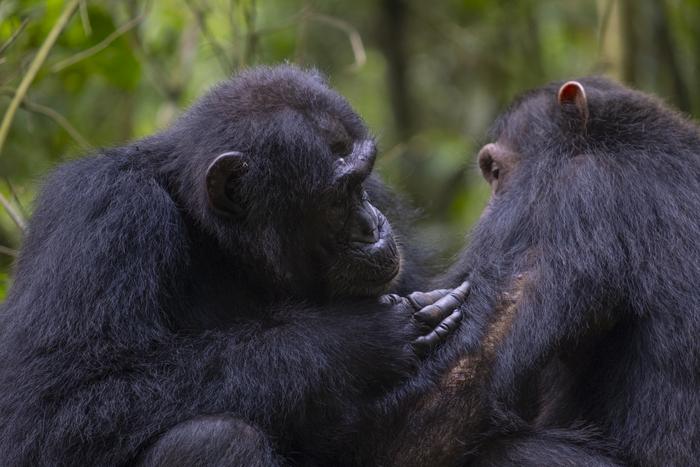
In the dense canopies of Uganda’s Budongo Forest, a remarkable revelation has emerged from the complex social lives of chimpanzees, shedding new light on the evolutionary origins of medicine and healthcare. Recent research led by Dr. Elodie Freymann from the University of Oxford presents compelling evidence that chimpanzees not only tend to their own injuries but extend medical care to their peers. These discoveries challenge previous assumptions regarding the limits of non-human animal care and suggest a far deeper-rooted foundation to the emergence of healthcare behaviors in our evolutionary past.
Chimpanzees, members of the great ape family sharing close genetic ties with humans, have long been observed using medicinal plants for self-treatment. However, Dr. Freymann’s study, published in Frontiers in Ecology and Evolution, meticulously documents instances of both self-directed care and prosocial medical intervention in two chimpanzee communities known as Sonso and Waibira within Budongo Forest. What stands out is the persistence and complexity of such behaviors which go beyond immediate familial bonds, signifying sophisticated social cognition and an inherent recognition of suffering within the community.
Not only do these chimpanzees display self-care by treating their own injuries, but crucially, they also engage in prosocial care—actions intended to aid others. This includes removing snares, assisting with wound treatment, and even hygiene activities such as cleaning genitals and anogenital areas with leaves following mating or defecation events. These behaviors likely lower infection risks, underscoring an evolved behavioral complexity that mirrors some facets of human medical care.
Quantitative data from the Budongo communities revealed 41 documented instances of healing behaviors, split between seven prosocial acts and 34 acts of self-care. Remarkably, the prosocial interventions were neither biased by kinship nor sex or age class, indicating a communal sense of welfare extending beyond genetically close individuals. The researchers suggest that social hierarchy stability, habituation levels of chimpanzee groups, and possibly ecological factors such as high injury risk from human snares influence the prevalence and visibility of these behaviors.
From an evolutionary biology perspective, these findings provide an unprecedented window into the precursors of human medicine. The chimpanzees’ selective use of medicinal plants and the deliberate multi-step wound care processes hint at cognitive capabilities involving problem-solving, memory, and social learning. These capacities would have been crucial in early hominin societies grappling with frequent injuries and the associated threats of infection and morbidity.
The researchers also noted that healing behaviors varied within and between communities, which may reflect cultural traditions or environmental constraints shaping healthcare strategies. Sonso chimpanzees exhibited more frequent prosocial medical actions, possibly linked to their longer habituation to human observers and higher social stability, making these behaviors easier to document. In contrast, the Waibira group’s lower visibility offers a reminder of methodological challenges in field primatology, especially when studying rare or subtle social behaviors.
One intriguing aspect of the study was the detailed description of wound-care techniques. Chimpanzees used leaf-dabbing to absorb pus or blood, finger licking combined with pressing of wounds to remove contaminants, and applications of plant compounds that could serve antiseptic and anti-inflammatory roles. The recorded recovery of injured chimpanzees supports the efficacy of these behaviors, although controlled pharmacological testing is pending to confirm the biochemical pathways involved.
Hygiene-related care further underscores the complexity of chimpanzee health management. The use of leaves to clean genitals after mating and anal areas after defecation reflects behavioral adaptations to reduce bacterial loads and subsequent infections. This nuanced attention to cleanliness is a foundational aspect of disease prevention, often overlooked in discussions of animal care but essential for understanding the trajectory of human healthcare evolution.
While the study’s findings are groundbreaking, Dr. Freymann and her colleagues highlight important limitations. Observation bias due to uneven habituation levels between communities and the rarity of prosocial care events impose constraints on interpreting the prevalence and drivers of healthcare behaviors. Moreover, the research calls for integrated pharmacological analyses to validate the specific medicinal properties of plants used, an essential step for bridging behavioral ecology with biochemical medicine.
Arguably, one of the most profound implications of this research lies in the social motivations underpinning chimpanzee care. The documented instances, including help given to unrelated individuals, suggest an empathetic recognition of distress and an evolved prosocial disposition. Such motivations could have been the evolutionary bedrock upon which human altruistic healthcare systems were constructed, reinforcing social cohesion and group survival.
Looking forward, this work opens exciting avenues for interdisciplinary study, merging primatology, ethnobotany, pharmacology, and evolutionary psychology. The urgent need for deeper investigation into social contexts, individual care roles, and ecological pressures promises richer understanding of how natural history shaped the emergence of medicine. It also offers valuable lessons for conservation efforts, emphasizing the importance of preserving not only species but the cultural and behavioral diversity within animal communities.
In unraveling the medical behaviors of Budongo’s chimpanzees, Dr. Freymann’s research eloquently bridges the chasm between human and nonhuman healthcare practices. It illuminates a shared evolutionary heritage where compassion, cognition, and the application of natural resources converge to address suffering. As humanity continues to confront health challenges, reflecting on these ancestral roots reminds us that caregiving is not solely a human invention but part of a broader biological continuum.
Subject of Research: Animals
Article Title: Self-Directed and Prosocial Wound Care, Snare Removal, and Hygiene Behaviors Amongst the Budongo Chimpanzees
News Publication Date: 14-May-2025
Web References: 10.3389/fevo.2025.1540922
Image Credits: Dr. Elodie Freymann
Tags: animal healthcare behaviorsBudongo Forest chimpanzeeschimpanzee community carechimpanzee social cognitionchimpanzees medicinal plantsevolutionary origins of medicinemedicinal leaves usagenatural healing techniques in animalsnon-human animal careprimatology research findingsprosocial behavior in animalsself-treatment in primates