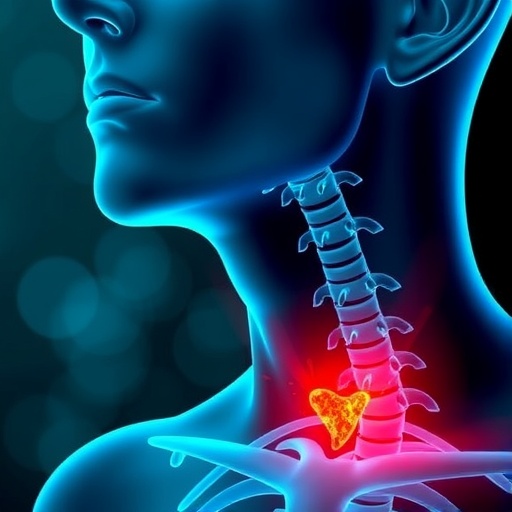

In a groundbreaking study poised to shift our understanding of thyroid cancer biology, researchers have unveiled the pivotal role of the amino acid transporter SLC1A5, also known as ASCT2, in fueling tumor progression and shaping the tumor microenvironment. This integrative research harnessed the power of transcriptomic and metabolomic analyses to decode the enigmatic functions of SLC1A5, revealing new therapeutic avenues for a disease that affects thousands worldwide annually.
Thyroid cancer (THCA), although often treatable, poses significant challenges in advanced stages, necessitating deeper insight into underlying molecular drivers. SLC1A5 has emerged as a critical glutamine transporter, extensively studied in various malignancies, where it catalyzes glutamine uptake essential for cancer cell metabolism and survival. However, its precise role in the thyroid cancer landscape remained unclear—until now.
The multidisciplinary team utilized publicly accessible datasets to chart SLC1A5 expression patterns in thyroid cancer patient samples. Their analyses uncovered a compelling association: elevated SLC1A5 levels correlated strongly with advanced tumor stages and poorer prognoses, positioning the transporter not merely as a passive participant but as a potential prognostic biomarker.
To probe the mechanistic underpinnings, the researchers employed thyroid cancer cell lines TPC-1 and B-CPAP. By deploying small interfering RNA (siRNA) to silence SLC1A5 expression, they observed a pronounced decrease in cell proliferation concomitant with heightened apoptotic activity. This functional knockdown strategy was corroborated by the application of GPNA, a pharmacological inhibitor targeting SLC1A5, which recapitulated these antitumor effects.
Diving deeper into the cellular response, transcriptome sequencing efforts unveiled a complex rewiring of intracellular signaling pathways following SLC1A5 suppression. Notably, the study highlighted an upregulation of NF-κB signaling—an axis traditionally linked to inflammatory and immune responses—alongside dampened oxidative phosphorylation, signaling a profound metabolic shift within the cancer cells.
Complementing transcriptomics, untargeted metabolomic profiling shed light on key metabolic disturbances. The SLC1A5-depleted cells exhibited significant dysregulation in glutathione and purine metabolism pathways, underscoring the transporter’s central role in maintaining redox balance and nucleic acid biosynthesis—both vital for tumor growth and survival.
Fascinatingly, the investigation extended to the tumor immune milieu using advanced computational algorithms like ESTIMATE and CIBERSORT. Data revealed a positive correlation between SLC1A5 expression and the infiltration of immune subsets, specifically CD4+ memory-activated T cells and follicular helper T cells, suggesting that SLC1A5 may influence not only cancer cell-intrinsic factors but also the dynamic interplay with immune components.
These discoveries collectively underscore SLC1A5 as a metabolic gatekeeper orchestrating tumor progression and immune regulation in thyroid cancer. By mediating glutamine uptake, SLC1A5 sustains critical anabolic processes and offers cancer cells a survival advantage, making it an attractive target for therapeutic intervention.
The translational implications are profound. Targeting SLC1A5 could impede cancer metabolism, impair tumor cell viability, and modulate the immunological environment, potentially enhancing responses to immunotherapy—an emerging frontier in cancer treatment. Crucially, this study elucidates the interconnectedness of metabolic pathways and immune signaling, reinforcing the need for integrative approaches in oncology drug development.
Beyond thyroid cancer, these insights could resonate across malignancies wherein SLC1A5 is upregulated, such as lung, breast, and colorectal cancers, expanding the horizon for metabolism-focused therapies. Considering the ubiquitous reliance of cancer cells on glutamine, SLC1A5 represents a metabolic vulnerability with wide-reaching clinical significance.
The study harnessed sophisticated bioinformatics analyses, from differential gene expression to immune cell deconvolution, providing a holistic understanding of the tumor ecosystem. Such methodological rigor exemplifies the cutting-edge in cancer research today, blending high-throughput omics and computational biology to unravel complex disease networks.
While the current investigations lay a solid foundation, future studies are warranted to delineate the precise molecular circuits downstream of SLC1A5 and explore the clinical efficacy of its inhibitors in vivo. Moreover, combining SLC1A5 targeting with existing therapies could yield synergistic effects, a tantalizing prospect for clinical trials.
In summary, this seminal work illuminates SLC1A5 as a multifaceted regulator in thyroid cancer, driving metabolic rewiring, influencing immune landscapes, and offering a beacon of hope for innovative treatments. As the fight against cancer continues, such integrative research charts the path toward personalized and precision medicine.
Subject of Research: The functional role of SLC1A5 in thyroid cancer development, metabolism, and tumor microenvironment interaction.
Article Title: Integrating transcriptomic and metabolomic analyses to characterize the potential function of SLC1A5 in thyroid cancer
Article References:
Shan, F., Wang, L., Lu, X. et al. Integrating transcriptomic and metabolomic analyses to characterize the potential function of SLC1A5 in thyroid cancer. BMC Cancer 25, 817 (2025). https://doi.org/10.1186/s12885-025-14123-x
Image Credits: Scienmag.com
DOI: https://doi.org/10.1186/s12885-025-14123-x
Tags: advanced thyroid cancer challengesamino acid transporter in tumorscancer cell metabolism and SLC1A5glutamine transporter SLC1A5metabolomic studies in thyroid cancermolecular drivers of thyroid cancermultidisciplinary research in cancer biologySLC1A5 role in thyroid cancertherapeutic targets for thyroid cancerthyroid cancer prognosis biomarkerstranscriptomic analysis in cancer researchtumor microenvironment and SLC1A5