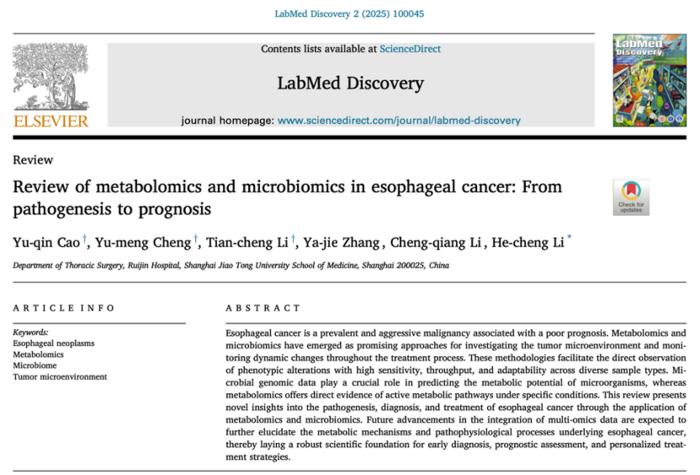
In the relentless pursuit of understanding cancer’s complex biology, a comprehensive review recently published in LabMed Discovery sheds unprecedented light on the intersection of metabolomics and microbiomics in esophageal cancer. This review meticulously integrates state-of-the-art research to decode the multifaceted metabolic disruptions and microbial ecosystem alterations that orchestrate tumor development, progression, and therapeutic resistance in esophageal malignancies. As esophageal cancer remains one of the deadliest cancers worldwide, elucidating these biological landscapes is crucial for pioneering innovative diagnostic and treatment strategies that can drastically improve patient outcomes.
Esophageal cancer pathogenesis is marked by profound metabolic reprogramming within tumor cells and their microenvironment. The review discusses how tumor tissues manifest a striking decline in fatty acid levels, diverging from the metabolic profiles typical in healthy esophageal epithelium. This depletion is counterbalanced by elevated concentrations of lysophosphatidylcholine, a phospholipid derivative that is increasingly recognized for its role in tumorigenesis and cancer cell proliferation. Moreover, an anomalous surge in citric acid—central to the tricarboxylic acid (TCA) cycle—highlights a complex shift in glucose and lipid metabolism pathways, revealing cancer cells’ adaptation mechanisms to fuel their unchecked growth.
Beyond metabolic alterations, the microbiome emerges as a pivotal player orchestrating esophageal cancer’s clinical trajectory. The review emphasizes dysbiosis, or microbial imbalance, both in the gastrointestinal tract and the oral cavity, identifying Fusobacterium nucleatum as a pathogenic keystone. This bacterium’s enrichment correlates with enhanced tumor progression and a predictable resistance to conventional chemotherapy regimens. By intricately intertwining with tumor biology, Fusobacterium nucleatum influences immune evasion and inflammatory pathways, thereby conditioning the tumor microenvironment to favor malignancy and diminish therapeutic efficacy.
The confluence of metabolomics and microbiomics offers remarkable promise in unveiling novel biomarkers that transcend the limitations of current diagnostic tools. Distinct metabolite signatures and microbial profiles delineated in the review stand as robust candidates for early detection and prognostic stratification of esophageal cancer patients. The ability to identify these biomarkers non-invasively can revolutionize screening programs, enabling interventions at stages when tumors are most amenable to treatment and thereby reducing mortality rates.
A major highlight of the review is the advent of multi-omics integration, which synergistically combines metabolomic and microbiomic data to construct a holistic portrait of the esophageal tumor microenvironment. This multi-dimensional approach pioneers comprehensive biomolecular mapping, unraveling the intricate crosstalk between cancer cells and their microbial counterparts. Such integration elevates our understanding far beyond single-parameter analyses, exposing nuanced biological networks that are critical for tumor sustenance and evolution.
The review further spotlights cutting-edge technological innovations that amplify the resolution and depth of tumor metabolic imaging. Artificial intelligence-driven metabolomic imaging facilitates intricate spatial delineation of metabolite distributions within tumor tissues, allowing researchers to pinpoint metabolic hotspots with unprecedented precision. Complementing this, spatially resolved mass spectrometry empowers the identification and quantification of metabolites and microbial constituents in situ, preserving tissue architecture and cellular context—a leap forward in cancer biomarker research.
In addition to diagnostic implications, the aforementioned technological strides hold significant therapeutic potential. Understanding the metabolic dependencies and microbial interactions governing esophageal cancer presents novel avenues for targeted intervention. Modulation of the tumor-associated microbiome to disrupt Fusobacterium nucleatum colonization, in tandem with strategies aimed at normalizing aberrant metabolic pathways, could synergistically enhance chemotherapy responses and mitigate resistance.
The clinical translation of these discoveries, however, mandates robust validation in large-scale cohorts alongside longitudinal studies. The review advocates for integrating metabolomics and microbiomics into clinical workflows through standardized protocols and reproducible analytical platforms. By doing so, the vision of personalized medicine—where treatment decisions are guided by comprehensive biomolecular profiles—comes closer to reality, potentially transforming esophageal cancer from a grim diagnosis to a manageable condition.
Moreover, this body of work underscores the increasingly pivotal role of computational biology and bioinformatics in cancer research. The voluminous and complex datasets generated by multi-omics studies necessitate sophisticated algorithms and machine learning models capable of extracting biologically meaningful patterns. These computational tools not only enhance biomarker discovery but also predict patient outcomes, treatment responses, and tumor evolution dynamics with greater accuracy.
The interdependence of metabolic reprogramming and microbial dysbiosis in esophageal cancer, as elaborated in the review, also resonates with growing evidence across other cancer types. This paradigm shift moves the field toward conceptualizing cancer as an ecosystem, wherein cancer cells coexist and co-evolve with a diverse milieu of microbial inhabitants and metabolic landscapes. Such an ecosystem perspective fosters innovative thinking in targeting cancer—not only eradicating malignant cells but also reshaping their supportive environments.
Furthermore, the review’s insights bear significant implications for preventive oncology. Identifying microbial and metabolic risk factors could inform lifestyle and dietary modifications that mitigate esophageal cancer risk. For instance, manipulating oral and gut microbiota through prebiotics, probiotics, or targeted antimicrobials may emerge as feasible preventive strategies, coupling microbiome science with public health initiatives.
In sum, the synthesis presented in LabMed Discovery heralds a new frontier in esophageal cancer research, where the confluence of metabolomics and microbiomics, powered by advanced analytical technologies and computational prowess, unravels the complex tapestry of tumor biology. This integration not only deepens scientific comprehension but also accelerates the translation of foundational discoveries into clinical realities—promising enhanced diagnostic accuracy, prognostication, and personalized therapies for one of the world’s most challenging malignancies.
Subject of Research: Esophageal cancer metabolomic and microbiomic alterations
Article Title: Review of Metabolomics and Microbiomics in Esophageal Cancer: From Pathogenesis to Prognosis
News Publication Date: 27-Feb-2025
Web References:
http://dx.doi.org/10.1016/j.lmd.2025.100045
Image Credits:
Yu-qin Cao, Yu-meng Cheng, Tian-cheng Li, Ya-jie Zhang, Cheng-qiang Li, He-cheng Li.
Keywords:
Health and medicine
Tags: citric acid and cancer metabolismdysbiosis in esophageal canceresophageal cancer pathogenesisinnovative diagnostic strategies for cancerlysophosphatidylcholine in tumorigenesismetabolic reprogramming in tumorsmetabolomics in cancer researchmicrobial ecosystem and cancermicrobiomics and cancerpatient outcomes in cancer treatmentstate-of-the-art cancer research techniquestherapeutic resistance in esophageal cancer