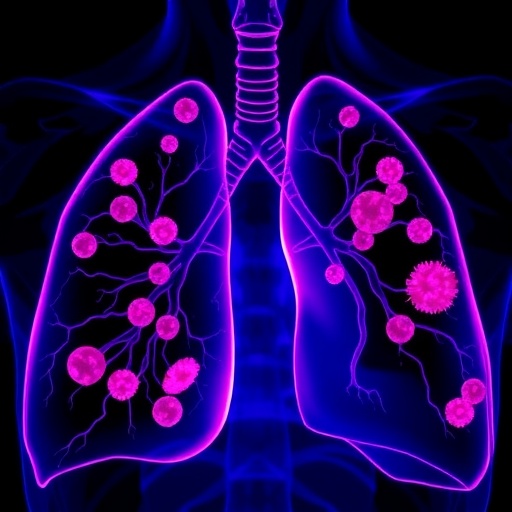

In the evolving landscape of cancer treatment, immunotherapy has emerged as a revolutionary approach, particularly for patients with advanced non-small cell lung cancer (aNSCLC). Despite significant progress, predicting which patients will benefit adequately from immune checkpoint inhibitors (ICIs) remains a critical challenge for oncologists worldwide. A recent groundbreaking study published in BMC Cancer sheds new light on this issue by identifying soluble CD14 (sCD14), a plasma biomarker, as a potent prognostic indicator for aNSCLC patients undergoing immunotherapy.
The research, conducted at the Cancer Hospital of the Chinese Academy of Medical Sciences (CHCAMS), delved into the complex milieu of cytokines—small proteins crucial for cell signaling and immune responses—to pinpoint factors associated with clinical benefit. Using an innovative flow fluorescence technique, the investigators analyzed an extensive panel of 41 cytokines in a discovery cohort comprising 42 aNSCLC patients treated with ICIs. Their goal was to discern molecular differences between those who experienced durable clinical benefit (DCB) and those who did not (NDB).
Remarkably, seven cytokines emerged as differentially expressed between these two cohorts, with CD14, CCL27, IL-17A, and TNFR1 being significantly elevated in patients who achieved durable responses. Conversely, EGF, CHI3L1, and CCL5 were found increased in patients with no durable benefit. Among these, the soluble form of CD14 stood out due to its impressive predictive performance, boasting an area under the curve (AUC) of 0.84—a robust metric indicating high accuracy in forecasting clinical outcomes.
Further in-depth analyses showed that sCD14 is intrinsically linked to pivotal immune pathways that orchestrate the body’s defense against tumors. Functional enrichment studies revealed connections to the inflammatory response and the MAPK signaling pathway, underscoring the protein’s multifaceted role in modulating immune activity and potentially enhancing the effectiveness of immunotherapy. This insight is especially critical given that immune evasion mechanisms remain a major hurdle in cancer treatment.
The prognostic value of sCD14 was not merely a statistical artifact confined to the discovery group. Validation cohorts—including 109 patients with plasma protein measurements, 22 patients assessed via multiplex immunofluorescence (mIF), and an expansive cohort of 403 NSCLC patients analyzed through messenger RNA datasets—consistently confirmed that elevated sCD14 correlates with prolonged progression-free survival (PFS). This consistent trend across diverse methodologies and independent datasets, such as GSE126044 and GSE135222, strongly supports the robustness and reproducibility of sCD14 as a biomarker.
Interestingly, the study also revealed that CD14 expression is elevated not only within tumor environments but also in various normal tissues, particularly lung adenocarcinoma and lung squamous cell carcinoma. This pattern hints at sCD14’s potential involvement in immune surveillance, signifying a broader, systemic role in maintaining immune vigilance beyond tumor confines. Such a finding opens doors to novel therapeutic strategies that might harness or enhance this natural defense mechanism.
From a mechanistic perspective, CD14 functions as a co-receptor for toll-like receptors (TLRs), particularly TLR4, which are critical for recognizing pathogen-associated molecular patterns and triggering immune responses. In the context of cancer, this TLR-CD14 axis may activate inflammatory pathways that promote antitumor immunity, facilitating immune cell infiltration and activity within the tumor microenvironment—essential factors for effective immunotherapy.
Beyond its biological role, the clinical implications of measuring plasma sCD14 are profound. A minimally invasive blood test capable of reliably predicting patient response to ICIs could revolutionize treatment paradigms, sparing non-responders from unnecessary side effects and healthcare costs while enabling a more personalized and adaptive therapeutic strategy. This aligns with the broader movement toward precision oncology, where biomarkers guide tailored interventions.
Despite these promising results, questions remain regarding the precise molecular cascades downstream of sCD14 that modulate immune dynamics in lung cancer. Furthermore, the interplay between sCD14 levels and other known prognostic factors, such as programmed death-ligand 1 (PD-L1) expression and tumor mutational burden, warrants comprehensive exploration. Future studies integrating these variables could refine predictive models and optimize patient stratification.
It is also worth noting that the study leveraged cutting-edge multiplex immunofluorescence, a powerful imaging technique that enables spatial mapping of multiple immune markers simultaneously within tissue samples. This allowed the researchers to not only quantify CD14 levels but also contextualize its expression within the intricate tumor-immune interface—an approach that provides richer insight than conventional methods.
Moreover, the robust association between elevated sCD14 and improved PFS challenges some conventional assumptions, as soluble immune mediators are often regarded solely as markers of inflammation or tumor burden. Here, sCD14 appears to signal an active, effective immune response, highlighting the nuanced role cytokines play in cancer immunity—a dualistic nature that continues to intrigue immunologists.
Taken together, the data position sCD14 as a compelling biomarker capable of bridging the gap between basic immunology research and clinical application. Its strong prognostic value, ease of measurement, and correlation with critical immune pathways make it a prime candidate for incorporation into future clinical trials and routine monitoring of aNSCLC patients undergoing immunotherapy.
This study represents a milestone in understanding the immune landscape of lung cancer and opens avenues for enhancing patient outcomes through biomarker-informed approaches. As immunotherapies continue to reshape oncology, integrating biomarkers like sCD14 could ensure that patients receive the most effective treatment regimens tailored to their unique immune profiles.
While further validation in larger, multiethnic cohorts and real-world settings will be necessary to cement sCD14’s clinical utility, the current findings provide a strong foundation for such efforts. Concurrently, mechanistic studies dissecting how sCD14 modulates the tumor microenvironment could identify novel therapeutic targets that synergize with checkpoint blockade.
In conclusion, the identification of pretreatment plasma sCD14 as a robust prognostic indicator heralds a new era of biomarker-driven immunotherapy in advanced non-small cell lung cancer. Its association with improved progression-free survival not only enhances our understanding of immune-tumor interactions but also paves the way for more personalized, effective cancer care paradigms centered on immune biomarkers.
The promise of sCD14 extends beyond prognostication, potentially informing combination therapies that amplify immune responses or mitigate immunotherapy resistance mechanisms. As researchers and clinicians continue to unravel the complexities of tumor immunity, discoveries like this offer hope for transforming lung cancer outcomes in the era of precision medicine.
Subject of Research: Prognostic biomarkers in advanced non-small cell lung cancer patients undergoing immunotherapy
Article Title: Pretreatment plasma sCD14 as a prognostic indicator in advanced non-small cell lung cancer patients undergoing immunotherapy
Article References:
Dai, L., Huang, L., Li, L. et al. Pretreatment plasma sCD14 as a prognostic indicator in advanced non-small cell lung cancer patients undergoing immunotherapy. BMC Cancer 25, 763 (2025). https://doi.org/10.1186/s12885-025-14148-2
Image Credits: Scienmag.com
DOI: https://doi.org/10.1186/s12885-025-14148-2
Keywords: sCD14, non-small cell lung cancer, immunotherapy, prognostic biomarker, cytokines, immune checkpoint inhibitors, progression-free survival, tumor microenvironment
Tags: advanced non-small cell lung cancercancer treatment biomarkersclinical research in oncologycytokine profiling in lung cancercytokines and immune responsedurable clinical benefit in immunotherapyflow fluorescence technique in researchimmune checkpoint inhibitorslung cancer immunotherapypredicting cancer treatment outcomesprognostic indicators in cancersoluble CD14 biomarker