• HOME
  • NEWS
  • EXPLORE
    • CAREER
      • Companies
      • Jobs
    • EVENTS
    • iGEM
      • News
      • Team
    • PHOTOS
    • VIDEO
    • WIKI
  • BLOG
  • COMMUNITY
    • FACEBOOK
    • INSTAGRAM
    • TWITTER
Thursday, June 25, 2026
BIOENGINEER.ORG
No Result
View All Result
  • Login
  • HOME
  • NEWS
  • EXPLORE
    • CAREER
      • Companies
      • Jobs
        • Lecturer
        • PhD Studentship
        • Postdoc
        • Research Assistant
    • EVENTS
    • iGEM
      • News
      • Team
    • PHOTOS
    • VIDEO
    • WIKI
  • BLOG
  • COMMUNITY
    • FACEBOOK
    • INSTAGRAM
    • TWITTER
  • HOME
  • NEWS
  • EXPLORE
    • CAREER
      • Companies
      • Jobs
        • Lecturer
        • PhD Studentship
        • Postdoc
        • Research Assistant
    • EVENTS
    • iGEM
      • News
      • Team
    • PHOTOS
    • VIDEO
    • WIKI
  • BLOG
  • COMMUNITY
    • FACEBOOK
    • INSTAGRAM
    • TWITTER
No Result
View All Result
Bioengineer.org
No Result
View All Result
Home NEWS Science News

The Darknet protects itself by being more robust against attacks

Bioengineer by Bioengineer
March 6, 2017
in Science News
Reading Time: 2 mins read
0
Share on FacebookShare on TwitterShare on LinkedinShare on RedditShare on Telegram
IMAGE

Credit: ©URV

The Darknet is a part of the internet that people can access and use anonymously. This privacy and the ability to work away from prying eyes means that the network is frequently used for anonymous exchanges of sensitive information and for illegal activities such as drug trafficking, sharing child pornography or exchanging protected intellectual property free of charge.

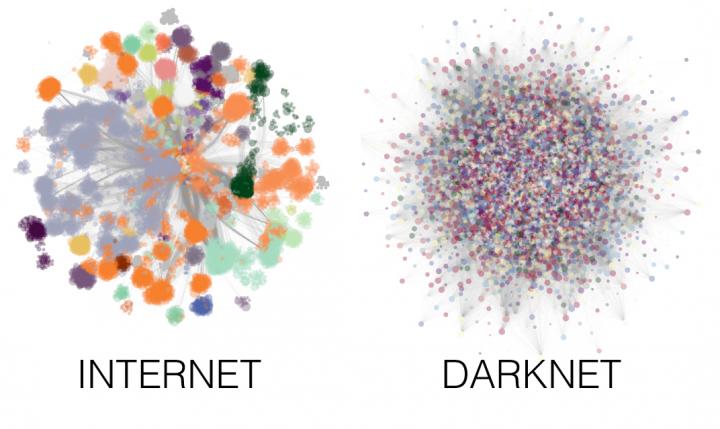
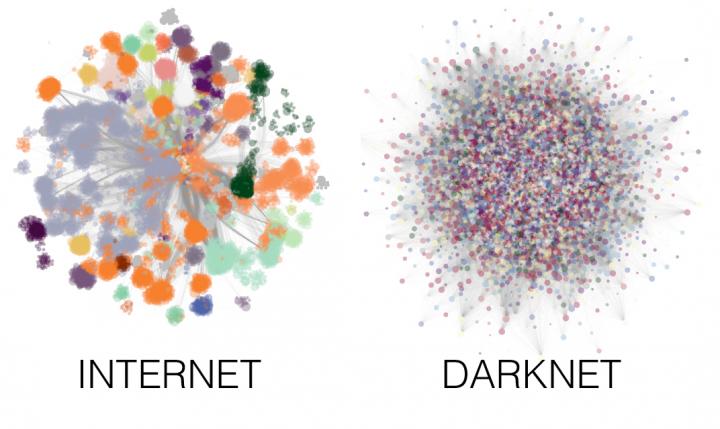
Cyberattacks are frequently launched against this network but usually with little success. Now, the researchers Manlio De Domenico and Alex Arenas from the URV's Department of Computer Engineering and Mathematics have manged to determine why the Darknet is so difficult to attack. In an article published in Physical Review E, the Darknet is practically impenetrable because of its unique topology, which is significantly different from the rest of the internet.

To demonstrate this, the researchers have used data published by the Internet Research Lab of the University of California (Los Angeles) and network analysis to quantify the resilience of the Darknet. They have described its topology and have developed a model that shows how information is transmitted using the "onion router", a technique that encrypts messages in multiple layers.

This has allowed them to simulate how the Darknet would respond to three types of attack: attacks on a specific node, attacks that cause certain nodes to fail randomly, and attacks that unleash a wave of errors that are propagated across the network.

The study's results show that to cause significant disruption an attack on the Darknet's various nodes needs to be four times stronger than an attack against the internet's nodes. Furthermore, the Darknet is able to easily counter the waves of attacks through its different nodes by simply adding more network capacity. The authors attribute this resilience to a more decentralised topology that emerges spontaneously from the Darknet's onion router protocol. In comparison, the internet's structure is much more heterogeneous.

###

Manlio De Domenico and Alex Arenas. "Modeling Structure and Resilience of the Dark Network". Physical Review, 2017. E. DOI: 10.1103/PhysRevE.95.022313

Media Contact

Alex Arenas
[email protected]
34-977-559-687
@universitatURV

http://www.urv.cat

############

Story Source: Materials provided by Scienmag

Share12Tweet8Share2ShareShareShare2

Related Posts

Tracking Lanthanide-Labeled Microplastics in Plants

June 25, 2026

POSTECH Researchers Slash Cost of Reconstituted Cell-Free Systems by 95%

June 25, 2026

AI and Physics Collaborate to Design Advanced Hydrogen Storage Materials

June 25, 2026

Natural Hallucinogens: Evolution’s Ecological Tools, Not Mere Chemical Byproducts

June 25, 2026
Please login to join discussion

POPULAR NEWS

  • Saying Goodbye to PGY-6: Pediatric Fellowship Realities

    103 shares
    Share 41 Tweet 26
  • Multi-Hospital Study Reveals Long Covid Burden Is Twice as High as Current Estimates

    92 shares
    Share 36 Tweet 23
  • Detection of EDCs in Breast Milk and Infant Urine Up to Six Months Highlights Early Exposure Risks

    77 shares
    Share 31 Tweet 19
  • New Drug Candidate Developed at McMaster Shows Potential for Treating Brain Cancer

    58 shares
    Share 23 Tweet 15

About

We bring you the latest biotechnology news from best research centers and universities around the world. Check our website.

Follow us

Recent News

Tracking Lanthanide-Labeled Microplastics in Plants

POSTECH Researchers Slash Cost of Reconstituted Cell-Free Systems by 95%

AI and Physics Collaborate to Design Advanced Hydrogen Storage Materials

Subscribe to Blog via Email

Success! An email was just sent to confirm your subscription. Please find the email now and click 'Confirm' to start subscribing.

Join 82 other subscribers
  • Contact Us

Bioengineer.org © Copyright 2023 All Rights Reserved.

Welcome Back!

Login to your account below

Forgotten Password?

Retrieve your password

Please enter your username or email address to reset your password.

Log In
No Result
View All Result
  • Homepages
    • Home Page 1
    • Home Page 2
  • News
  • National
  • Business
  • Health
  • Lifestyle
  • Science

Bioengineer.org © Copyright 2023 All Rights Reserved.