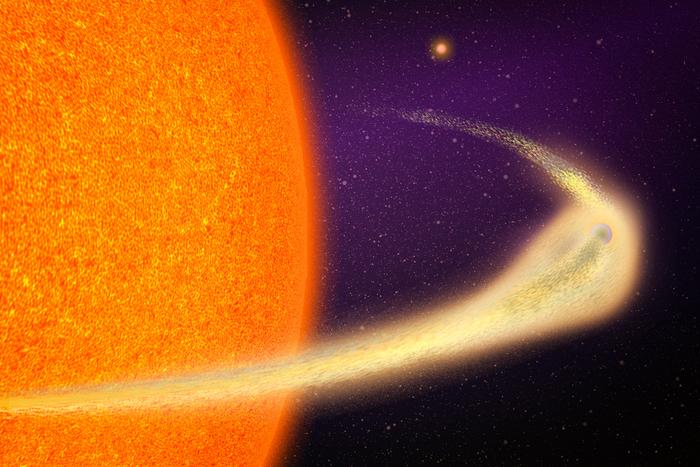

In a groundbreaking discovery that expands our understanding of planetary evolution, astronomers at the Massachusetts Institute of Technology have identified a remarkable exoplanet orbiting perilously close to its host star, undergoing rapid disintegration. This extraordinary world, designated BD+05 4868 Ab, is located approximately 140 light-years from Earth and possesses a mass comparable to that of Mercury. However, unlike the relatively stable terrestrial planets familiar to us, this planet is in the throes of a catastrophic demise, shedding vast quantities of its surface materials into space in a comet-like tail that extends millions of kilometers.
BD+05 4868 Ab completes an orbit around its parent star every 30.5 hours, making it an extreme example of a close-in rocky exoplanet subjected to intense stellar radiation and gravitational forces. Its proximity is nearly 20 times closer than Mercury’s orbit around the Sun, positioning the planet so near to the star that its surface is believed to be covered in molten magma at temperatures reaching roughly 1,600 degrees Celsius, or nearly 3,000 degrees Fahrenheit. Such conditions are conducive to the vaporization of surface minerals, which are then swept away by stellar winds, creating an extensive debris tail.
The initial detection of this disintegrating planet arose from observations by NASA’s Transiting Exoplanet Survey Satellite (TESS), a mission led by MIT that surveys nearby stars for periodic reductions in brightness indicative of planetary transits. Unlike typical exoplanet transit signals, which are characterized by uniform, symmetrical dips in stellar light caused by a planet crossing the face of its star, the transit signal for BD+05 4868 Ab was highly irregular. The depth of the light dips varied from orbit to orbit, and the return to baseline brightness was notably delayed, suggesting a trailing structure obscuring part of the star’s light.
Astrophysicists reasoned that this trailing structure was not an ordinary atmospheric phenomenon but rather a colossal cloud of mineral dust originating from the evaporating planetary surface. The tail is gargantuan, stretching a staggering nine million kilometers—equivalent to nearly half the planet’s entire orbital circumference. This extensive dust stream reflects a scenario of extreme mass loss that scientists describe as a runaway evaporation process intensified by the planet’s low gravity.
The planet’s low gravitational field, measured to be weaker than that of both Mercury and Earth’s Moon, amplifies its vulnerability. As BD+05 4868 Ab loses mass, its gravitational grip on remaining material weakens further, accelerating its disintegration. Researchers estimate that the planet loses a mass comparable to that of Mount Everest with each orbit. At this rapid pace, complete disintegration is projected to occur within one to two million years, a mere blink in astronomical timescales.
Such a discovery is rare; only three other examples of disintegrating rocky planets with comet-like tails have been identified before, all within data collected by NASA’s Kepler Space Telescope over a decade ago. BD+05 4868 Ab stands out by exhibiting the deepest transit signals and the most pronounced dust tail among this exclusive group, opening unprecedented opportunities for detailed study of planetary evaporation mechanisms.
The comparatively luminous host star of BD+05 4868 Ab makes this system uniquely accessible for follow-up observations with next-generation observatories like NASA’s James Webb Space Telescope (JWST). By analyzing the infrared signatures of the dust tail, JWST will enable astronomers to decode the mineralogical composition of the evaporated material, providing direct insights into the planet’s internal geology and potentially revealing the building blocks of rocky planets beyond our solar system.
Plans are underway for observations led by Marc Hon, a postdoctoral researcher at MIT, and graduate student Nicholas Tusay from Pennsylvania State University. Their investigations aim to leverage JWST’s superb sensitivity and spectral resolution to map the mineral content of the dust tail with unprecedented precision, an effort that could unlock clues about planetary formation, differentiation, and habitability potential in extrasolar environments.
Beyond the immediate fascination with this crumbling world, the discovery of BD+05 4868 Ab challenges astronomers to refine their models of exoplanetary atmospheres and surfaces under extreme irradiative stress. It underscores the complexity of planet-star interactions and the diverse evolutionary pathways that planets may follow, from stable orbits to violent evaporation and ultimate dissolution.
Moreover, the irregular and evolving transit signals observed by TESS signal novel challenges for detecting similar objects. Unlike the steady periodic dips used to confirm most exoplanets, these variable signals require innovative detection methods capable of tracking fluctuating transit shapes and depths. The research team is actively developing algorithms to uncover more examples of disintegrating exoplanets hidden within existing and forthcoming survey data.
The demise of BD+05 4868 Ab offers a live demonstration of planetary evaporation on human-observable timescales, presenting a natural laboratory for understanding the fate of small rocky worlds in harsh stellar environments. It exemplifies the dynamism of planetary systems and provides a stark reminder of the fragility of terrestrial planets subjected to intense radiation and gravitational forces.
This discovery, detailed in an upcoming article in The Astrophysical Journal Letters, not only enriches the catalog of known exoplanets but also opens a new window into planetary geology and astrophysics. The findings underscore NASA’s TESS mission’s pivotal role in unveiling diverse planetary phenomena and set the stage for synergy with JWST and future space-based observatories aimed at exploring the nature and diversity of worlds across the galaxy.
Subject of Research: Disintegrating rocky exoplanet with comet-like dust tail
Article Title: “A Disintegrating Rocky Planet with Prominent Comet-like Tails Around a Bright Star”
Image Credits: Jose-Luis Olivares, MIT
Keywords
Exoplanetary science, Compact stars, Evaporation, Planetary surfaces, Circular orbits, Space research, Minerals, Comets, Observational data, Space telescopes, Observational astronomy, Space sciences, Planetary science, Astronomy, Physics
Tags: astronomical observations of exoplanetsBD+05 4868 Abclose-in rocky planetscomet-like tail formationexoplanet mass comparison to Mercuryextreme stellar radiation effectsintense gravitational forces on planetsMIT astronomy researchmolten magma planetary surfacesplanetary evolution discoveriesrapidly disintegrating exoplanetstellar winds and debris