In the relentless quest for sustainable energy sources, water splitting emerges as a beacon of hope, promising a clean and abundant supply of hydrogen fuel. Despite the theoretical appeal, the process remains hampered by inefficiencies that have long puzzled researchers. At the heart of these challenges lies the complex chemistry of water molecules interacting with electrodes during the oxygen evolution reaction (OER), a critical half of water splitting. Recently, a groundbreaking study from Northwestern University has shed new light on the molecular intricacies that underlie this inefficiency, revealing a previously unknown behavior of water molecules that fundamentally impacts the energy cost of splitting water.
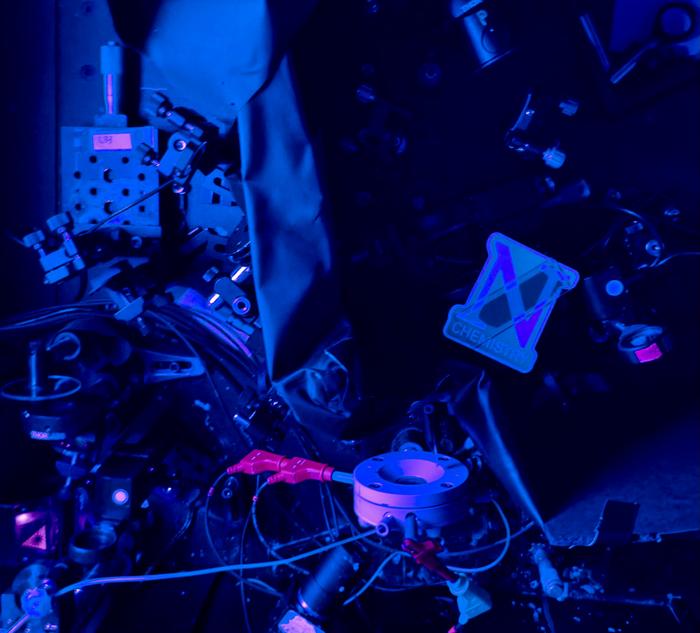
Through the innovative application of a cutting-edge technique called phase-resolved second harmonic generation (PR-SHG), Northwestern chemists have for the first time directly observed water molecules “flipping” their orientation at the interface with a metallic electrode during the OER. This molecular acrobatics occurs in the fleeting moment before oxygen atoms are released, demanding a significant input of extra energy beyond theoretical calculations. The discovery elucidates a key barrier in water splitting’s energy requirements, highlighting the pivotal role that water molecule orientation plays in the overall reaction efficiency.
The crux of this phenomenon lies in the electrostatic environment of the electrode surface. Initially, water molecules tend to position themselves with their positively charged hydrogen atoms facing the negatively charged electrode. In this orientation, electron transfer is impeded because oxygen atoms—the actual sites for electron donation—are turned away from the electrode surface. It is only when the applied electric field reaches a critical strength that water molecules flip, reorienting so that oxygen atoms face the electrode, facilitating efficient electron transfer. This flipping, however, is energetically expensive, contributing to the departure from the ideal 1.23 volts theorized for water splitting, with actual operational voltages registering closer to 1.5 or 1.6 volts.
Remarkably, the PR-SHG technique enabled precise measurement of not just the occurrence of flipping but also the energy associated with this reorientation. These measurements revealed a striking correlation between the energy barrier for flipping and the inherent molecular forces that maintain the cohesion of liquid water. This insight suggests that the fundamental properties of water itself impose a baseline energetic hurdle for efficient OER, a factor previously unaccounted for in catalyst design.
Another significant finding from the team shows that this energy barrier is sensitive to the pH level of the water solution. At lower pH values, flipping water molecules require substantially more energy, effectively stalling the electrochemical reaction. Conversely, when the pH exceeds nine, the energy demand decreases, and the flipping process supports robust electrochemical activity. This pH dependency offers a tangible parameter for optimizing water splitting conditions, signaling that managing solution acidity could be a straightforward way to enhance efficiency.
By deploying PR-SHG on hematite electrodes immersed in water, the research team could monitor water molecule behavior in real-time, an achievement likened by lead scientist Franz Geiger to an “optical equivalent of noise-canceling headphones.” This metaphor captures how the technique isolates signals at half the laser wavelength, allowing precise quantification of molecular orientations without interference. The dynamic insights gained provide a powerful new tool for probing electrochemical interfaces with unprecedented clarity.
This study builds upon earlier work by the same group, which observed similar water flipping phenomena on nickel electrodes, demonstrating the universality of this mechanism across both metallic and semiconductor substrates. The generality of the behavior across electrode types underscores the fundamental nature of water flipping as a prerequisite for OER, emphasizing the necessity to factor this step into catalyst design and operation protocols for efficient water splitting.
Beyond immediate applications on Earth, these insights carry potential ramifications for space exploration and extraterrestrial colonization. Efficient water splitting is critical not only for hydrogen fuel generation but also for producing breathable oxygen, an essential resource for human life in off-world environments such as Mars. By enhancing our understanding of the molecular steps in OER, this research aids the development of technologies that could support sustainable human presence beyond our planet.
Additionally, the findings align with broader efforts to transition from fossil fuels to a hydrogen economy. Integrating catalysts such as hematite into solar water oxidation systems could leverage sunlight to reduce the necessary applied voltage for splitting water. This synergy between solar energy and electrochemical catalysis promises to produce green hydrogen cost-effectively, a key step toward decarbonizing the global energy landscape.
Funded by the U.S. Department of Energy, National Science Foundation, and the Air Force Office of Scientific Research, this study represents a seminal advance in physical chemistry and energy research. The interdisciplinary collaboration, involving researchers from Northwestern University, Argonne National Laboratory, and Pacific Northwest National Laboratory, exemplifies the cooperative spirit driving innovation in clean energy technologies.
Subject of Research: Not applicable
Article Title: Water flipping and the oxygen evolution reaction on Fe2O3 nanolayers
News Publication Date: 15-Apr-2025
Web References: http://dx.doi.org/10.1038/s41467-025-58842-y
References: Geiger et al., Nature Communications, 2025
Image Credits: Franz Geiger/Northwestern University
Keywords
Water splitting, Hydrogen energy, Water molecules, Solar water splitting, Water, Hydrogen fuel
Tags: barriers to efficient water splittingelectrochemical processesenergy efficiency challengeshydrogen fuel productionmolecular behavior of waterNorthwestern University researchoxygen evolution reactionphase-resolved second harmonic generationrenewable energy technologysustainable energy solutionswater molecule orientationwater-splitting technology