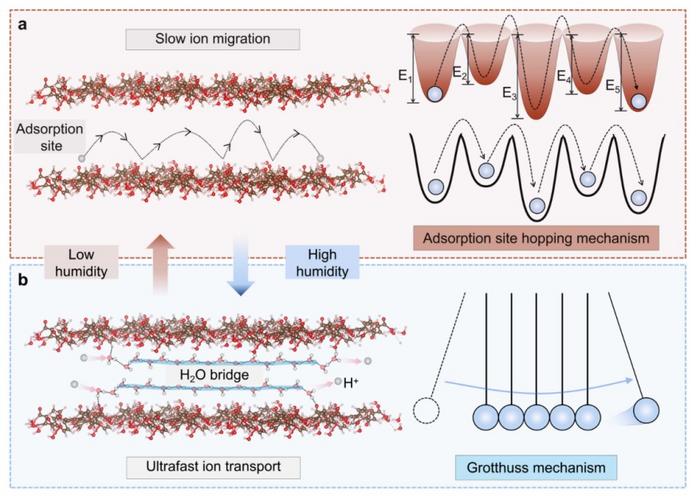
On January 17, 2025, a groundbreaking study led by Professor ZHANG Zhen’s team at the Suzhou Institute for Advanced Research, part of the University of Science and Technology of China (USTC), was published in the prestigious journal Nature Communications. The research introduces a novel solid-state proton gating membrane that achieves an unprecedented gating ratio of 5,740, setting a new benchmark in proton transport technologies. By surpassing previous limits, this innovation represents a significant leap forward for various applications in fields ranging from environmental monitoring to biomedical sensing.
In response to this challenge, the research team engineered a solid-state membrane utilizing two-dimensional hydrogen-bonded organic frameworks (HOFs). These innovative materials are synthesized in such a way that they can dramatically improve the performance of proton gating by using ambient humidity as a regulatory mechanism. Unlike conventional methods that rely on blocking or activating ion flow, this membrane employs an ingenious strategy: it modulates proton transport pathways, making it responsive to environmental conditions.
Through intricate density functional theory (DFT) calculations, the researchers uncovered a fascinating mechanism behind their membrane’s capabilities. It was found that the reversible formation and disruption of water bridges, triggered by fluctuations in humidity, enhances proton transport. When water bridges form within the membrane’s framework, they facilitate the transition of protons between sites through a process known as site-to-site hopping. This mechanism is significantly more efficient than classical proton transport scenarios, aligning more closely with the Grotthuss mechanism—a process that allows protons to move through the network of water molecules in a coordinated manner.
In their pursuit to enhance performance even further, the research team incorporated bacterial cellulose into their membrane composition. Bacterial cellulose is a biopolymer known for its exceptional ability to absorb and retain moisture. By integrating this material, the researchers successfully improved the adsorption and desorption of water clusters. This synergistic effect not only optimized the membrane’s performance but also allowed for the achievement of the staggering proton gating ratio of 5,740—a significant advancement over existing solid-state gating technologies.
The implications of this discovery extend far beyond laboratory walls. Due to its operational principles based entirely on solid-state materials, the membrane is poised for widespread applications. From environmental sensors capable of detecting harmful pollutants to advanced medical devices that monitor human health, the potential use cases for this innovative technology are numerous and diverse. It signifies a meaningful step toward creating more efficient, reliable, and compact systems for a range of modern-day challenges.
Moreover, the research contributes important insights into the development of next-generation biomimetic ion transport systems. By mimicking the natural mechanisms found in living organisms, these solid-state membranes could inspire a new wave of technologies that utilize the inherent properties of materials more effectively. This approach aligns with contemporary trends within materials science that emphasize sustainability and biomimicry in engineering practices.
The findings from Professor Zhang and his team’s research may also support further academic inquiry across a multitude of scientific domains. As other researchers build upon these principles, we may see a proliferation of materials that leverage similar mechanisms to achieve enhanced performance in various fields, from energy storage systems to water purification technologies. The potential for interdisciplinary collaboration could lead to innovations that redefine current technological landscapes.
With an eye toward the future, this pioneering research envisions an era where high-performance proton gating membranes serve as the cornerstone for smart systems in multiple industrial sectors. It opens up a plethora of opportunities for the integration of smart sensors that can effectively and accurately interact with their surroundings, expanding the horizon for technological advancements in numerous applications.
This remarkable work also raises essential questions regarding the scalability of this technology. As academic and industrial researchers examine the feasibility of commercializing solid-state proton gating membranes, factors such as production costs, material availability, and long-term stability will be of paramount importance. Understanding these dynamics will be crucial for the successful translation of laboratory results into real-world solutions.
In conclusion, the team’s innovative approach—combining advanced material science with the clever utilization of environmental factors—has established a new paradigm in the realm of proton gating technologies. With applications that potentially affect health care, environmental protection, and energy management, this work not only highlights the ingenuity of scientific research but also illustrates the profound impact that modern technology can have on society at large.
The achievements of Professor ZHANG Zhen’s team mark an essential milestone in scientific explorations aimed at developing high-efficiency proton gating systems. As this research continues to inspire the scientific community, it also serves as a reminder of the importance of creativity and collaboration in driving technological progress forward. The horizons of what is possible in materials science and engineering have been broadened, paving the way for future innovations that address pressing global challenges.
Subject of Research: Solid-state proton gating membranes
Article Title: High-performance solid-state proton gating membranes based on two-dimensional hydrogen-bonded organic framework composites
News Publication Date: 17-Jan-2025
Web References: Nature Communications
References: DOI: 10.1038/s41467-025-56228-8
Image Credits: Image from Prof. ZHANG’s team
Keywords
Biomimetics, Proton gating membranes, High-performance materials, Environmental sensors, Biomedical devices, Material science, Sustained technology
Tags: advanced proton transport technologiesbiomedical sensing advancementsbiomimetic proton gating systemsenvironmental monitoring applicationsgating ratio in proton transporthydrogen-bonded organic frameworksion channel limitationsnovel materials in ion transportProfessor Zhang Zhen’s teamsolid-state proton gating membranesynthetic nanochannels performanceUSTC research breakthroughs