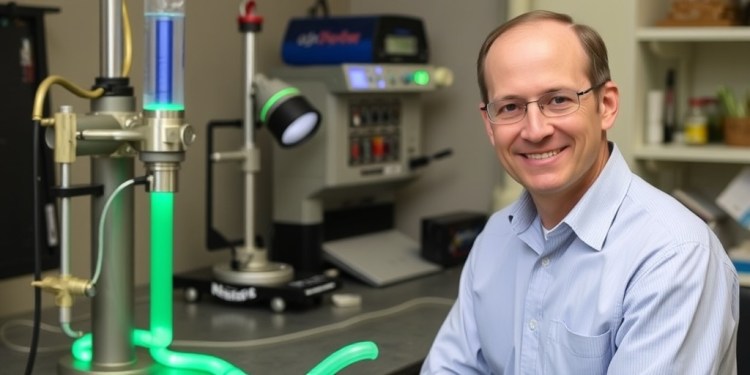

A groundbreaking discovery from the University of Massachusetts Amherst has unveiled a new class of materials known as “shape-recovering liquids.” This research, spearheaded by graduate student Anthony Raykh and his team, challenges traditional expectations set by the laws of thermodynamics, providing insights into the behavior of mixtures involving oil, water, and magnetized particles. The findings, published in the esteemed journal Nature Physics, showcase a remarkable phenomenon where a mixture, when shaken, forms a consistent and elegant urn-shaped structure that seems to defy natural expectations.
Raykh’s journey began with an experiment that feels almost culinary in nature. In mixing oil, water, and special particles, he intended to explore the limits of emulsification—the process by which disparate liquids blend. “Imagine shaking up your favorite salad dressing,” Raykh explained, elaborating on how the inclusion of magnetized nickel particles transformed a mundane mixing process into a captivating scientific revelation. This unexpected outcome was not just aesthetically pleasing but, more importantly, scientifically profound.
During the initial experiments, the mixture displayed a talent for returning to its urn-like form after any degree of agitation, leading Raykh to question the conventional understanding of particle interactions in fluids. Conventional wisdom suggests that particles, when added to oil-water mixtures, reduce surface tension at the interface, enhancing emulsification. However, the peculiar behavior of strongly magnetized particles revealed a fascinating twist: rather than decreasing tension, these particles actually increased it.
The implications of this finding are significant. Traditionally, the stability of emulsions relies heavily on the reduction of interfacial tension, allowing oil and water to mix, an understanding deeply rooted in thermodynamic principles. However, the research team discovered that the strong magnetism of the nickel particles interfered with this principle, leading to an increase in interfacial tension that curiously shaped the liquid into an elegantly curved boundary rather than allowing it to mix freely.
Senior co-author Thomas Russell noted the serendipitous nature of the discovery, remarking, “When something defies established scientific understanding, it compels further investigation.” His excitement mirrored that of Raykh, who spent time consulting with various faculty members to dissect this anomaly, drawing the attention of experts in polymer science to delve deeper into this unexpected behavior.
To further validate their findings, the research team conducted a series of experiments and simulations in collaboration with colleagues from Tufts and Syracuse universities. The collective effort established the link between the dynamics of magnetization and fluid shape behavior, providing a clearer understanding of how such phenomena can emerge in soft materials.
In essence, the research captures a previously unrecognized relationship between magnetism and the structural stability of emulsions. The detailed examinations of the nanoparticles revealed their unique assembly patterns, illustrating how strong interparticle interactions can reshape our normative understanding of fluid dynamics. “These particles organize in ways that produce behaviors contrary to the expected outcome, steering us towards a re-evaluation of the fundamental concepts in soft materials,” Hoagland explained.
As the team continues to explore the practical applications of their discovery, the potential for meaningful advancements in soft-matter physics becomes apparent. While Raykh’s findings may not yet have commercial applications, the prospect of harnessing this novel state of matter holds immense promise for future innovation. The ability to control and manipulate materials at the microscopic level can lead to breakthroughs in various technology sectors, including drug delivery systems, material design, and nanotechnology applications.
This research encapsulates the spirit of inquiry and the groundbreaking work being conducted at the University of Massachusetts Amherst. Raykh, Russell, and Hoagland stand at the forefront of a new scientific frontier that invites further exploration into the complexities of fluid mechanics and particle behavior. As they forge ahead, the implications of their findings will undoubtedly ripple through scientific communities and beyond.
Ultimately, the discovery of shape-recovering liquids not only enhances our understanding of emulsification but also prompts a much broader re-examination of the boundaries of fluid dynamics governed by thermodynamic laws. The revelation serves as a reminder of the mysteries still present in material science and the ever-evolving landscape of research. As this team of researchers continues to delve into these phenomena, we can anticipate new knowledge that challenges existing paradigms and opens doors to future possibilities.
Such foundational work underscores the importance of interdisciplinary collaboration and innovation within academic research. The support from the U.S. National Science Foundation and the U.S. Department of Energy played a crucial role in enabling this research, emphasizing the value of investment in scientific endeavors. As we look ahead, the hope is that discoveries like these will inspire the next generation of researchers to push the boundaries of what we know about the physical world.
The scientific community watches with eager anticipation as the implications of this research unfold. Scholars, innovators, and technologists alike stand to benefit from a deeper understanding of the unique properties of shape-recovering liquids. As we unravel the potential applications and fundamental principles guiding these new materials, the fabric of material science will undoubtedly be woven with newfound threads of knowledge and discovery.
Subject of Research: Shape-recovering liquids and their thermodynamic implications
Article Title: Shape-recovering liquids
News Publication Date: April 4, 2025
Web References: Nature Physics
References: DOI
Image Credits: Credit: UMass Amherst
Keywords
Shape-recovering liquids, Thermodynamics, Emulsification, Magnetized particles, Soft matter, Fluid dynamics, Polymer science, Interfacial tension, Material science, Interdisciplinary research.
Tags: emulsification sciencegroundbreaking research in physicsinnovative material discoverymagnetized particles behaviorNature Physics publicationoil-water mixturesparticle interactions in fluidsscientific culinary experimentsshape-recovering liquidsthermodynamic principles exceptionUMass Amherst researchurn-shaped structures in mixtures