
In a significant development for sustainable energy, researchers at the Karlsruhe Institute of Technology (KIT) have achieved a groundbreaking milestone in the field of synthetic fuel production. European climate targets have placed increasing pressure on industries to innovate alternatives to traditional fossil fuels. The aviation sector, in particular, continues to grapple with the challenge of relying on sustainable kerosene as a transitional solution. The recent advancements in co-electrolysis technology, developed in partnership with industry collaborator Sunfire, may pave the way for more environmentally friendly aviation fuel options.
Professor Roland Dittmeyer, who heads the research activities at KIT’s Institute for Micro Process Engineering, emphasizes the importance of synthetic fuels produced through power-to-liquid processes. The methodology utilizes carbon dioxide sourced from either the atmosphere or biogenic sources, alongside water and green electricity. Such an approach aligns well with the pressing need for renewable energy solutions that do not easily convert to electrification. The significance of co-electrolysis technology cannot be understated, as it successfully couples water vapor and CO2 with a synthesis process, achieving an unprecedented scale in synthetic fuel production.
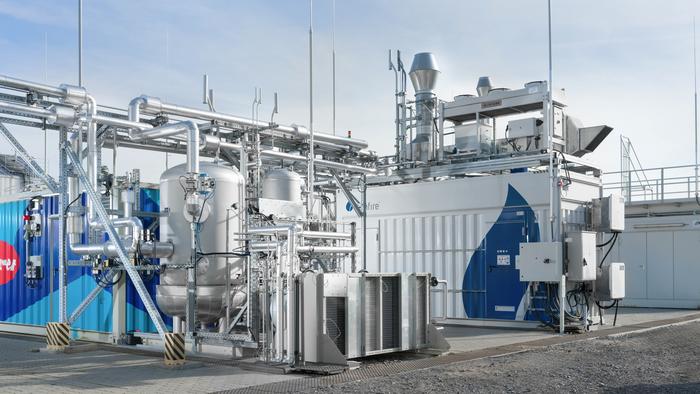
The co-electrolysis module stands poised at the heart of this innovative process, boasting an impressive output of 220 kilowatts. This level of efficiency marks a significant improvement and enables the production of syngas, which is a crucial precursor for creating synthetic kerosene. Notably, the co-electrolysis process operates differently than traditional methods, enabling the direct electrochemical conversion of water vapor and CO2 into syngas in a singular step. This innovation alone can recover up to 85 percent of the electrical energy utilized during the process, translating into a substantial reduction in energy costs overall.
An additional advantage of the co-electrolysis approach is its enhanced reliability and availability, as echoed by Hubertus Richter, a Senior Engineer in R&D at Sunfire. The option to eliminate the traditional production of hydrogen prior to syngas creation further streamlines the process, maximally utilizing input materials and thereby improving the overall energy conversion efficiency. This represents a crucial step towards realizing a sustainable and economically viable method for producing synthetic fuels.
Following the generation of syngas, the next phase of this production journey involves maintaining reaction pressure through a specialized compressor equipped with safety features to facilitate downstream applications. Once at the correct pressure, the syngas undergoes Fischer-Tropsch synthesis within a microstructured reactor that KIT has worked diligently to develop. This synthesis process translates the syngas into long-chain hydrocarbons, which includes the eventual production of kerosene and other essential chemicals.
The ongoing research positions KIT’s methods not only for immediate applications but also for future advancements. By capturing and utilizing the heat generated during synthesis, researchers can further minimize energy demands, underscoring the feasibility of this sustainable production process at a significant scale. Moreover, the innovative integration of these technologies allows for a robust recycling of material flows and the maximization of energy recovery, setting a new benchmark for sustainable synthetic fuel production.
Currently, researchers at KIT have successfully piloted the integration of co-electrolysis under real-world conditions, achieving a remarkable output of one hundred liters of syncrude per day. This operation is regarded as a pivotal step forward within the second funding phase of the Kopernikus P2X project, highlighting the advancements made toward the larger goal of producing a tonne of fuel daily. The enhanced facility is soon to be expanded to accommodate a capacity of up to 300 liters of syncrude each day, showcasing the scalability of this promising research.
In the ongoing third phase of the Kopernikus P2X project, researchers, alongside partners like INERATEC, are actively developing a larger production facility aimed at reaching tonne-scale operations in Höchst Industrial Park near Frankfurt. This ambitious project illustrates the commitment to advancing synthetic fuel technology, with products eventually intended for testing by aircraft engine manufacturers. They are poised to ensure that the resulting fuels align with stringent aviation industry standards.
The Kopernikus P2X project represents a collaborative effort that unites various organizations, including Climeworks and Sunfire, along with academic institutions such as KIT. Focused on the production of carbon-neutral fuels known as e-fuels, the project receives backing from Germany’s Federal Ministry of Education and Research (BMBF) and boasts a consortium of 18 partners spanning both industry and scientific sectors, as well as civil society entities.
This innovative approach towards the synthesis of synthetic fuels embodies a broader movement towards sustainability and carbon neutrality in energy production. As aviation and other sectors continue to grapple with the impacts of climate change, the advancements demonstrated at KIT signal a hopeful trajectory toward achieving substantial reductions in greenhouse gas emissions. Enabled by cutting-edge technology and collaborative efforts, the potential for broad adoption of synthetic fuels offers a promising glimpse into a lower-carbon future.
With ongoing research and development efforts aimed at refining and expanding this innovative technology, the potential for widespread application of synthetic fuels is growing. The work conducted at KIT exemplifies how dedicated research, industry partnerships, and advanced technology can converge to create viable solutions for some of the most pressing challenges of our time.
In conclusion, the advancements in co-electrolysis and synthetic fuel production at KIT represent a significant and necessary step towards sustainable aviation and energy solutions, demonstrating how interdisciplinary collaboration and technological innovation are essential in the face of climate change. The journey toward achieving carbon-neutral fuels is an evolving story, and the commitment to research such as that undertaken at KIT may soon bear fruit, illuminating the path to a more sustainable and renewable energy future.
Subject of Research: Co-electrolysis for Sustainable Synthetic Fuels
Article Title: Revolutionary Breakthrough in Synthetic Fuel Production at KIT
News Publication Date: October 2023
Web References: KIT Energy Center
References: Kopernikus P2X Project
Image Credits: Amadeus Bramsiepe, KIT
Keywords
Sustainable fuels, synthetic kerosene, co-electrolysis, Renewable energy, Climate change, KIT, Energy Lab, Fischer-Tropsch synthesis, Carbon neutrality, European aviation, Power-to-liquid processes.
Tags: aviation sector climate targetscarbon dioxide utilization in fuelsco-electrolysis technology in aviationenvironmentally friendly aviation fuelgreen electricity in fuel synthesisindustry collaboration for sustainable fuelsinnovative fuel production methodsKarlsruhe Institute of Technology researchpower-to-liquid processes in fuel productionrenewable energy solutions for aviationsustainable aviation fuelssynthetic fuel production advancements