
image:
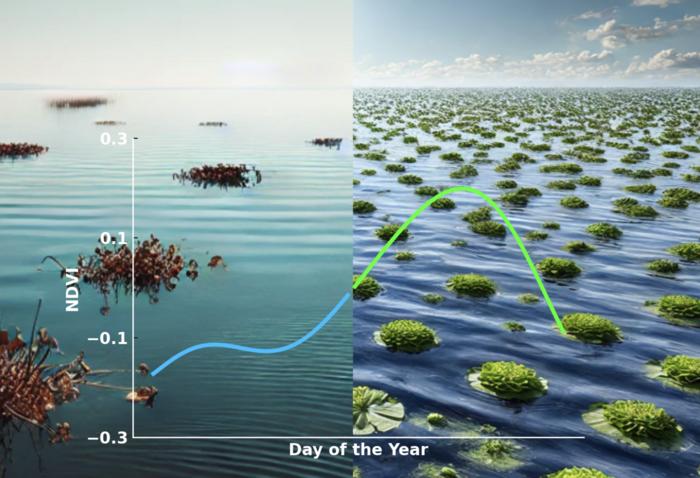
An illustration depicting seasonal changes in floating vegetation and the resulting periodic changes in water surface reflectance. It is expected to become a novel indicator in searching for life on ocean planets.
view more
Credit: Astrobiology Center
Background
Astronomical surveys have discovered nearly 6,000 exoplanets, including many habitable planets, which may harbor liquid water on their surfaces. The search for life on such planets is one of the most significant scientific endeavors of this century, with direct imaging observation projects currently under development.
On Earth-like planets, the characteristic reflectance spectrum of terrestrial vegetation, known as “vegetation red edge”, is considered as a key biosignature. However, ocean planets, with most of their surfaces covered by water, are unlikely to support terrestrial vegetation. To broaden the scope of life detection on ocean planets, this study examined the characteristics of reflectance spectra from floating plants and tested their detectability.
Results
The study investigated the reflectance spectra of floating plants across different scales, from individual leaves in laboratory settings to large-scale observation via satellite remote sensing of lake vegetation.
Although floating leaves exhibit considerable morphological variation among species, their general trend reveals a pronounced red edge, often comparable to or even exceeding that of terrestrial plants. This enhancement is attributed to air gaps in sponge tissue that provide buoyancy and specialized epidermal structures that offer water repellency. While floating leaves show slightly reduced reflectance when wet, they still display a more distinct red edge than submerged water plants (Figure 1).
However, on a larger scale, the red edge signature of floating vegetation weakens due to lower vegetation density and reduced leaf overlap on the water surface. Landscape-scale analyses using satellite remote sensing (Sentinel-2; ESA) with the Normalized Difference Vegetation Index (NDVI) flourishes in summer and disappears in winter, causing the NDVI to be relatively low when averaged over the year. Nevertheless, the fluctuation between minimum and maximum NDVI values is more pronounced for floating vegetation compared to forests. To further investigate this pattern, a large-scale survey of 148 lakes and marshes across Japan was conducted. The study revealed a characteristic seasonal NDVI variation, shifting from negative values in winter to positive values in summer (Figure 2). Importantly, while water suppresses the reflectance of floating vegetation, its own reflectance is even lower and remains stable. It enhances the detectability of seasonal NDVI fluctuations, which remain robust against atmospheric and cloud interference, suggesting that this method could be promising for detecting life on habitable exoplanets in the future.
Perspectives
If photosynthetic organisms, such as floating plants, exist universally on habitable exoplanets, then the scope of life exploration can be expanded to include ocean planets rather than being limited to Earth-like planets. It is important to understand the origin and evolutionary process of life as it coevolves with planetary environments to predict the morphology of organisms that may adapt to diverse planetary conditions. This study provides a foundation for future research on biosignatures, paving the way for the next generation of life-detection missions.
Journal
Astrobiology
DOI
10.1089/ast.2024.0127
Method of Research
Observational study
Subject of Research
Not applicable
Article Title
Remote Detection of Red-Edge Spectral Characteristics in Floating Aquatic Vegetation
Article Publication Date
24-Feb-2025
Media Contact
Hayao KIMURA
National Institutes of Natural Sciences
Office: 81-354-251-890
Journal
Astrobiology
Funder
Japan Society for the Promotion of Science
DOI
10.1089/ast.2024.0127
Journal
Astrobiology
DOI
10.1089/ast.2024.0127
Method of Research
Observational study
Subject of Research
Not applicable
Article Title
Remote Detection of Red-Edge Spectral Characteristics in Floating Aquatic Vegetation
Article Publication Date
24-Feb-2025
Keywords
/Applied sciences and engineering/Remote sensing
/Space sciences/Astronomy/Celestial bodies/Planets/Habitable planets
bu içeriği en az 2000 kelime olacak şekilde ve alt başlıklar ve madde içermiyecek şekilde ünlü bir science magazine için İngilizce olarak yeniden yaz. Teknik açıklamalar içersin ve viral olacak şekilde İngilizce yaz. Haber dışında başka bir şey içermesin. Haber içerisinde en az 12 paragraf ve her bir paragrafta da en az 50 kelime olsun. Cevapta sadece haber olsun. Ayrıca haberi yazdıktan sonra içerikten yararlanarak aşağıdaki başlıkların bilgisi var ise haberin altında doldur. Eğer yoksa bilgisi ilgili kısmı yazma.:
Subject of Research:
Article Title:
News Publication Date:
Web References:
References:
Image Credits:
Keywords
Tags: astrobiology researchastronomical surveys of exoplanetsdirect imaging of exoplanetsexoplanet habitabilityfloating vegetationlife detection indicatorsliquid water on planetsocean worlds explorationreflectance spectrum analysissearch for extraterrestrial lifeseasonal changes in oceanic ecosystemsvegetation red edge phenomenon