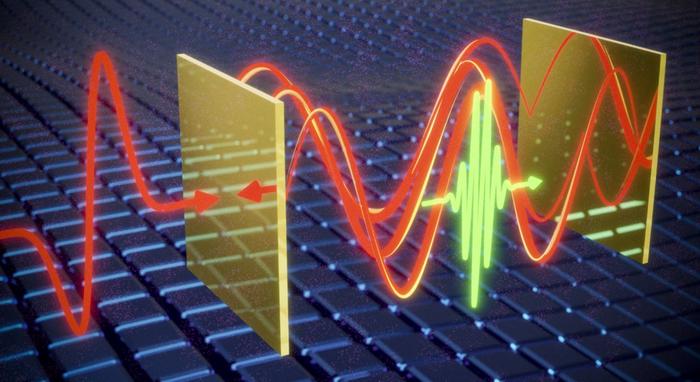

In a pioneering development that stands to reshape our understanding of light-matter interactions, physicists have introduced an innovative method utilizing electro-optic cavities to capture critical intra-cavity electric fields. This research, which centers on the functionality of electro-optic Fabry-Pérot resonators, promises to provide unprecedented insights into the dynamics of quantum states and the emergent behaviors of quasi-particles. By enabling measurements on sub-cycle timescales, the work opens the door to a more nuanced understanding of the quantum world, particularly in materials that exhibit complex excitations under low-energy conditions.
Terahertz (THz) radiation is where this groundbreaking research finds its foothold, a spectral range often overlooked but critical in the exploration of how materials behave under specific conditions. Within the realm of cavity electrodynamics, researchers aim to unravel the intricate relationships between light and the materials encapsulated within the cavity. These relationships redefine our conceptual frameworks of material properties and their corresponding dynamic changes, especially as they pertain to low-energy excitations that characterize fundamental material behaviors.
The newly designed hybrid cavity utilizes a split detector crystal and an adjustable air gap, granting researchers the ability to manipulate internal reflections with remarkable precision. This tunable configuration is a game-changer, allowing distinct interference patterns to emerge based solely on how light interacts with the materials within the cavity. The researchers have mathematically modeled these interactions, which aids in revealing the complexities of cavity dispersion, ultimately shedding light on the transient behaviors of light-matter quasi-particles known as polaritons.
Polaritons are hybrid light-matter excitations formed at the interface where light and a material interact, and they serve as the focal point for deeper investigations in this realm of study. The electro-optic cavities developed by the team enable unprecedented observation and measurement of these quasi-particles in real-time, bridging gaps in our current understanding and allowing for the possibility of manipulating these interactions to achieve specific desired outcomes. By effectively tuning the cavity’s conditions, researchers could explore novel quantum states and even new forms of matter.
Furthermore, the implications of this research extend far beyond mere academic interest. Potential applications in quantum computing, for instance, may benefit significantly from the insights gained through enhanced light-matter interactions. Scientists are increasingly interested in harnessing these interactions to create more efficient quantum bits (qubits) and thereby improve computational capabilities. The high-resolution measurements enabled by these electro-optic cavities provide a powerful tool for fine-tuning interactions in quantum systems.
The findings from this research not only mark significant theoretical advancements but also inspire innovative experimental avenues. As most phenomena in quantum mechanics remain elusive, the capacity to observe and measure them as they occur in situ is a vital breakthrough. It allows for two-way interactions, where the dynamics of light and matter can be observed in real-time, providing a clearer depiction of their behavior, interactions, and the resultant phenomena that emerge from their convergence.
As the researchers prepare for broader applications, they are also optimistic about how this technology could inform future scientific pursuits across various domains including material science, condensed matter physics, and even biophysics. With the advancements in cavity design and measurement techniques, the scientific community is poised to enter a new era of exploration and discovery. These insights promise to influence not only fundamental research but also practical manufacturing applications that rely on precise manipulation of quantum states.
The collaborative nature of the research team has fostered a dynamic environment conducive to innovation and discovery. Researchers have emphasized the importance of interdisciplinary approaches to tackle complex questions arising within this field. By combining insights from various scientific domains, they hope to enhance the understanding of light-matter interactions and uncover new material properties that could revolutionize technology.
In addition to their ambitious research goals, the team’s work sets a foundational framework for future studies in cavity quantum electrodynamics. Their work illuminates the potential pathways for further explorations, fueling curiosity and experimentation among scientists who wish to delve deeper into this promising area of study. With the ability to investigate light-matter dynamics in a high-resolution setting, researchers can expect an influx of discoveries that may lead to unforeseen technological advancements.
Ultimately, this revolutionary approach to measuring electronic fields within cavities can lead to more profound insights into the quantum world. By shedding light on the complex dynamics at play, researchers pave the way for a better understanding of fundamental interactions that underpin much of modern physics. As the world stands at the precipice of advancements in quantum technologies, this research offers a critical stepping stone toward a future where the lines between light and matter become even more blurred, promising lasting impacts on science and technology as we know it.
Through their groundbreaking work, physicists are poised to break through existing barriers in our comprehension of quantum phenomena. The synthesis of high-precision measurements, advanced theoretical models, and intuitive experimental designs fosters an environment ripe for discoveries, sparking a sense of excitement about what future explorations might uncover. As the future unfolds, the implications of this research could echo throughout our scientific understanding and technological innovation for years to come.
Subject of Research: Electro-optic cavities for in-situ measurement of cavity fields
Article Title: Electro-optic cavities for in-situ measurement of cavity fields
News Publication Date: 6-Feb-2025
Web References: N/A
References: N/A
Image Credits: © FHI
Keywords: Electro-optic cavities, Terahertz spectral range, Cavity electrodynamics, Polaritons, Quantum computing, Light-matter interactions, Hybrid cavity design, Sub-cycle measurement, Material science, Quantum dynamics, Fabry-Pérot resonators, Advanced measurements
Tags: cavity electrodynamics advancementsElectro-optic cavities researchFabry-Pérot resonators applicationshybrid cavity design innovationsinsights into light-matter interactionslow-energy excitation behaviorsmanipulating internal reflections in opticsmeasuring intra-cavity electric fieldsmeasuring light waves sub-cycle timescalesquantum states dynamicsquasi-particles emergent behaviorsterahertz radiation exploration