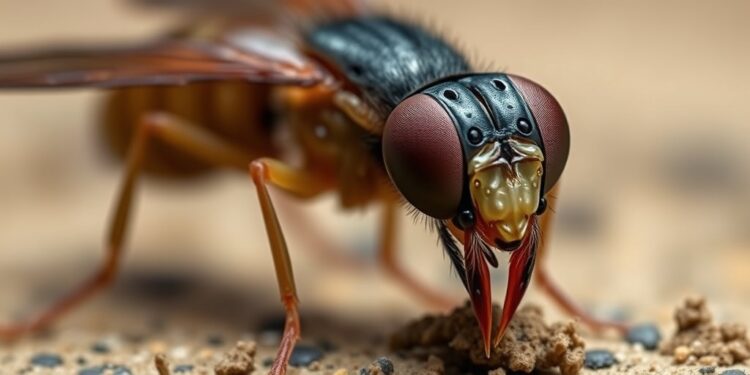

In the vast domain of evolutionary biology, nature frequently astonishes researchers by revealing intricate relationships that blur the lines of predation and symbiosis. In a remarkable discovery, an international study has lifted the veil on a species of blow fly that has ingeniously integrated itself into the intricate social structure of harvester termites. This phenomenon emphasizes the incredible adaptative capabilities found in the world of insects and showcases yet another level of complexity in evolutionary interactions.
The study, led by the Institute of Evolutionary Biology (IBE) in collaboration with a host of esteemed institutions, was conducted in the Anti-Atlas mountain range in southern Morocco. Researchers stumbled upon this remarkable species when, under the distraction of unfavorable weather for typical butterfly hunting, they turned their search efforts to ants and their habitats. Upon investigating a termite mound, researchers discovered the larvae of a fly species previously unknown to science. This serendipitous encounter has opened doors to understanding an evolutionary adaptation so refined it seems almost fantastical.
Upon closer examination, the blow fly larvae display unique morphological adaptations that enhance their ability to infiltrate the tightly-knit communities of harvester termites. They exhibit traits likened to what could be characterized as a “termite mask,” designed to mimic both the appearance and the sensory cues of their hosts. This non-functional head complete with antennae and palps not only helps them blend in visually, but it also signifies a deeper evolutionary strategy, where the larvae dodge detection by recreating the specific features of the termites they cohabit.
Moreover, these larvae do not stop at superficial mimicry; they exhibit a remarkable biochemical adaptation as well. They have evolved to emit a chemical profile indistinguishable from that of the resident termites within their specific colony. This olfactory mimicry is crucial for resting comfortably within an environment that is normally hostile to intruders. By sharing the unique scent of their hosts, they avoid the instinctual defenses displayed by soldier termites, who are known to aggressively defend their nests.
The persistence of this chemical disguise indicates sophisticated interspecies communication mechanisms at play within these termite colonies. Termites utilize their highly developed antennae to detect not only the shapes of their nest mates but also their distinctive scents—a crucial survival trait. By aligning their chemical signals with those of termites, blow fly larvae can seamlessly integrate into the social fabric of these complex colonies, setting the stage for a dynamic relationship that may hover between parasitism and mutualism.
The interactions observed in the study appear to go even further than mere tolerance; researchers noted behavior that suggests an empathetic relationship between the two species. When fly larvae were observed within the termite mounds, they were found to receive grooming and tending from their termite hosts, who engaged in preening behaviors that would typically be reserved for nest mates. Such attention not only aids the larvae’s survival but also hints at a deeper evolutionary alliance, with potential implications for familial affiliations and cooperative behaviors among species.
Despite these observations, there remains a plethora of unanswered questions regarding the diet and life cycle of these larvae. While sharing close quarters with the termites, the researchers have not definitively uncovered what sustains the blow fly larvae nutritionally. Their existence within the food chambers of the nest, combined with behaviors reminiscent of trophallaxis—the mouth-to-mouth transfer of food—hints at a complex nourishment exchange potentially in play. However, capturing this secretive feeding behavior has proven elusive thus far.
Another intriguing aspect of this study is the rapid evolution demonstrated by this newly discovered species. The calliphorid fly, belonging to the genus Rhyncomya, has displayed such extraordinary adaptations that its morphological traits set it apart from all known relatives within the genus. This finding challenges preconceived notions of how quickly evolutionary traits can arise in response to specific ecological pressures. Indeed, the evolutionary journey that allowed this species to develop intricate disguises and chemical mimicry may have occurred within a condensed time frame.
In the world of evolutionary biology, instances of social integration or parasitism among species are often isolated and occur under select circumstances. Yet, this blow fly larvae’s unique association with termites throws into question the existing definitions of these relationships. For instance, the case of humpback flies which exhibit a similar relationship with termites, serves as a comparative framework, yet it highlights a case of divergence, wherein only the adult flies partake in mimicry, as opposed to the larval stage seen here.
The intricacies uncovered by this study compel scientists to rethink the underlying mechanisms of adaptation and the evolutionary potential of social bonds in nature. Nature often exhibits a delicate balance, and the discovery of this blow fly species adds yet another layer of complexity to our understanding of ecological interactions. It emphasizes that the biological world is expansive, with intricate webs of relationships yet to be fully charted and understood.
This research exemplifies the collaborative effort of multiple institutions and the importance of intercontinental scientific dialogue. It underscores that discoveries in biodiversity are not limited to observable phenomena but also hinge on the collaborations that facilitate these explorations. Researchers from the IBE, the Botanical Institute of Barcelona, and several other international partners are building a foundational body of knowledge that may lead to further discoveries about the adaptive capabilities of insects in the broader ecosystem.
In conclusion, the discovery of this blow fly larvae, with its remarkable adaptations and intriguing relationships with harvester termites, invites a paradigm shift in our understanding of ecological and evolutionary dynamics. By revealing the complexities of mimicry and social integration among insects, this research not only enriches our knowledge of evolutionary biology but also serves as a reminder of the hidden complexities inhabiting the natural world. As researchers look towards the future, this remarkable finding sets the stage for new hypotheses about survival strategies, adaptation, and the evolutionary potential lying within the interconnectedness of life.
This breakthrough urges a reconsideration of our perceptions regarding ecological interactions, pushing scientists to delve deeper into the mysteries of insect diversity and behavior. By chronicling these biodiversity narratives, researchers expose the rich tapestry of life that characterizes our planet, promoting appreciation and respect for the intricate ecosystems that sustain us.
Subject of Research: Animals
Article Title: Blow fly larvae socially integrate termite nests through morphological and chemical mimicry
News Publication Date: 10-Feb-2025
Web References:
References: Schär S, Talavera G, Dapporto L, et al. Blow fly larvae socially integrate termite nests through morphological and chemical mimicry. Current Biology. 2024;
Image Credits:
Keywords: Evolutionary biology, Adaptive evolution, Social parasitism, Termite mimicry, Insect relationships.
Tags: anti-atlas mountain range researchblow fly social interactionscomplex insect communitiesengineered termite face adaptationevolutionary biology discoveriesevolutionary interactions in natureharvester termite symbiosisinsect morphological adaptationslarval adaptations in insectsnew species of blow flypredation and symbiosis in insectstermite mound ecosystems