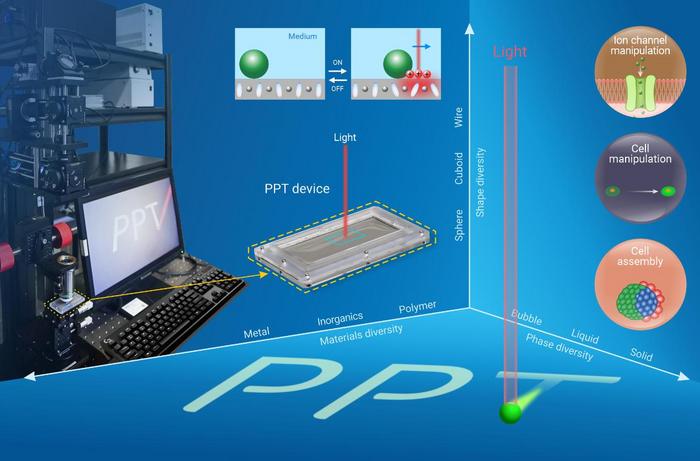

In recent advancements showcased by a research team led by Dr. DU Xuemin at the Shenzhen Institutes of Advanced Technology (SIAT), a groundbreaking innovation in the field of particle manipulation has emerged. This development introduces the Photopyroelectric Tweezer (PPT), a novel tool that harmoniously integrates the functionalities of optical tweezers with the benefits of electric fields. The study, published in the esteemed journal The Innovation, emphasizes not only the imagination behind the PPT but also its potential versatility across various application scenarios in the physical, biological, and medical realms.
Optical tweezers have historically been pivotal in manipulating microscopic entities, yet their widespread application has been impeded by several practical limitations. These challenges include the need for high-intensity laser sources, complex electrode designs, and additional power supplies, all of which significantly undermine the experiments’ flexibility and operational adaptability. Conventional methods often require intricate setups and impose constraints that can deter researchers from harnessing these powerful tools in practical environments.
The Photopyroelectric Tweezer seeks to address these hurdles through its ingenious design, which comprises two primary components: a near-infrared (NIR) laser light source and a well-engineered PPT apparatus integrating a liquid medium with a photopyroelectric substrate. This dual-component system not only simplifies the manipulation process but enhances its capacity to work reliably under lower energy inputs. Henceforth, researchers can explore manipulation techniques that were previously relegated to theoretical discussions.
At the heart of this innovation is the photopyroelectric substrate, composed of a superhydrophobic ferroelectric polymer layer paired with a lubricant-infused slippery surface. This combination employs Ga-In liquid metal microparticle-embedded poly(vinylidene fluoride-co-trifluoroethylene) composites, which demonstrate remarkable properties essential for efficient manipulation. When illuminated by low-intensity NIR light, the ferroelectric polymer generates real-time surface charges through the photopyroelectric effect, harnessing energy in an effective manner.
Diving deeper into the functionality of the PPT, it is essential to highlight how the lubricant-infused layer plays a critical role in optimizing performance. The infusion of this lubricant minimizes resistance during object motion and effectively curtails issues of contamination. Notably, it neutralizes the potential for charge screening by conductive media, thus enhancing overall operational efficiency. Consequently, the PPT provides a streamlined solution to some of the critical issues previously faced by optical tweezers.
The advantages of the PPT are underscored by its capability to generate robust surface charges even under low-intensity NIR irradiation, as minimal as approximately 8.3 mW mm^-2. This efficiency results in a driving force that can reach upwards of 4.6×10^-5 N, showcasing the potential for robust particle manipulation without the reliance on high-energy laser beams or complex configurations. Marketed as a flexible and adaptable tool, the PPT stands to revolutionize the approach to particle manipulation in scientific research.
Dr. DU’s remarks highlight the intrinsic flexibility of the PPT, emphasizing the profound implications of its design. The device’s capacity to programmatically and remotely manipulate diverse materials and geometries—including polymers, metals, and various liquid phases—marks a significant advancement in interfacing technology with biological research. It showcases an ability to handle a broad array of conditions, compatible with either macroscopic or microscopic scenarios, which opens the door to novel experimental paradigms.
Equipped for diverse operational ranges, the PPT adapts seamlessly to different media, demonstrating efficacy across a wide conductivity spectrum. This versatility translates into practical implications, enabling researchers to manipulate objects ranging from mere micrometers to several millimeters in dimension. Its operational capacity covers a range from single cellular entities to clusters, emphasizing its potential role in biological sampling and experimentation.
Furthermore, the introduction of the PPT not only sidesteps the limitations of conventional optical tweezers but serves as a bridge encompassing both micro and macro manipulation domains. By enriching the available tools for research, it especially positions itself as an invaluable asset in interdisciplinary fields, merging physics, biology, and engineering. The applications of the PPT extend towards robotics, colloidal science, organoid research, and tissue engineering, providing a versatile platform adaptable to a multitude of future scientific inquiries.
The process by which the PPT transforms traditional manipulation methods showcases its innovative approach toward experimental designs. Its introduction promises a significant reshaping of established methodologies, encouraging researchers to explore new territories where manipulation techniques can yield novel findings. By suggesting a streamlined and adaptable experimental setup, the PPT could inspire an array of innovative studies and applications.
The continued development and refinement of the Photopyroelectric Tweezer exemplify the profound trajectory of modern scientific research where invention meets existing challenges. It heralds a fresh beginning for researchers who have long sought effective tools for intricate manipulation tasks pivotal in advancing human understanding across multiple dimensions. As its characteristics beckon practical utilization across various disciplines, the impact of the PPT on fundamental research could indeed be both widespread and transformative in nature.
Researchers and institutions eager to leverage the advantages of the Photopyroelectric Tweezer are encouraged to delve into the published study for in-depth technical insights and applications. This innovative breakthrough marks an exciting chapter in scientific exploration, inviting further inquiries and developments in the field of photonic and electrical manipulation.
Subject of Research: Cells
Article Title: Photopyroelectric tweezers for versatile manipulation
News Publication Date: 12-Dec-2024
Web References: The Innovation DOI
References: None
Image Credits: SIAT
Keywords
Photopyroelectric tweezer, optical tweezers, manipulation, photonic technology, electrical manipulation, biological applications, microparticle control, innovation in research.