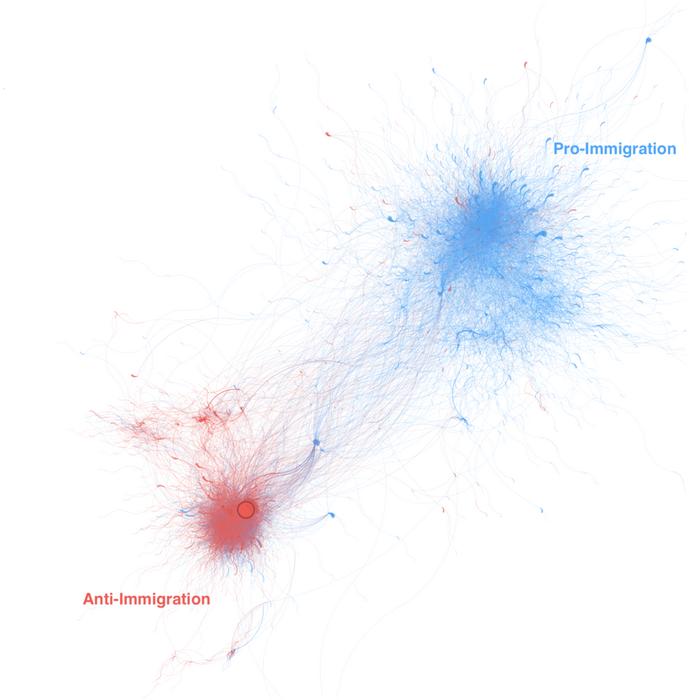
A study of more than 200,000 tweets from 2019 and 2020 finds that anti-immigration content spreads faster than pro-immigration tweets and that a few users disproportionally generated most of the UK-based anti-immigration content. Andrea Nasuto and Francisco Rowe of the Geographic Data Science Lab at the University of Liverpool, UK, present these findings in the open-access journal PLOS ONE on September 4, 2024.
A study of more than 200,000 tweets from 2019 and 2020 finds that anti-immigration content spreads faster than pro-immigration tweets and that a few users disproportionally generated most of the UK-based anti-immigration content. Andrea Nasuto and Francisco Rowe of the Geographic Data Science Lab at the University of Liverpool, UK, present these findings in the open-access journal PLOS ONE on September 4, 2024.
Online social media platforms are widely considered to contribute significantly to rising tensions in debates about immigration. Increased online polarization, the clout of key influencers, and the speed with which anti-immigration sentiments spread are all thought to markedly affect the propagation of pro- and anti-immigration sentiments on social media.
However, few studies have quantitatively assessed these contributing factors. To address that gap, Nasuto and Rowe analyzed 220,870 immigration-related tweets posted in the UK from December 2019 through April 2020. They applied natural language processing methods and social network science to explore the three factors, including building a ‘ChatGPT-like’ language model to identify different stances towards immigration.
Their analysis confirmed a high degree of polarization between networks of pro- and anti-immigration Twitter users in the UK During the study period, the pro-immigration community was 1.69 times larger in number than the anti-immigration community, but the anti-immigration community was more active and engaged to a greater degree with each other’s content. Anti-immigration tweets spread 1.66 times more rapidly than pro-immigration tweets.
Within the anti-immigration community, the top 1 percent of users generated about 23 percent of anti-immigration tweets, while the top 1 percent of pro-immigration users generated about 12 percent of pro-immigration tweets. Overall, bots appeared to make up less than 1 percent of all key producers and spreaders of pro- or anti-immigration content, suggesting limited influence.
The researchers note the potential for online anti-immigration content to provoke real-world harm, including violence. On the basis of their findings, they suggest that efforts to curb online hate content might benefit from identification and monitoring of highly active anti-immigration users. They also note that future research could address their study’s limitations, such as uncertainty as to how representative the data are of the entire UK population.
The authors add: “A concentrated effort by a few can amplify a message far beyond its origins, redefining the power dynamics of social media.”
“The speed at which anti-immigration content circulates is more than just alarming—it’s dangerous. England’s recent events reveal how fast online narratives can incite real-world violence.”
#####
In your coverage please use this URL to provide access to the freely available article in PLOS ONE: https://journals.plos.org/plosone/article?id=10.1371/journal.pone.0307917
Citation: Nasuto A, Rowe F (2024) Understanding anti-immigration sentiment spreading on Twitter. PLoS ONE 19(9): e0307917. https://doi.org/10.1371/journal.pone.0307917
Author Countries: UK
Funding: NWSSDTP Grant Number ES/P000665/1.
Journal
PLoS ONE
DOI
10.1371/journal.pone.0307917
Method of Research
Observational study
Subject of Research
People
Article Title
Understanding anti-immigration sentiment spreading on Twitter
Article Publication Date
4-Sep-2024
COI Statement
The authors have declared that no competing interests exist.