Researchers from the National University of Singapore (NUS) have successfully simulated higher-order topological (HOT) lattices with unprecedented accuracy using digital quantum computers. These complex lattice structures can help us understand advanced quantum materials with robust quantum states that are highly sought after in various technological applications.
Researchers from the National University of Singapore (NUS) have successfully simulated higher-order topological (HOT) lattices with unprecedented accuracy using digital quantum computers. These complex lattice structures can help us understand advanced quantum materials with robust quantum states that are highly sought after in various technological applications.
The study of topological states of matter and their HOT counterparts has attracted considerable attention among physicists and engineers. This fervent interest stems from the discovery of topological insulators – materials that conduct electricity only on the surface or edges – while their interiors remain insulating. Due to the unique mathematical properties of topology, the electrons flowing along the edges are not hampered by any defects or deformations present in the material. Hence, devices made from such topological materials hold great potential for more robust transport or signal transmission technology.
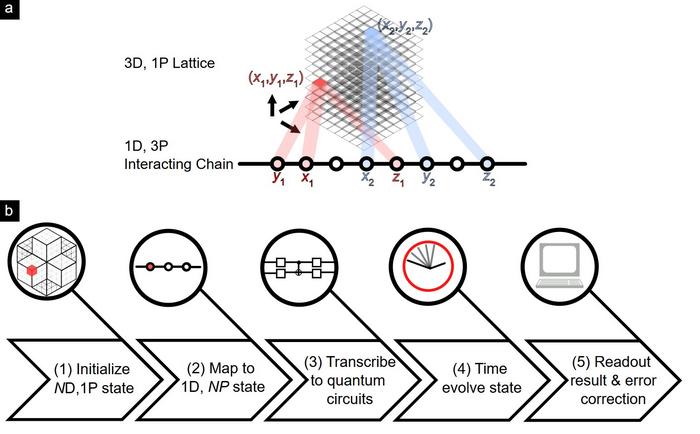
Using many-body quantum interactions, a team of researchers led by Assistant Professor Lee Ching Hua from the Department of Physics under the NUS Faculty of Science has developed a scalable approach to encode large, high-dimensional HOT lattices representative of actual topological materials into the simple spin chains that exist in current-day digital quantum computers. Their approach leverages the exponential amounts of information that can be stored using quantum computer qubits while minimising quantum computing resource requirements in a noise-resistant manner. This breakthrough opens up a new direction in the simulation of advanced quantum materials using digital quantum computers, thereby unlocking new potential in topological material engineering.
The findings from this research have been published in the journal Nature Communications.
Asst Prof Lee said, “Existing breakthrough studies in quantum advantage are limited to highly-specific tailored problems. Finding new applications for which quantum computers provide unique advantages is the central motivation of our work.”
“Our approach allows us to explore the intricate signatures of topological materials on quantum computers with a level of precision that was previously unattainable, even for hypothetical materials existing in four dimensions” added Asst Prof Lee.
Despite the limitations of current noisy intermediate-scale quantum (NISQ) devices, the team is able to measure topological state dynamics and protected mid-gap spectra of higher-order topological lattices with unprecedented accuracy thanks to advanced in-house developed error mitigation techniques. This breakthrough demonstrates the potential of current quantum technology to explore new frontiers in material engineering. The ability to simulate high-dimensional HOT lattices opens new research directions in quantum materials and topological states, suggesting a potential route to achieving true quantum advantage in the future.
Journal
Nature Communications
DOI
10.1038/s41467-024-49648-5
Article Title
Realization of higher-order topological lattices on a quantum computer
Article Publication Date
10-Jul-2024