Personalized wearable devices that monitor people’s health are on the rise. From watches to patches and other types of sensors, these smart devices can monitor heart activity, inflammation levels, and more to help patients better manage their health from their own homes. Now, a new type of wearable device can be added to the list: a high-tech paper mask that monitors one’s breath.
Personalized wearable devices that monitor people’s health are on the rise. From watches to patches and other types of sensors, these smart devices can monitor heart activity, inflammation levels, and more to help patients better manage their health from their own homes. Now, a new type of wearable device can be added to the list: a high-tech paper mask that monitors one’s breath.
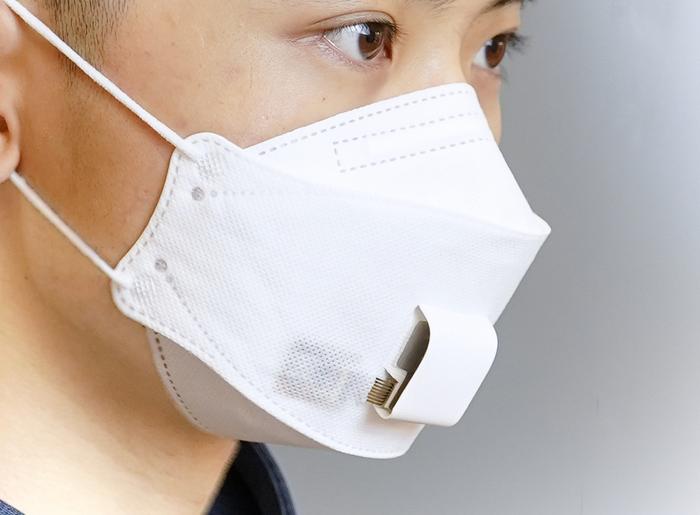
Caltech’s Wei Gao, professor of medical engineering, and his colleagues have developed a prototype for a smart mask that can be used to monitor a range of medical conditions, including respiratory ailments, such as asthma, COPD (chronic obstructive pulmonary disease), and post-COVID-19 infections. In contrast to other smart masks being developed that monitor physical changes like the temperature, humidity, or rate of breath, this one, called EBCare, can analyze the chemicals in one’s breath in real time. (“EBC” is an acronym used in this field that means “exhaled breath condensate.”) For example, the mask could monitor asthma patients for levels of nitrite, a chemical that indicates airway inflammation.
“Monitoring a patient’s breath is something that is routinely done, for example, to assess asthma and other respiratory conditions. However, this has required the patient to visit a clinic for sample collection, followed by a waiting period for lab results,” says Gao, the lead investigator of a new study describing the mask in the journal Science. “Since COVID-19, people are wearing masks more. We can leverage this increased mask use for remote personalized monitoring to get real-time feedback about our own health in our home or office. For instance, we could use this information to assess how well a medical treatment may be working.”
Gao, who is also a Heritage Medical Research Institute Investigator and Ronald and JoAnne Willens Scholar, has already developed a range of wearable biosensors that analyze human sweat to measure metabolites, nutrients, hormones, and protein levels. In this case, Gao’s goal was to monitor the breath, which came with a new set of challenges.
To selectively analyze the chemicals or molecules in somebody’s breath, it needs to be first cooled and condensed into a liquid. In clinical settings, this cooling step is done separately from the analysis. Moistbreath samples are chilled on buckets of ice or bulky refrigerated coolers. Gao’s new mask, in contrast, is self-cooling. The breath is cooled by a passive cooling system that integrates hydrogel evaporative cooling with radiative cooling to effectively chill the breath on face masks.
“The mask represents a new paradigm for respiratory and metabolic disease management and precise medicine because we can easily get breath specimens and analyze the chemical molecules in breath in real time through daily masks,” says Wenzheng Heng, lead author of the study and a graduate student at Caltech. “The breath condensate contains soluble gases as well as nonvolatile substances in the form of aerosols or droplets, such as metabolic substances, inflammatory indicators, and pathogens.”
Once the breath has been converted into a liquid, a series of capillaries, belonging to a class of devices referred to as bioinspired microfluidics, immediately transports the liquid to sensors for analysis. “We learned from plants how to transport the water,” says Gao. “Plants use capillary forces to draw water upward from the ground.”
The results of the analysis are then transmitted wirelessly to a personal phone, tablet, or computer. “The smart mask can be prepared at a relatively low cost,” says Gao. “It is designed to cost only about $1 in materials.”
To test the masks, the team performed a set of human studies, primarily focused on patients with asthma or COPD. They specifically monitored the patients’ breath for nitrite, a biomarker for inflammation in both conditions. The results showed that the masks accurately detected the biomarker, indicting inflammation in the patients’ airways.
In another study, the team demonstrated that the masks accurately detected blood alcohol levels in human subjects, suggesting the masks could be used for on-site drinking-and-driving checks or other forms of alcohol-consumption monitoring.
They also looked at how the masks could potentially be used to evaluate blood urea levels in the monitoring and management of kidney disease. As kidney function declines, protein metabolism by-products like urea accumulate in the blood. At the same time, urea increases in saliva, which breaks down into ammonia gas, and this leads to higher ammonium levels in the breath condensate. The new study showed that the smart masks could accurately detect these ammonium levels, closely reflecting urea levels in the blood.
“These first studies are a proof of concept,” says Gao. “We want to expand this technology to incorporate different markers related to various health conditions. This is a foundation for creating a mask that functions as a versatile general health–monitoring platform.”
As for the comfort of the masks, participants reported favorable experiences, even those with breathing problems.
“The smart mask platform for EBC harvesting and analysis represents a major advance in the potential to monitor lung health in real time,” says co-author Harry Rossiter, investigator at the Lundquist Institute for Biomedical Innovation at Harbor-UCLA and professor of medicine at the David Geffen School of Medicine at UCLA. “That concept, that biosensors for a wide range of compounds may be added in the future, highlights the game-changing potential of the smart mask for health monitoring and diagnostics.”
The study titled “A smart mask for exhaled breath condensate harvesting and analysis” was funded by the National Institutes of Health, the National Science Foundation, the Tobacco Related Disease Research Program, and the U.S. Army Medical Research Acquisition Activity. Other Caltech authors include graduate students Shukun (Kevin) Yin, Canran Wang, Hong Han, and Jiahong Li, and postdoc Jihong Min, in addition to Ehsan Shirzaei Sani and Yu Song, former postdocs at Caltech.
Journal
Science
DOI
10.1126/science.adn6471
Article Title
A smart mask for exhaled breath condensate harvesting and analysis
Article Publication Date
30-Aug-2024