Large-scale genomic analysis of darkling beetles, a hyper-diverse insect group of more than 30,000 species worldwide, rolls back the curtain on a 150-million-year evolutionary tale of one of Earth’s most ecologically important yet inconspicuous creatures, according to new research from The Australian National University (ANU) and CSIRO.
Large-scale genomic analysis of darkling beetles, a hyper-diverse insect group of more than 30,000 species worldwide, rolls back the curtain on a 150-million-year evolutionary tale of one of Earth’s most ecologically important yet inconspicuous creatures, according to new research from The Australian National University (ANU) and CSIRO.
Scientists have long been captivated by the “extraordinary” diversity of darkling beetles – tiny critters that have lived since the age of the dinosaurs – and their ability to successfully adapt to and thrive in a range of diverse and harsh environments over hundreds of millions of years.
But until now, it was not fully understood how beetles were able to evolve certain traits and abilities that allowed them to “conquer the world”.
According to lead author Dr Yun (Living) Li, from ANU and CSIRO, darkling beetles underwent multiple “big bang” evolutionary events right from the start, allowing them to expand and colonise a vast range of terrestrial environments across Earth and rapidly evolve into a “spectacular array” of different body forms that we see today.
“Primarily scavengers, darkling beetles play critical ecological roles as decomposers. But their habits are particularly diverse,” Dr Li said.
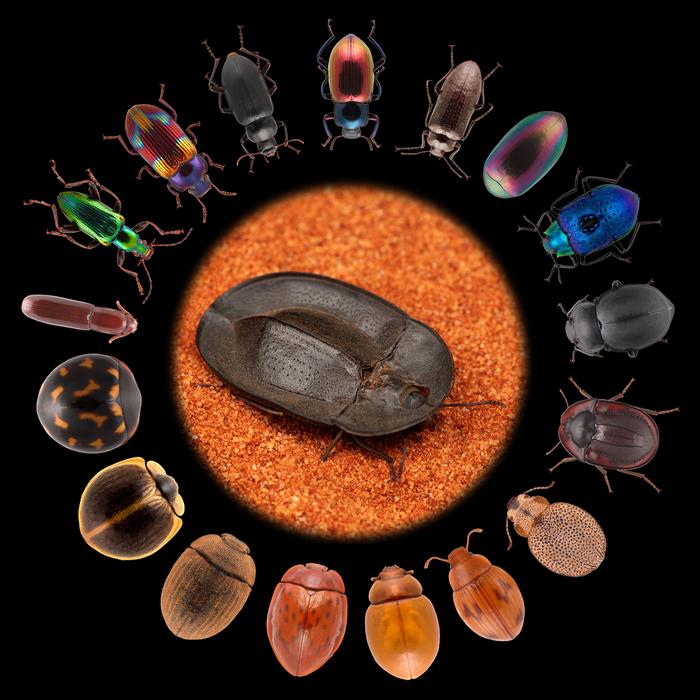
“Darkling beetles are masters of shape-shifting, displaying a wide array of body shapes from the wood-boring, cylindrical form that resembles a candlestick to surface-grazing, hemispherical forms reminiscent of a ping-pong ball.”
By analysing darkling beetle DNA extracted from museum specimens, the researchers reconstructed an evolutionary tree looking back at 150 million years of evolution for more than 300 species.
To understand the drivers of darkling beetle diversity, the researchers collected ecological information and quantified body shape variations by digitising more than 900 specimens deposited at the Australian National Insect Collection (ANIC) at CSIRO.
Across the darkling beetle family tree, the researchers found substantial variations in the speed of darkling beetles’ body shape evolution, with some lineages displaying particularly fast evolution –what the researchers refer to as “quantum evolution”.
This is what allowed darkling beetles to rapidly change their body shape over time to adapt to challenging new environments.
Dr Li said quantum evolution is the key to the exceptional “shape-shifting” abilities of darkling beetles.
“This is how darkling beetles have been able to conquer a variety of environments which have changed over hundreds of millions of years, from tropical savannas and arid deserts to coastal dunes and mountain tops, and even our backyards,” Dr Li said.
“Our results show that quantum evolution occurred frequently across the evolutionary tree of darkling beetles. We discovered more than 60 rapid evolutionary jumps that are linked to ecological changes to highly specialised environments in which these beetles were living in.
“Looking back in time, these beetles underwent periods of rapid bursts of evolution, particularly near the end of the Cretaceous–Paleogene mass extinction event that occurred about 66 million years ago, which wiped out more than 70 per cent of all species on the planet.”
With more than 400,000 known species, beetles account for almost one quarter of all animal life on Earth. Dr Li said beetles “truly dominate the world”, both in terms of their diversity and ecological importance.
“By looking into the evolutionary history of these small but hyper-diverse insects, we can draw a detailed picture of the evolution of diverse life forms on Earth,” Dr Li said.
“The rapid evolution of darkling beetles has helped them rise to global ecological dominance.”
The research is published in Current Biology.
Journal
Current Biology
DOI
10.1016/j.cub.2024.06.080
Method of Research
Computational simulation/modeling
Subject of Research
Animals
Article Title
Evolution across the adaptive landscape in a hyperdiverse beetle radiation
Article Publication Date
26-Jul-2024