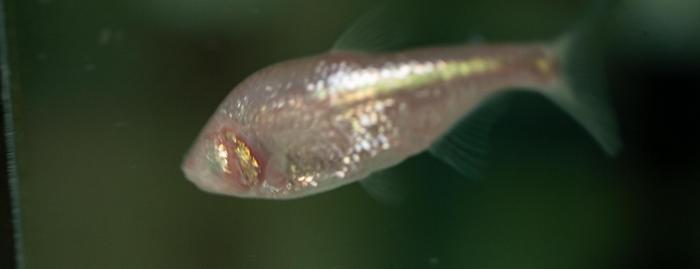
Over thousands of years, cavefish evolved and lost their vision, earning the moniker “the blind cavefish,” but some cavefish also developed an inordinate number of taste buds on the head and chin.
Over thousands of years, cavefish evolved and lost their vision, earning the moniker “the blind cavefish,” but some cavefish also developed an inordinate number of taste buds on the head and chin.
In a new study, now published in the Nature journal Communications Biology, scientists at the University of Cincinnati have determined when the taste buds start to appear in areas beyond the oral cavity. The study was supported by the National Science Foundation.
To begin, blind cavefish evolved in cave ponds in northeastern Mexico. They are pale pink and nearly translucent compared to their silvery counterparts that live in surface rivers and streams. While cavefish have the faintest outline of eye sockets, the surface fish have enormous round eyes that give them a perpetually surprised expression.
Despite the many obvious physical differences, the two fish are considered the same species.
“Regression, such as the loss of eyesight and pigmentation, is a well-studied phenomenon, but the biological bases of constructive features are less well understood,” says the article’s senior author UC professor and biologist Joshua Gross, whose laboratory is dedicated to the study of evolution and development of cave-dwelling vertebrates.
Although scientists in the 1960s discovered that certain populations of blind cavefish had extra taste buds — on the head and chin — there was no further study of the developmental or genetic processes that explain this unusual trait, says Gross.
To determine when the extra taste buds appear, Gross and his research team looked at the species Astyanax mexicanus, including two separate cavefish populations that dwell in the Pachón and Tinaja caves in northwestern Mexico, known to have the additional taste buds.
The research team found that the number of taste buds is similar to the surface fish from birth through 5 months of age. The taste buds then start to increase in number and appear on the head and chin in smatterings, well into adulthood, at approximately 18 months.
Cavefish can live much longer than 18 months in nature and captivity, and the authors suspect even more taste buds continually accumulate as the fish get older.
While timing of taste bud appearance was comparable for the Pachón and Tinaja cavefish populations, some differences were evident with respect to density and timing of expansion, says Gross. The other surprising discovery from this study, says Gross, is the genetic architecture of this trait: “Despite the complexity of this feature, it appears that more taste buds on the head are controlled mainly by only two regions of the genome.”
The increase correlates with the time that the cavefish stop eating other live foods for sustenance and start to pursue other food sources, Gross says, such as bat guano. Equally fascinating, he says, is that the expansion may occur in other cave locations where there are no bat populations.
With more taste buds, he says, the cavefish have a keener sense of taste, “which is likely an adaptive trait.”
“It remains unclear what is the precise functional and adaptive relevance of this augmented taste system,” says Gross, which has led the team to begin new studies that focus on taste, by exposing the fish to different flavors such as sour, sweet and bitter.
Journal
Communications Biology
Method of Research
Data/statistical analysis
Subject of Research
Animals
Article Title
The spatiotemporal and genetic architecture of extraoral taste buds in Astyanax cavefish
Article Publication Date
6-Aug-2024