WASHINGTON, July 2, 2024 – An energy crisis hit Europe in 2021-2022, following Russia’s invasion of Ukraine, which sent electricity prices skyrocketing — even within countries that don’t rely on Russian gas. It begs the question: Was there more to it?
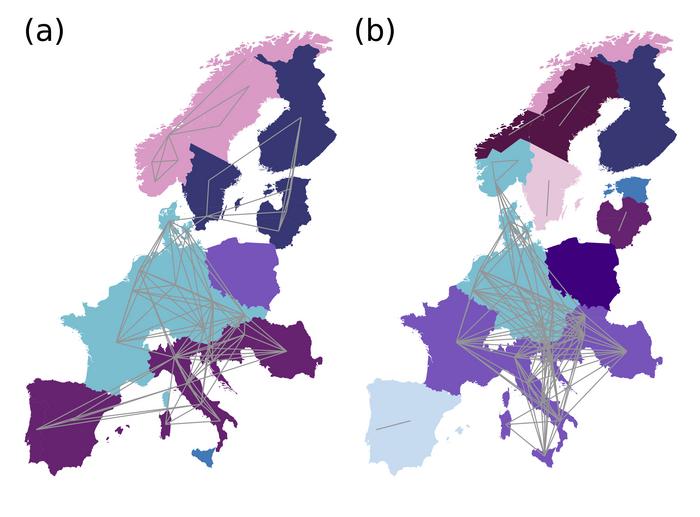
Credit: Julius Trebbien, Anton Tausendfreund, Leonardo Rydin, and Dirk Witthaut
WASHINGTON, July 2, 2024 – An energy crisis hit Europe in 2021-2022, following Russia’s invasion of Ukraine, which sent electricity prices skyrocketing — even within countries that don’t rely on Russian gas. It begs the question: Was there more to it?
A team of researchers from the Institute for Energy and Climate Research at Forschungszentrum Jülich, the University of Cologne, and the Norwegian University of Life Sciences had already been working with electricity price data for years, exploring statistics and developing forecasting methods. Adopting a European perspective, they zeroed in on how prices in different countries relate and how countries were affected by the energy crisis.
In Chaos, from AIP Publishing, the team addresses the interdependencies of different markets.
“We use an empirical approach to these topics and complement modeling efforts by economists,” said Dirk Witthaut, a professor of network science for the Institute for Energy and Climate Research at Forschungszentrum Jülich and the University of Cologne.
This approach combines statistical physics and network science, which “provide very useful tools to study questions well beyond the traditional realm of physics,” said Witthaut. “The biggest step is to see the connections.”
First, the researchers identify communities — groups of European countries whose markets are strongly correlated. Then, they identify the fundamental spatiotemporal patterns within the electricity price/time data from all countries. The exciting part for the researchers was how these structures and patterns changed during the energy crisis.
The team noticed Russian natural gas and skyrocketing electricity prices were frequently attributed to the soaring gas prices, while other factors were simultaneously at play with impacts that should not be underestimated.
“Remarkably, France and southern Norway saw the strongest increase in electricity prices — although they do not rely on Russian gas for electric power plants,” said Witthaut. “The high unavailability of nuclear power plants in France and the operation of new interconnectors from Norway to the continent surely played a role.”
The team found that when the energy crisis shook European electricity markets, the structures and patterns within the electricity price data changed in a variety of ways.
“Our results emphasize that a national perspective on electricity systems can be quite misleading,” he said. “Europe’s electric power system is highly integrated, which is overall highly beneficial for the customers.”
The researchers hope their work will strengthen the European perspective in the political debate about electricity markets and prices, because problems like this are best tackled via international cooperation. They expect immediate impacts within the field of electricity price forecasting.
“Most scientists only look at one national market, but the interactions with other countries must not be neglected,” said Witthaut. “We’ll get accurate forecasts only if we model all countries together.”
The next step for the team is to move beyond analyzing correlations to identifying cause and effects.
“There’s an intensive debate about how changes in our electricity mix affect prices and costs,” said Witthaut. “How does the rise of renewable power affect market prices? How important are nuclear power plants for the market? We can’t answer these questions by a simple correlation analysis. Instead, we need statistical tools that can quantify causal effects.”
###
The article “Patterns and correlations in European electricity pricing” is authored by Julius Trebbien, Anton Tausendfreund, Leonardo Rydin, and Dirk Witthaut. It will appear in Chaos on July 2, 2024 (DOI: 10.1063/5.0201734). After that date, it can be accessed at https://doi.org/10.1063/5.0201734.
ABOUT THE JOURNAL
Chaos is devoted to increasing the understanding of nonlinear phenomena in all areas of science and engineering and describing their manifestations in a manner comprehensible to researchers from a broad spectrum of disciplines. See https://aip.scitation.org/journal/cha.
###
Journal
Chaos An Interdisciplinary Journal of Nonlinear Science
DOI
10.1063/5.0201734
Article Title
Patterns and correlations in European electricity pricing
Article Publication Date
2-Jul-2024