Bioaerosols include bacteria, fungi, fungal spores and plant pollen, as well as viruses and their secretions such as endotoxin, glucan and mycotoxins. Various respiratory diseases such as rhinitis, respiratory inflammation, asthma and coronavirus disease (COVID-19) are related to bioaerosol exposure. However, due to the complexity, diversity and non-biological interference of bioaerosols, online detection of bioaerosols has challenging.
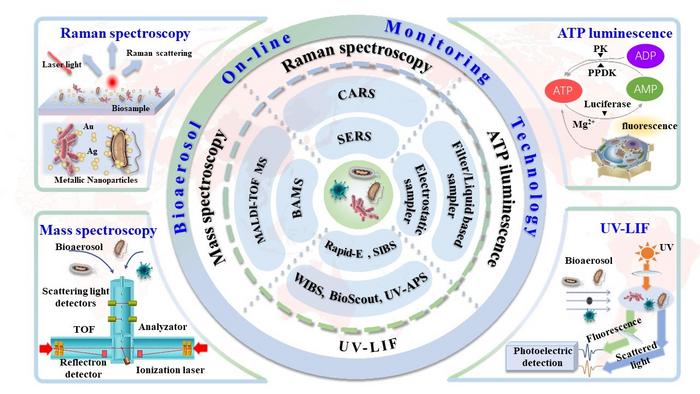
Credit: Zhen Chen
Bioaerosols include bacteria, fungi, fungal spores and plant pollen, as well as viruses and their secretions such as endotoxin, glucan and mycotoxins. Various respiratory diseases such as rhinitis, respiratory inflammation, asthma and coronavirus disease (COVID-19) are related to bioaerosol exposure. However, due to the complexity, diversity and non-biological interference of bioaerosols, online detection of bioaerosols has challenging.
In a review published in the journal Fundamental Research, a team of researchers from Guangdong University of Technology summarized the existing technologies and instruments that can be used for online detection of bioaerosols, and put forward prospects for the development of detection technologies and instruments.
According to lead author of the study Professor Taicheng, different bioaerosol detection technologies have their own characteristics and suitable conditions, and there is a need to select appropriate detection methods based on different conditions and purpose.
“ATP is a simple, economical, efficient and fast method that can be used to quantify microbial concentration,” says An. “We can create an online detection platform of bioaerosol by combining with filtration method, electrostatic method and aerosol-hydrosol sampler.”
Notably, laser-induced fluorescence technology is the most widely used non-invasive bioaerosol detection method with fast resolution. It involves the use of laser to excite fluorescent substances such as tryptophan, and reduced coenzymes contained in biological particles to achieve the detection of bioaerosols.
Additionally, Raman spectroscopy is rapid, specific, reliable and non-invasive technique for real-time detection of bioaerosols, with surface-enhanced Raman spectroscopy (SERS) and coherent anti-stokes Raman spectroscopy (CARS) being the two most popular techniques for rapid bioaerosol identification.
According to co-author Dr Zhishu Liang, although the reviewed methods can achieve rapid detection of bioaerosols, there remain flaws that need to be improved. For example, ATP bioluminescence method cannot distinguish microorganisms at the species level, while LIF cannot eliminate environmental factors and non-biological particle interference without fluorescence database. As for Raman spectroscopy, it needs to be used in combination with other tools to improve selectivity and sensitivity of bioaerosol.
“We hope that future research on the development of detection instruments will prioritize accuracy, rather than solely pursuing the function of online monitoring,” concludes Liang.
###
Contact the author: Taicheng An, School of Environmental Science and Engineering, Institute of Environmental Health and Pollution Control, Guangdong University of Technology, Guangzhou 510006, China, [email protected]
The publisher KeAi was established by Elsevier and China Science Publishing & Media Ltd to unfold quality research globally. In 2013, our focus shifted to open access publishing. We now proudly publish more than 100 world-class, open access, English language journals, spanning all scientific disciplines. Many of these are titles we publish in partnership with prestigious societies and academic institutions, such as the National Natural Science Foundation of China (NSFC).
Journal
Fundamental Research
DOI
10.1016/j.fmre.2023.05.012
Method of Research
Literature review
Subject of Research
Not applicable
Article Title
Recent progress in online detection methods of bioaerosols
COI Statement
The authors declare that they have no conflicts of interest in this work.