X-ray binaries are intriguing systems consisting of two celestial bodies: a normal star and a compact, dead object such as a black hole or a neutron star that sucks material from its stellar companion. A few hundred such sources have been identified thus far in our Galaxy. When it comes to the most powerful phenomena in the Universe, the release of gravitational energy in X-ray binary systems stands out as a highly efficient process.
Credit: Alexander Mushtukov
X-ray binaries are intriguing systems consisting of two celestial bodies: a normal star and a compact, dead object such as a black hole or a neutron star that sucks material from its stellar companion. A few hundred such sources have been identified thus far in our Galaxy. When it comes to the most powerful phenomena in the Universe, the release of gravitational energy in X-ray binary systems stands out as a highly efficient process.
Among the first X-ray binary systems discovered in the cosmos is the system Cygnus X-3. Since the early 1970s, this binary system was noted for its ability to briefly emerge as one of the most intense radio sources, yet in a few days it dims or vanishes altogether. This peculiar characteristic spurred early efforts, coordinated by telephone calls, to unite astronomical observations across the globe. The unique behavior of the system during these short-lived, highly energetic events, contrasting its otherwise “normal” nature, led to it being dubbed the “astronomical puzzle Cygnus X-3” by R.M. Hjellming in 1973. Numerous efforts have been aimed at understanding its nature ever since.
The breakthrough in unravelling this puzzle has been achieved thanks to the study of this system with the satellite Imaging X-ray Polarimetry Explorer (IXPE) that was launched by NASA in December 2021. According to Alexandra Veledina, an Academy Research Fellow at the University of Turku in Finland and the lead author of the study, the use of X-ray polarized vision has provided insights into the configuration of matter surrounding the compact object in the nearest proximity to the black hole.
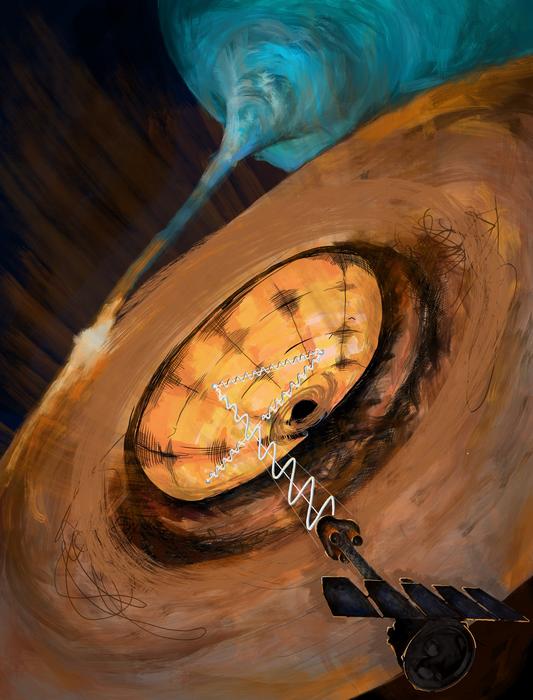
“We have discovered that the compact object is surrounded by an envelope of a dense, opaque matter. The light that we observe is a reflection off the inner funnel walls formed by the surrounding gas, resembling a cup with a mirror interior,” Veledina explains.
This revelation has led to the identification of Cygnus X-3 as a member of the class of ultra-luminous X-ray sources (ULXs), which consume matter at such a gargantuan rate that a considerable fraction of the infalling material does not fit inside the event horizon, but rather is being spat away from the system.
“ULXs are typically observed as luminous spots in the images of distant galaxies, with their emissions amplified by the focusing effects of the compact object’s surrounding funnel, acting akin to a megaphone,” elaborates Juri Poutanen, Professor at the Department of Physics and Astronomy of the University of Turku and a co-author of the research.
“However, due to the vast distances to these sources, thousands of times beyond the span of the Milky Way, they appear relatively faint to X-ray telescopes. Our discovery has now unveiled a bright counterpart of these distant ULXs residing within our own Galaxy.”
This significant finding marks a new chapter in the investigation of this extraordinary cosmic source, offering an opportunity for in-depth exploration of extreme matter consumption.
Journal
Nature Astronomy
DOI
10.1038/s41550-024-02294-9
Article Title
Cygnus X-3 revealed as a Galactic ultraluminous X-ray source by IXPE
Article Publication Date
21-Jun-2024