Smell and touch are the earliest sensations perceived by mammals, enabling newborns to nurse and bond with their mother. If one of these two early senses is defective, various neurodevelopmental disorder may develop in humans. “Our senses are crucial for the proper formation and functioning of brain circuits,” says Theofanis Karayannis, associate professor of neuroscience and co-director of the Brain Research Institute of the University of Zurich (UZH).
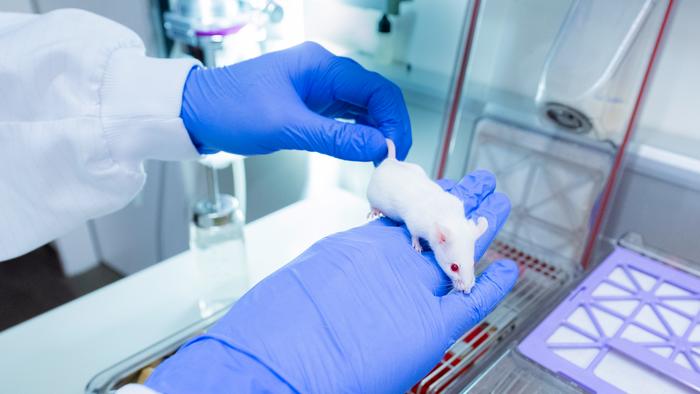
Credit: Frank Brüderli, University of Zurich
Smell and touch are the earliest sensations perceived by mammals, enabling newborns to nurse and bond with their mother. If one of these two early senses is defective, various neurodevelopmental disorder may develop in humans. “Our senses are crucial for the proper formation and functioning of brain circuits,” says Theofanis Karayannis, associate professor of neuroscience and co-director of the Brain Research Institute of the University of Zurich (UZH).
Odors affect the brain of newborns
Previous research has shown the importance of corresponding sensory input for the development of senses – odors for the sense of smell, sounds for the sense of hearing and so on. So far, however, little is known about how the different senses may influence another sense’s maturation.
A research team led by Karayannis has now taken a closer look at the effect of olfactory stimuli on the brains of newborn mice. To do this, the researchers delivered a pleasant odor to the nostrils of the pups and mapped the resulting activity pattern of brain cells using state-of-the-art wide field-of-view imaging of one cortical hemisphere. They observed that the odors triggered neural activity across a large part of the cerebral cortex in the mice, including areas responsible for touch.
Critical time window after birth
Furthermore, the researchers observed this phenomenon within only a very short window of time: during the first week after birth. In older pups as well as in adult mice, the odors affected more restricted areas of the brain. “This clearly shows that olfactory input in the first postnatal week induces a special pattern of electrical activity in the brain. This indicated to us that it may be essential for the formation of brain circuits for non-olfactory sensory processing,” explains Karayannis.
Maturation of sense of smell and touch is linked
To test this assumption, the team investigated whether early olfactory stimulation is also crucial for the maturation of the sense of touch. For this, they trained adult mice to distinguish whether fine or coarse sandpaper was touching their whiskers – a primary way by which mice survey their environment. The researchers found that mice who had not received any olfactory input in the first week of their lives performed significantly worse than those that had been exposed to odors. “A deficiency in olfaction during the critical window of time also affects touch processing in later life,” says Karayannis.
The transient functional interaction between the two early senses was also evident in anatomy of the brain: in the first week of life – that is, the critical window of time – the researchers detected a string of nerve connections stretching between the brain areas that process smell and touch. This link then disappeared within a couple of weeks.
Early olfactory stimuli are important
“Our study demonstrates that early-life exposure to odor is essential for touch development and maturation,” says Karayannis. “This finding perhaps extends to other senses such as hearing or sight, which mature later in life.” Although the experiments were done with mice, previous findings suggest that similar processes are at work in the human brain. “Our findings therefore raise attention to assessing the impact of olfactory deficiencies, especially early in life on the maturation of general sensory and cognitive processing.” Such deficits can come about by genetic alterations, but are also environmentally induced.
Odor therapy useful in NICUs?
One such example relates to premature babies which are placed in the neonatal intensive care unit (NICU), where they are deprived of a normal sensory environment. This has been shown to potentially leave long-term affective and cognitive marks on individuals. “While hospitals aim to provide optimal tactile, auditory and visual stimuli to these babies, the sense of smell is not as widely used,” says Karayannis. “Our results suggest a mechanism by which proper olfactory cues may have a positive effect on supporting the development of various sensory and cognitive skills in babies.”
Journal
Science
DOI
10.1126/science.adn5611oi
Method of Research
Experimental study
Subject of Research
Animals
Article Title
A nasal chemosensation-dependent critical window for somatosensory development
Article Publication Date
10-May-2024