Ancient apes in Germany co-existed by partitioning resources in their environment, according to a study published June 7, 2024 in the open-access journal PLOS ONE by Madelaine Böhme of Eberhard Karls University of Tübingen, Germany and David R. Begun, of University of Toronto, Canada and colleagues.
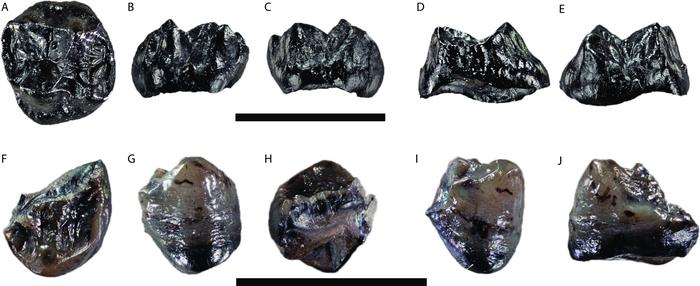
Credit: Böhme et al., 2024, PLOS ONE, CC-BY 4.0 (https://creativecommons.org/licenses/by/4.0/)
Ancient apes in Germany co-existed by partitioning resources in their environment, according to a study published June 7, 2024 in the open-access journal PLOS ONE by Madelaine Böhme of Eberhard Karls University of Tübingen, Germany and David R. Begun, of University of Toronto, Canada and colleagues.
The Hammerschmiede fossil site in Bavaria, Germany is best known for exceptional remains of the ancient great ape Danuvius dating to the late Miocene Epoch, 11.6 million years ago. Other experts contest the strength of the evidence to support whether Danuvius is a hominid or whether this is a new genus or not. No Miocene sites in Europe are known to have more than one species of fossil ape, and Hammerschmiede has been no exception until now. In this study, Böhme and colleagues identify a second species of great ape from the same stratigraphic layer as Danuvius.
This new ape is represented by partial remains of two teeth and one patella whose size and shape are distinct from Danuvius and all other known apes. The authors name this new species Buronius manfredschmidi. Based on the structure of the teeth and patella, the authors infer that Buronius was an adept climber which ate a diet of soft foods such as leaves. From the size of the fossils, the authors estimate a full body size of around 10kg, making Buronius the smallest known great ape.
These features suggest that Buronius had a distinct lifestyle from Danuvius, which is a larger bodied species with a diet of tougher foods. These differences likely allowed these two species to share a habitat without competing for resources, similar to modern gibbons and orangutans which share habitats in Borneo and Sumatra. This is the first known example of a European Miocene fossil site with multiple ancient ape species, though the authors suggest that re-examination of other similar sites might uncover more examples of this cohabiting behavior.
The authors add: “The new great ape from Hammerschmiede, Buronius manfredschmidi, is with about 10 kg body weight not only the smallest known crown ape, he attested the first case of hominid syntopy for Europe. The leaf-eating Buronius shared the habitat with the omnivorous bipedal ape Danuvius guggenmosi.”
#####
In your coverage please use this URL to provide access to the freely available article in PLOS ONE: https://journals.plos.org/plosone/article?id=10.1371/journal.pone.0301002
Citation: Böhme M, Begun DR, Holmes AC, Lechner T, Ferreira G (2024) Buronius manfredschmidi—A new small hominid from the early late Miocene of Hammerschmiede (Bavaria, Germany). PLoS ONE 19(6): e0301002. https://doi.org/10.1371/journal.pone.0301002
Author Countries: Germany, Canada
Funding: Since 2020, the excavations and associated research were supported by the Bavarian State Ministry of Research and the Arts and by the Bavarian Natural History Collections (SNSB). DRB acknowledges support from the Natural Sciences and Engineering Research Council of Canada (Grant File Number RGPIN-2016-06761).
Journal
PLoS ONE
DOI
10.1371/journal.pone.0301002
Method of Research
Observational study
Subject of Research
Animals
Article Title
Buronius manfredschmidi—A new small hominid from the early late Miocene of Hammerschmiede (Bavaria, Germany)
Article Publication Date
7-Jun-2024
COI Statement
The authors have declared that no competing interests exist.