FOR IMMEDIATE RELEASE
Credit: The Mitochondrial Phospholipid Research Center at Johns Hopkins Medicine
FOR IMMEDIATE RELEASE
By studying mutations in yeast and human cells, Johns Hopkins Medicine scientists say they have found that biochemical bonds between fats and proteins in the mitochondrion, the cell’s powerhouse, play a crucial role in how our cells produce energy.
The study results, published June 5 in The EMBO Journal, shed new light, researchers say, on the way the altered mitochondrial membranes found in people with metabolic diseases such as Barth syndrome, a rare genetic disorder that weakens the heart, fail to enable cellular power production.
Metabolism is a set of biochemical reactions central to making energy to fuel life and to getting rid of substances a body no longer needs. Metabolic diseases include forms of high cholesterol that run in families. Approximately one in three adults have some form of a metabolic syndrome, according to the National Heart, Lung, and Blood Institute.
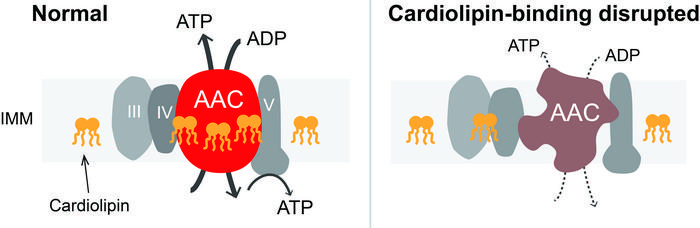
Building on previous research, the Johns Hopkins scientists sought to better understand the interaction of two components in the mitochondrial membrane: cardiolipin, a fatty compound, or lipid, and proteins that transport the building blocks of adenosine triphosphate, or ATP, an energy molecule made by the mitochondria that fuels cell metabolism.
“Down the line, a better understanding of protein-lipid interactions could help researchers find new therapeutic targets for a wide range of metabolic diseases, including Barth syndrome,” says senior author Steven Claypool, Ph.D., professor of physiology at the Johns Hopkins University School of Medicine.
He says previous studies suggested it’s likely that protein-lipid interactions in mitochondrial membranes play an important role in regulating mitochondria’s powerhouse activities.
The researchers conducted their experiments in samples of yeast with mutations, or alterations, in a mitochondrial membrane protein called AAC and samples of human cells that modeled a person with a mutation of the protein ANT1 who was diagnosed with metabolic disease, symptoms of which include weakness in the heart and skeletal muscles, exercise intolerance and hyperlactatemia, or elevated lactate levels in the blood.
The protein in yeast, AAC, is the equivalent of ANT in humans, Claypool says.
Looking at three areas where cardiolipin binds to the AAC proteins in yeast, Claypool and his colleagues found that when they introduced mutations into AAC2 to disrupt these interactions, cardiolipin could no longer bond to the protein, which weakened its structure and lowered its function.
Similarly, in the cell model of the person with mutations in ANT1, the protein’s structure was weakened, limiting its ability to transport ATP across the mitochondrial membrane.
“These findings indicate that when the interaction between cardiolipin and proteins break down, the entire process that makes mitochondria our powerhouse is disrupted,” says first author Nanami Senoo, Ph.D., a postdoctoral fellow in Claypool’s lab.
Claypool says few studies have detailed individual protein-lipid interactions, and many more experiments will be needed to “understand the full complement of mechanisms and roles that these interactions have in the membrane.”
Mitochondrial membranes contain a lot of proteins, many of which associate with lipids.
“This discovery opens up new possibilities for understanding the complexities of how our cells produce energy,” Claypool says. “In the future, we plan to explore how other protein-lipid interactions contribute to energy production.”
Other scientists who contributed to the study are Matthew G. Baile, Oluwaseun B. Ogunbona, James A. Saba, Teona Munteanu, Yllka Valdez, Kevin Whited and Macie S. Sheridan of Johns Hopkins; Dinesh K. Chinthapalli, Bodhisattwa Saha, Abraham O. Oluwole, Dror Chorev and Carol V. Robinson of University of Oxford; Vinaya K. Golla, Nathan N. Alder and Eric R. May of University of Connecticut.
Funding for this study was provided by the National Institutes of Health (R01HL108882, R01HL165729, R35GM119762, T32GM007445 and T32GM136577), the American Heart Association, the Uehara Memorial Foundation, the Barth Syndrome Foundation and the Royal Society Newton International Fellowship.
DOI: 10.1038/s44318-024-00132-2
Journal
The EMBO Journal
DOI
10.1038/s44318-024-00132-2