• HOME
  • NEWS
  • EXPLORE
    • CAREER
      • Companies
      • Jobs
    • EVENTS
    • iGEM
      • News
      • Team
    • PHOTOS
    • VIDEO
    • WIKI
  • BLOG
  • COMMUNITY
    • FACEBOOK
    • INSTAGRAM
    • TWITTER
Sunday, August 16, 2026
BIOENGINEER.ORG
No Result
View All Result
  • Login
  • HOME
  • NEWS
  • EXPLORE
    • CAREER
      • Companies
      • Jobs
        • Lecturer
        • PhD Studentship
        • Postdoc
        • Research Assistant
    • EVENTS
    • iGEM
      • News
      • Team
    • PHOTOS
    • VIDEO
    • WIKI
  • BLOG
  • COMMUNITY
    • FACEBOOK
    • INSTAGRAM
    • TWITTER
  • HOME
  • NEWS
  • EXPLORE
    • CAREER
      • Companies
      • Jobs
        • Lecturer
        • PhD Studentship
        • Postdoc
        • Research Assistant
    • EVENTS
    • iGEM
      • News
      • Team
    • PHOTOS
    • VIDEO
    • WIKI
  • BLOG
  • COMMUNITY
    • FACEBOOK
    • INSTAGRAM
    • TWITTER
No Result
View All Result
Bioengineer.org
No Result
View All Result
Home NEWS Science News

A cracking discovery – eggshell waste can recover rare earth elements needed for green energy

Bioengineer by Bioengineer
June 5, 2024
in Science News
Reading Time: 3 mins read
0
Conceptual framework
Share on FacebookShare on TwitterShare on LinkedinShare on RedditShare on Telegram

A collaborative team of researchers has made a cracking discovery with the potential to make a significant impact in the sustainable recovery of rare earth elements (REEs), which are in increasing demand for use in green energy technologies. The team found that humble eggshell waste could recover REES from water, offering a new, environmentally friendly method for their extraction.
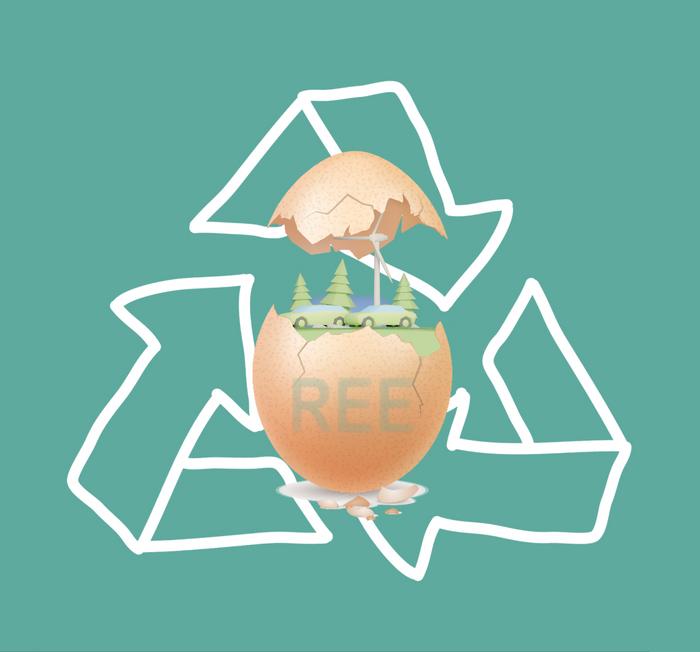
Conceptual framework

Credit: Prof. Juan Diego Rodriguez-Blanco, Trinity College Dublin

A collaborative team of researchers has made a cracking discovery with the potential to make a significant impact in the sustainable recovery of rare earth elements (REEs), which are in increasing demand for use in green energy technologies. The team found that humble eggshell waste could recover REES from water, offering a new, environmentally friendly method for their extraction.

The researchers, from Trinity College Dublin’s School of Natural Sciences, and iCRAG, the Science Foundation Ireland research centre in applied geosciences, have just published their ground-breaking findings in the international journal ACS Omega.

REEs, which are essential for the technologies used in electric cars and wind turbines, for example, are in increasing demand but in relatively short supply. As a result, scientists must find new ways of extracting them from the environment – and in sustainable ways, with current methods often harmful. 

Here, the researchers discovered that calcium carbonate (calcite) in eggshells can effectively absorb and separate these valuable REEs from water.

The researchers placed eggshells in solutions containing REEs at various temperatures from a pleasant 25 °C to a scorching 205 °C, and for different time periods of up to three months. They found that the elements could enter the eggshells via diffusion along the calcite boundaries and the organic matrix, and, at higher temperatures, that the rare earth built new minerals on the eggshell surface. 

At 90 °C, the eggshell surface helped recover formations of a rare earth compound called kozoite. As things got hotter, the eggshells underwent a complete transformation with the calcite shells dissolving and being replaced by polycrystalline kozoite. And at the highest temperature of 205°C, this mineral gradually transitioned into bastnasite, the stable rare earth carbonate mineral that is used by industry to extract REEs for technology applications. 

This innovative method suggests that waste eggshells could be repurposed as a low-cost, eco-friendly material to help meet the growing demand for REES, as the eggshells trap distinct rare earths within their structure over time.

Lead author Dr Remi Rateau commented on the significance of the research, stating, “This study presents a potential innovative use of waste material that not only offers a sustainable solution to the problem of rare earth element recovery but also aligns with the principles of circular economy and waste valorisation.”

Principal Investigator, Prof. Juan Diego Rodriguez-Blanco, emphasised the broader implications of the findings, adding: “By transforming eggshell waste into a valuable resource for rare earth recovery, we address critical environmental concerns associated with traditional extraction methods and contribute to the development of greener technologies.”

Work was conducted at the Department of Geology in the School of Natural Sciences, Trinity. iCRAG (Irish Centre for Research in Applied Geosciences) is an SFI centre dedicated to advancing geosciences research with a focus on sustainable resource management and environmental protection.


Journal

ACS Omega

DOI

10.1021/acsomega.4c00931

Share12Tweet8Share2ShareShareShare2

Related Posts

KAIST develops semiconductor neuron that harnesses noise to selectively process signals

KAIST develops semiconductor neuron that harnesses noise to selectively process signals

August 16, 2026
Imagining natural and extra robotic thumbs together strengthens kinesthetic sensorimotor networks

Imagining natural and extra robotic thumbs together strengthens kinesthetic sensorimotor networks

August 16, 2026

PARP1 Drives Neuropathic Pain Through GPX4-Dependent Ferroptosis in Injured Mice’s Sensory Neurons

August 15, 2026

Strubbelig–NHL3 Receptor Complex Helps Arabidopsis Respond to Cellulose Deficiency

August 15, 2026

POPULAR NEWS

  • KAIST develops semiconductor neuron that harnesses noise to selectively process signals

    29 shares
    Share 12 Tweet 7
  • Imagining natural and extra robotic thumbs together strengthens kinesthetic sensorimotor networks

    29 shares
    Share 12 Tweet 7
  • PARP1 Drives Neuropathic Pain Through GPX4-Dependent Ferroptosis in Injured Mice’s Sensory Neurons

    29 shares
    Share 12 Tweet 7
  • Strubbelig–NHL3 Receptor Complex Helps Arabidopsis Respond to Cellulose Deficiency

    29 shares
    Share 12 Tweet 7

About

We bring you the latest biotechnology news from best research centers and universities around the world. Check our website.

Follow us

Recent News

KAIST develops semiconductor neuron that harnesses noise to selectively process signals

Imagining natural and extra robotic thumbs together strengthens kinesthetic sensorimotor networks

PARP1 Drives Neuropathic Pain Through GPX4-Dependent Ferroptosis in Injured Mice’s Sensory Neurons

Subscribe to Blog via Email

Success! An email was just sent to confirm your subscription. Please find the email now and click 'Confirm' to start subscribing.

Join 85 other subscribers
  • Contact Us

Bioengineer.org © Copyright 2023 All Rights Reserved.

Welcome Back!

Login to your account below

Forgotten Password?

Retrieve your password

Please enter your username or email address to reset your password.

Log In
No Result
View All Result
  • Homepages
    • Home Page 1
    • Home Page 2
  • News
  • National
  • Business
  • Health
  • Lifestyle
  • Science

Bioengineer.org © Copyright 2023 All Rights Reserved.