• HOME
  • NEWS
  • EXPLORE
    • CAREER
      • Companies
      • Jobs
    • EVENTS
    • iGEM
      • News
      • Team
    • PHOTOS
    • VIDEO
    • WIKI
  • BLOG
  • COMMUNITY
    • FACEBOOK
    • INSTAGRAM
    • TWITTER
Sunday, August 16, 2026
BIOENGINEER.ORG
No Result
View All Result
  • Login
  • HOME
  • NEWS
  • EXPLORE
    • CAREER
      • Companies
      • Jobs
        • Lecturer
        • PhD Studentship
        • Postdoc
        • Research Assistant
    • EVENTS
    • iGEM
      • News
      • Team
    • PHOTOS
    • VIDEO
    • WIKI
  • BLOG
  • COMMUNITY
    • FACEBOOK
    • INSTAGRAM
    • TWITTER
  • HOME
  • NEWS
  • EXPLORE
    • CAREER
      • Companies
      • Jobs
        • Lecturer
        • PhD Studentship
        • Postdoc
        • Research Assistant
    • EVENTS
    • iGEM
      • News
      • Team
    • PHOTOS
    • VIDEO
    • WIKI
  • BLOG
  • COMMUNITY
    • FACEBOOK
    • INSTAGRAM
    • TWITTER
No Result
View All Result
Bioengineer.org
No Result
View All Result
Home NEWS Science News Biology

Comprehensive transcriptional atlas of human adenomyosis deciphered by the integration of single-cell RNA-sequencing and spatial transcriptomics

Bioengineer by Bioengineer
May 30, 2024
in Biology
Reading Time: 2 mins read
0
The cellular landscape of adenomyosis
Share on FacebookShare on TwitterShare on LinkedinShare on RedditShare on Telegram

Adenomyosis is a poorly understood gynecological disorder with limited treatment options. The study employed single-cell RNA sequencing and spatial transcriptomics to map transcriptional alterations across different regions of the uterus in adenomyosis patients and controls. It highlights unique epithelial and stromal subpopulations and aberrant signaling pathways involved in adenomyosis, offering potential targets for precise diagnostics and therapeutics.
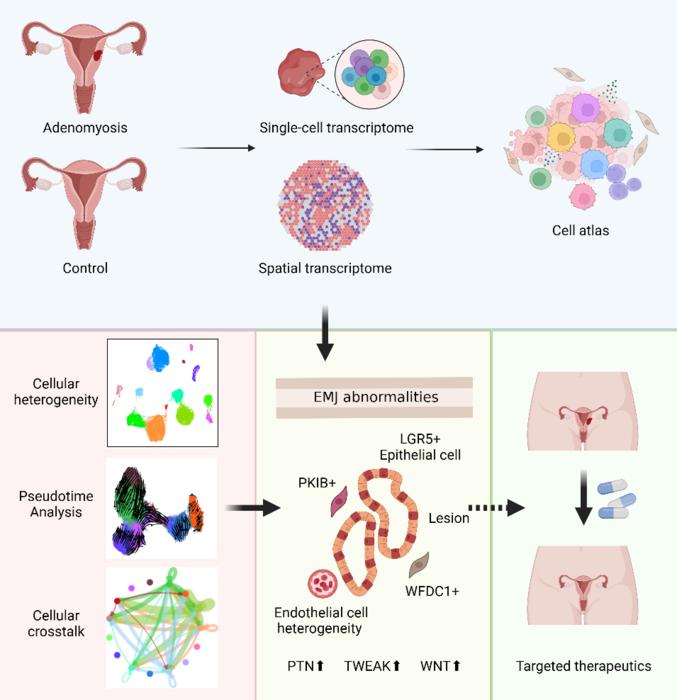
The cellular landscape of adenomyosis

Credit: Tao Chen, Yiliang Xu, Xiaocui Xu, Jianzhang Wang, Zhiruo Qiu, Yayuan Yu, Xiaohong Jiang, Wanqi Shao, Dandan Bai, Mingzhu Wang, Shuyan Mei, Tao Cheng, Li Wu, Shaorong Gao, Xuan Che

Adenomyosis is a poorly understood gynecological disorder with limited treatment options. The study employed single-cell RNA sequencing and spatial transcriptomics to map transcriptional alterations across different regions of the uterus in adenomyosis patients and controls. It highlights unique epithelial and stromal subpopulations and aberrant signaling pathways involved in adenomyosis, offering potential targets for precise diagnostics and therapeutics.

Key findings from the study include:

  1. Unique epithelial (LGR5+) and stromal (PKIB+) subpopulations were identified in adenomyotic lesions, supporting a complex interplay between “invagination” and “metaplasia” theories. Additionally, WFDC1+ stromal progenitor cells might act as precursors to lesion-specific stromal cells, indicating a sophisticated mechanism of lesion formation.
  2. Abnormal angiogenic signaling and endothelial cell heterogeneity were observed in lesions. Notable pathways involved include vascular endothelial growth factor and angiopoietin, highlighting disrupted angiogenic processes in these tissues.
  3. Altered cell-cell communication was identified between ectopic and eutopic endometrium, particularly within adenomyotic lesions. The study found aberrant signaling pathways, including pleiotrophin, TWEAK, and WNT cascades, suggesting modified signaling dynamics in the lesions.

This study advances the understanding of adenomyosis by providing a comprehensive single-cell and spatial transcriptomic landscape. It reveals unique cellular subpopulations and signaling aberrations within adenomyotic lesions, supporting both invagination and metaplasia theories. These insights offer potential for developing precise diagnostic and therapeutic strategies, emphasizing the need for clinical validation of these findings. The work entitled “ Comprehensive transcriptional atlas of human adenomyosis deciphered by the integration of single-cell RNA-sequencing and spatial transcriptomics ” was published on Protein & Cell (published on Mar. 15, 2024).


Journal

Protein & Cell

DOI

10.1093/procel/pwae012

Method of Research

Experimental study

Subject of Research

Human tissue samples

Article Title

Comprehensive transcriptional atlas of human adenomyosis deciphered by the integration of single-cell RNA-sequencing and spatial transcriptomics

Article Publication Date

15-Mar-2024

Share12Tweet8Share2ShareShareShare2

Related Posts

Strubbelig–NHL3 Receptor Complex Helps Arabidopsis Respond to Cellulose Deficiency

Strubbelig–NHL3 Receptor Complex Helps Arabidopsis Respond to Cellulose Deficiency

August 15, 2026
Bombyx mori Satellitome Analysis Reveals Evolutionary Stability, Dispersed Chromosomal Organization, Transposon Origins

Bombyx mori Satellitome Analysis Reveals Evolutionary Stability, Dispersed Chromosomal Organization, Transposon Origins

August 15, 2026

Synthetic pyrenoid reconstruction reveals EPYC1-driven carbon concentration mechanisms and evolution

August 15, 2026

Endophytic Flavobacterium boosts root hairs and drought tolerance through ERF–CEP5 signaling

August 15, 2026

POPULAR NEWS

  • KAIST develops semiconductor neuron that harnesses noise to selectively process signals

    29 shares
    Share 12 Tweet 7
  • Imagining natural and extra robotic thumbs together strengthens kinesthetic sensorimotor networks

    29 shares
    Share 12 Tweet 7
  • PARP1 Drives Neuropathic Pain Through GPX4-Dependent Ferroptosis in Injured Mice’s Sensory Neurons

    29 shares
    Share 12 Tweet 7
  • Strubbelig–NHL3 Receptor Complex Helps Arabidopsis Respond to Cellulose Deficiency

    29 shares
    Share 12 Tweet 7

About

We bring you the latest biotechnology news from best research centers and universities around the world. Check our website.

Follow us

Recent News

KAIST develops semiconductor neuron that harnesses noise to selectively process signals

Imagining natural and extra robotic thumbs together strengthens kinesthetic sensorimotor networks

PARP1 Drives Neuropathic Pain Through GPX4-Dependent Ferroptosis in Injured Mice’s Sensory Neurons

Subscribe to Blog via Email

Success! An email was just sent to confirm your subscription. Please find the email now and click 'Confirm' to start subscribing.

Join 85 other subscribers
  • Contact Us

Bioengineer.org © Copyright 2023 All Rights Reserved.

Welcome Back!

Login to your account below

Forgotten Password?

Retrieve your password

Please enter your username or email address to reset your password.

Log In
No Result
View All Result
  • Homepages
    • Home Page 1
    • Home Page 2
  • News
  • National
  • Business
  • Health
  • Lifestyle
  • Science

Bioengineer.org © Copyright 2023 All Rights Reserved.