An international research group led by researchers from the University of Turku and Turku University Hospital in Finland has succeeded in identifying the probable origin of stuttering in the brain.
Credit: Brain, awae059 / Clinical Neurosciences, University of Turku
An international research group led by researchers from the University of Turku and Turku University Hospital in Finland has succeeded in identifying the probable origin of stuttering in the brain.
Stuttering is a speech rhythm disorder characterised by involuntary repetitions, prolongations or pauses in speech that prevent typical speech production. Approximately 5–10% of young children stutter, and an estimated 1% continue to stutter into adulthood. A severe stutter can have a profound negative impact on the life of the individual affected.
“Stuttering was once considered a psychological disorder. However, with further research, it is now understood to be a brain disorder related to the regulation of speech production,” says Professor of Neurology Juho Joutsa from the University of Turku.
Stuttering may also be acquired as a result of certain neurological diseases, such as Parkinson’s disease or a stroke. However, the neurobiological mechanisms of stuttering are not yet fully understood, and where it originates in the brain remains uncertain. The findings from brain imaging studies are partly contradictory, and it is challenging to determine which changes are the root cause of stuttering and which are merely associated phenomena.
Stuttering localised in the same brain network regardless of its cause
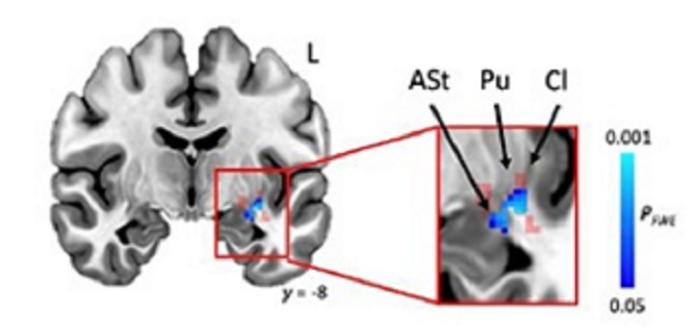
Researchers from Finland, New Zealand, the United States and Canada developed a new research design that could provide a solution to this problem. The study included individuals who had suffered a stroke, some of whom developed a stutter immediately after it. The researchers discovered that although the strokes were located in different parts of the brain, they all localised to the same brain network, unlike the strokes that did not cause stuttering.
In addition to people who had suffered a stroke, the researchers used magnetic resonance imaging (MRI) to scan the brains of 20 individuals with developmental stuttering. In these individuals, the stuttering was associated with structural changes in the nodes of the brain network originally identified in relation to causal stroke lesions – the greater the changes, the more severe the stuttering. This finding suggests that stuttering is caused by a common brain network, regardless of the aetiology (developmental or neurological).
The key nodes of the network identified by the researchers were putamen, amygdala and claustrum located deep within the brain, and the connections between them.
“These findings explain well-known features of stuttering, such as the motor difficulties in speech production and the significant variability in stuttering severity across emotional states. As major nuclei in the brain, the putamen regulates motor function and the amygdala regulates emotions. The claustrum, in turn, acts as a node for several brain networks and relays information between them,” explains Joutsa.
The results of the study provide a unique insight into the neurobiological basis of stuttering. Locating stuttering in the brain opens up new possibilities for medical treatment. Researchers hope that in the future, stuttering could be effectively treated, for example, with brain stimulation that can be targeted specifically to the now identified brain network.
Journal
Brain
DOI
10.1093/brain/awae059
Article Title
Localization of stuttering based on causal brain lesions
Article Publication Date
27-May-2024