In recent years, global environmental concerns have prompted a shift toward eco-friendly manufacturing in the field of organic synthetic chemistry. In this regard, research into photoredox catalytic reactions, which use light to initiate redox or reduction-oxidation reactions via a photoredox catalyst, has gained significant attention. This approach reduces the reliance on harsh and toxic reagents and uses visible light, a clean energy source.
Credit: Kenta Tanaka from Okayama University
In recent years, global environmental concerns have prompted a shift toward eco-friendly manufacturing in the field of organic synthetic chemistry. In this regard, research into photoredox catalytic reactions, which use light to initiate redox or reduction-oxidation reactions via a photoredox catalyst, has gained significant attention. This approach reduces the reliance on harsh and toxic reagents and uses visible light, a clean energy source.
A key research area has been the development of recycling methods for photocatalysts, which offer both economic and environmental benefits. Photocatalysts use light to accelerate a chemical reaction without getting consumed in the process, and photoredox catalysts are photocatalysts specifically designed for redox reactions. While recycling methods for heterogeneous photocatalysts, such as semiconductors and polymers, have been widely developed, there has been less focus on recycling organic photocatalysts. Considering the cost-effectiveness and low toxicity of organic photoredox catalysts, developing suitable recycling approaches is essential for achieving sustainable organic synthesis.
Addressing this gap, a team of researchers from Okayama University, Japan, including Assistant Professor Kenta Tanaka from the Research Institute for Interdisciplinary Science, along with then-graduate student Haru Ando, Associate Professor Hiroyoshi Takamura, and Professor Isao Kadota from the Department of Chemistry at the Graduate School of Natural Science and Technology, developed a novel phenothiazine-based organic photoredox catalyst. Their study was published in Issue 36 of the journal Chemical Communications on March 19, 2024.
“Phenothiazines, or PTHs, are widely used as photocatalysts in organic chemistry,” explains Prof. Tanaka. “However, the high reactivity of the p-position relative to the nitrogen atom on 10-aryl phenothiazine molecules, makes them prone to reacting with electrophiles, reducing their stability. The development of more stable and sustainable photocatalysts is therefore highly desirable. To address this, we developed new phenothiazine-based photocatalysts that is both stable and recyclable.”
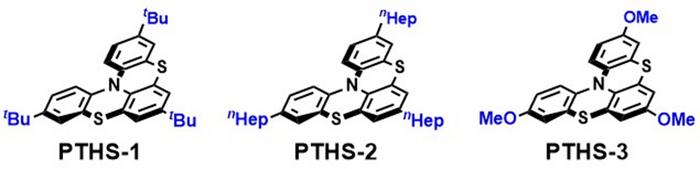
Their novel phenothiazine catalyst, called PTHS, features a spiral structure with a bulky electron donating group, called tBu, substituted at the p-position of the nitrogen atom, providing enhanced stability. The researchers developed a series of phenothiazine photocatalysts (PTHS 1–3) and evaluated their structural and physical properties via electrochemical and spectroscopic experiments. They discovered that the new catalysts possess a strong reducing ability and can be activated using blue light.
To test their stability, the team compared the new catalysts with existing PTH catalysts by subjecting them to photochemical sulfonylation reactions. The results revealed that while PTH could not be recovered and monosulfonylated product was obtained in 78%, 95% of PTHS could be recovered, indicating greater stability. Additionally, the researchers tested the recyclability of the catalysts in a photochemical phosphonation and found that the catalytic activity of PTH, and thus reaction yield, decreased with repeated use. In contrast, PTHS-1 could be effectively recovered multiple times without any loss of catalytic activity and yield. Moreover, PTHS-1 is also suitable for large-scale synthesis, achieving 96% recovery even at gram-scale synthesis.
“The new phenothiazine photocatalysts have the potential to be applied to various visible-light-induced photochemical reactions, which was not possible with any of the hitherto reported phenothiazine photocatalysts. We believe our recyclable organic photocatalysts will be a promising tool for the efficient synthesis of various pharmaceuticals and functional materials,” remarks Ando.
Overall, these innovative photocatalysts represent a significant step for achieving sustainable organic synthesis, paving the way towards environment-friendly chemical manufacturing.
About Okayama University, Japan
As one of the leading universities in Japan, Okayama University aims to create and establish a new paradigm for the sustainable development of the world. Okayama University offers a wide range of academic fields, which become the basis of the integrated graduate schools. This not only allows us to conduct the most advanced and up-to-date research, but also provides an enriching educational experience.
Website: https://www.okayama-u.ac.jp/index_e.html
About Assistant Professor Kenta Tanaka from Okayama University, Japan
Kenta Tanaka is currently an Assistant Professor at the Research Institute for Interdisciplinary Science at Okayama University. He received his M.S. and Ph.D. from Yokohama University, Japan in 2015 and 2018, respectively. He is the recipient of the 2022 Reiwa 4th (35th) Japan Society of Synthetic Organic Chemistry Tosoh Research Planning Award. He has over 30 publications and over 400 citations on them. His research interests include the development of photochemical reactions and the design and synthesis of organic photoredox catalysts.
About Associate Professor Hiroyoshi Takamura from Okayama University, Japan
Hiroyoshi Takamura is currently an Associate Professor at the Department of Chemistry, Graduate School of Natural Science and Technology, Okayama University. He received his M.S. and Ph.D. from Tohoku University, Japan in 2000 and 2005, respectively. He received the 30th Okayama University Faculty of Science Educational Contribution Award in 2019. He has over 60 publications with over 1000 citations. His research interests include synthetic organic chemistry and natural product synthesis.
About Professor Isao Kadota from Okayama University, Japan
Isao Kadota is currently a Professor at the Department of Chemistry, Graduate School of Natural Science and Technology, Okayama University. He received his M.S. and Ph.D. from Kochi University, Japan in 1990 and Tohoku University, Japan in 1993, respectively. He has over 100 publications with over 3000 citations. His research is focused on the development of new synthetic reactions and their application to natural product synthesis.
About Haru Ando
Haru Ando is a Graduate Student at the Laboratory of Organic Chemistry at Okayama University.
Journal
Chemical Communications
DOI
10.1039/D4CC00904E
Method of Research
Experimental study
Subject of Research
Not applicable
Article Title
Strongly reducing helical phenothiazines as recyclable organophotoredox catalysts
Article Publication Date
19-Mar-2024
COI Statement
There are no conflicts to declare.