Who were the earliest ancestors of scorpions, spiders and horseshoe crabs? A PhD student from the University of Lausanne (Switzerland), with the support of a CNRS researcher[1], has identified a fossil that fills the gap between modern species and those from the Cambrian period (505 million years ago), solving a long paleontological mystery.
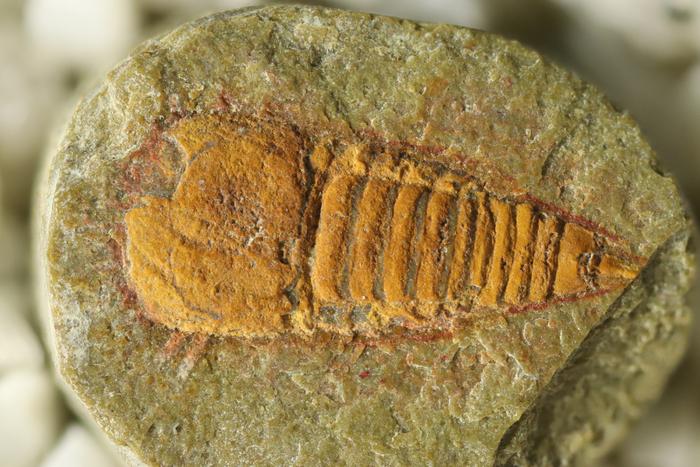
Credit: UNIL
Who were the earliest ancestors of scorpions, spiders and horseshoe crabs? A PhD student from the University of Lausanne (Switzerland), with the support of a CNRS researcher[1], has identified a fossil that fills the gap between modern species and those from the Cambrian period (505 million years ago), solving a long paleontological mystery.
Modern scorpions, spiders and horseshoe crabs belong to the vast lineage of arthropods, which appeared on earth nearly 540 million years ago. More precisely, they belong to a subphylum that includes organisms equipped with pincers used notably for biting, grasping prey, or injecting venom – the chelicerae, hence their name chelicerates. But what are the ancestors of this very specific group?
This question has puzzled paleontologists ever since the study of ancient fossils began. It was impossible to identify with certainty any forms among early arthropods that shared enough similarities with modern species to be considered ancestors. The mystery was further compounded by the lack of fossils available for the key period between -505 and -430 million years ago, which would have facilitated genealogical investigation.
Lorenzo Lustri, then a PhD student at the University of Lausanne (UNIL)’s Faculty of Geosciences and Environment, provided the missing piece of the puzzle. Together with his supervisors, he studied a hundred fossils dating back 478 million years from the Fezouata Shale of Morocco and identified the candidate that links modern organisms to those of the Cambrian (505 million years ago). The study was published in Nature Communications.
Fossils from the Fezouata Shale were discovered in the early 2000s and have undergone extensive analysis. However, the fossil illustrated in the publication, one of the most abundant in the deposit, had never been described before. Measuring between 5 and 10 millimeters in size, it has been named Setapedites abundantis. This animal makes it possible, for the first time, to trace the entire lineage of chelicerates, from the appearance of the earliest arthropods to modern spiders, scorpions and horseshoe crabs.
“Initially, we only intended to describe and name this fossil. We had absolutely no idea that it would hold so many secrets,” confides Lorenzo Lustri, the paper’s first author, who defended his PhD in March 2023. “It was therefore an exhilarating surprise to realize, after careful observations and analysis, that it also filled an important gap in the evolutionary tree of life.”
Still, the fossil has yet to reveal all its secrets. In fact, some of its anatomical features allow for a deeper understanding of the early evolution of the chelicerate group, and perhaps even link to this group other fossil forms whose affinities remain highly debated.
A temporary exhibition on the Fezouata biota, in collaboration with UNIL, will soon be held at the Palais de Rumine in Lausanne, Switzerland.
Method
To obtain these results, the scientists studied a hundred fossils and used an X-ray scanner to
reconstruct their anatomy in detail and in 3D. They were then able to draw comparisons with
numerous fossil chelicerates from other sites, as well as with their more ancient relatives.
Finally, the importance of the Fezouata fossil became clear with the help of phylogenetic
analyses, which mathematically reconstruct the family tree of different species based on the
“coding” of all their anatomical traits.
Source : L. Lustri, P. Gueriau, and A. C. Daley, Lower Ordovician synziphosurine reveals early euchelicerate diversity and evolution, Nature Communications.
PRESS KIT (additional images, pictures)
[1] Working in Ipanema (CNRS/MNHN/UVSQ/Ministry of Culture)
Journal
Nature Communications
Article Title
Lower Ordovician synziphosurine reveals early euchelicerate diversity and evolution
Article Publication Date
7-May-2024