CORVALLIS, Ore. – Artificial intelligence analysis of data gathered by acoustic recording devices is a promising new tool for monitoring the marbled murrelet and other secretive, hard-to-study species, research by Oregon State University and the U.S. Forest Service has shown.
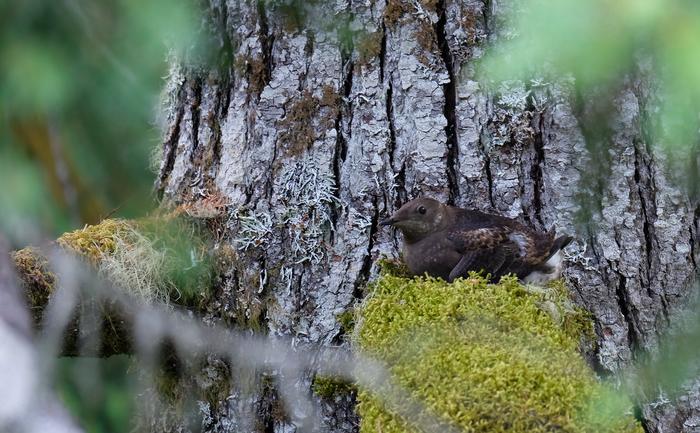
Credit: Marbled murrelet, photo by Brett Lovelace
CORVALLIS, Ore. – Artificial intelligence analysis of data gathered by acoustic recording devices is a promising new tool for monitoring the marbled murrelet and other secretive, hard-to-study species, research by Oregon State University and the U.S. Forest Service has shown.
The threatened marbled murrelet is an iconic Pacific Northwest seabird that’s closely related to puffins and murres, but unlike those birds, murrelets raise their young as far as 60 miles inland in mature and old-growth forests.
“There are very few species like it,” said co-author Matt Betts of the OSU College of Forestry. “And there’s no other bird that feeds in the ocean and travels such long distances to inland nest sites. This behavior is super unusual and it makes studying this bird really challenging.”
A research team led by Adam Duarte of the U.S. Forest Service’s Pacific Northwest Research Station used data from acoustic recorders, originally placed to assist in monitoring northern spotted owl populations, at thousands of locations in federally managed forests in the Oregon Coast Range and Washington’s Olympic Peninsula.
Researchers developed a machine learning algorithm known as a convolutional neural network to mine the recordings for murrelet calls.
Findings, published in Ecological Indicators, were tested against known murrelet population data and determined to be correct at a rate exceeding 90%, meaning the recorders and AI are able to provide an accurate look at how much murrelets are calling in a given area.
“Next, we’re testing whether murrelet sounds can actually predict reproduction and occupancy in the species, but that is still a few steps off,” Betts said.
The dove-sized marbled murrelet spends most of its time in coastal waters eating krill, other invertebrates and forage fish such as herring, anchovies, smelt and capelin. Murrelets can only produce one offspring per year, if the nest is successful, and their young require forage fish for proper growth and development.
The birds typically lay their single egg high in a tree on a horizontal limb at least 4 inches in diameter. Steller’s jays, crows and ravens are the main predators of murrelet nests.
Along the West Coast, marbled murrelets are found regularly from Santa Cruz, California, to the Aleutian Islands. The species is listed as threatened under the U.S. Endangered Species Act in Washington, Oregon and California.
“The greatest number of detections in our study typically occurred where late-successional forest dominates, and nearer to ocean habitats,” Duarte said.
Late-successional refers to mature and old-growth forests.
“Our results offer considerable promise for species distribution modeling and long-term population monitoring for rare species,” Duarte said. “Monitoring that’s far less labor intensive than nest searching via telemetry, ground-based nest searches or traditional audio/visual techniques.”
Matthew Weldy of the College of Forestry, Zachary Ruff of the OSU College of Agricultural Sciences and Jonathon Valente, a former Oregon State postdoctoral researcher now at the U.S. Geological Survey, joined Betts and Duarte in the study, along with Damon Lesmeister and Julianna Jenkins of the Forest Service.
Funding was provided by the Forest Service, the Bureau of Land Management and the National Park Service.
DOI
10.1016/j.ecolind.2024.112016
Method of Research
Data/statistical analysis
Subject of Research
Animals
Article Publication Date
1-May-2024